 Cymraeg

RLDP Deposit 2018-2033
5. Placemaking policy framework
5.1 Approach
5.1.1 Sustainable places and improved wellbeing in Conwy RLDP area will be positively contributed to via the placemaking policy framework. The placemaking policy framework consists of four strategic themes supported by overarching strategic placemaking policies and development management policies, working collectively to deliver the spatial framework consisting of the vision, objectives and growth & distribution strategy of the plan.
5.1.2 PPW defines placemaking as:
“"Placemaking” is a holistic approach to the planning and design of development and spaces, focused on positive outcomes. It draws upon an area’s potential to create high quality development and public spaces that promote people’s prosperity, health, happiness, and well‑being in the widest sense.
Placemaking considers the context, function and relationships between a development site and its wider surroundings. This will be true for major developments creating new places as well as small developments created within a wider place.
Placemaking should not add additional cost to a development, but will require smart, multi‑dimensional and innovative thinking to implement and should be considered at the earliest possible stage. Placemaking adds social, economic, environmental and cultural value to development proposals resulting in benefits which go beyond a physical development boundary and embed wider resilience into planning decisions.”
5.1.3 Effective strategic placemaking requires early collective consideration of placemaking issues from the outset.The RLDP Spatial Framework provides an overarching approach to underpin all other components of the Conwy RLDP, devised to create the right conditions to address the various social, cultural, environmental and economic well-being outcomes. The following section sets out the Placemaking Policy Framework for the four thematic themes:
- Strategic theme 1: strategic and spatial choices in Conwy
- Strategic theme 2: healthy and social places in Conwy
- Strategic theme 3: prosperous places in Conwy
- Strategic theme 4: natural and cultural places in Conwy
5.1.4 As with other sections of the RLDP, all policies are complementary in terms of supporting the achievement of the national Wellbeing Goals, local Wellbeing Objectives and sustainable development. Linkages between each policy and relevant wellbeing goals have therefore been identified (see Appendix 2) and all policies have been subject to SA, incorporating SEA.
5.1.5 All policies are inter-related in their nature and need to be read in conjunction with one another in order to gain an understanding of the overall policy direction of the RLDP. Each section highlights the relevant objective(s) and includes an overarching strategic policy, development management policies and supporting justification. The policies are intended to ensure that development proposals deliver the Spatial Framework (sections 2-4) of the plan, positive economic, social, environmental and cultural outcomes and contribute positively to placemaking, sustainable places and improved wellbeing in Conwy’s RLDP area. They will form the basis of all planning decisions, and indicators have been developed as part of the plan’s monitoring framework to show the effectiveness of the policies.
5.1.6 A suite of strategic policies were identified in the RLDP Preferred Strategy. These have been modified to take account of representations received, stakeholder feedback, new evidence, changes in national policy and extended to provide for a more comprehensive placemaking policy framework for the Conwy plan area.
5.2 Strategic theme 1: strategic and spatial choices in Conwy
Introduction
5.2.1 The RLDP is formulated having had consideration of the strategic placemaking issues impacting on Conwy’s RLDP area. This section of the RLDP focuses on those strategic placemaking policies that will have the greatest impact on the type of development which is ultimately delivered and its contribution to sustainable development and the environmental, social, cultural and economic well-being of Conwy. This section promotes integrated policies that should not be considered in isolation during the development process. This includes considering the design of a development and its impacts upon everyday lives as well as thinking holistically about where people might live and work and which areas should be protected. This section provides the strategic and locally distinctive placemaking vision for delivering sustainable placemaking, including identification of key development sites to achieve the Spatial Framework (sections 2-4). The Strategic and Spatial Choices Section consists of the following policies:
PL/1 sustainable placemaking,
PL/2 sustainable housing strategy
PL/3 sustainable economic strategy
PL/4 growth distribution and hierarchy of settlements
PL/5 placemaking and good design
PL/6 promoting healthier places
PL/7 the Welsh language
PL/8 sustainable management of natural resources
PL/9 placemaking in rural areas
PL/10 rural conversions
PL/11 Placemaking Plans and Place Plans
PL/12 new development, infrastructure and planning obligations
PL/13 new development and viability
PL/14 managing settlement form
PL/15 Eastern Improvement Area
PL/16 placemaking and sites
PL/17 site 157 Caeffynnon, Llanfairfechan mixed use housing and education site
PL/18 site 91 Pentywyn Road Deganwy/Llanrhos housing site
PL/19 site 68 Peulwys Farm, Old Colwyn housing site
PL/20 site 56 Penloyn, Llanrwst housing site
PL/21 site 203 Queen’s Road, Llandudno housing site
PL/22 site 115 Llanddulas Quarry employment and renewable energy site
PL/23 site 103 Bryniau, Llandudno employment site
PL/24 site 206 Nant y Coed, Llandudno Junction housing site
PL/25 site 132 Dinerth Road, Rhos on Sea housing site
5.2.2 All policies within this section relate to SO1. The objective is therefore not repeated throughout the section.
Sustainable placemaking
SO1: contribute to the creation of sustainable places, social inclusion and improved wellbeing overall in Conwy through the delivery of inclusive placemaking and regeneration that ensures future growth levels and development takes place in sustainable and accessible locations, seeks to promote good design and healthier places, protects and promotes the use of the Welsh language and its history and is supported by the necessary social, environmental, cultural and economic infrastructure to sustain existing and create new great places.
PL/1 sustainable placemaking
- All development proposals (excluding householder applications) must contribute to creating high quality, attractive, sustainable places that support active and healthy lifestyles and enhance the community in which they are located by demonstrating:
- alignment with the national sustainable placemaking outcomes, the national objectives of good design, the Wales Placemaking Charter and the national key planning principles; and,
- a sustainable placemaking approach to the siting, design, construction and operation of the development.
- alignment with the national sustainable placemaking outcomes, the national objectives of good design, the Wales Placemaking Charter and the national key planning principles; and,
- All planning applications (excluding householder applications) must be supported through the submission of required design and technical information to demonstrate compliance with the following criteria:
- Maximise environmental protection and limit environmental impact by:
- Protecting and enhancing biodiversity, ecosystems, townscapes, soundscapes and landscapes (the DECCA framework and Stepwise approach should be applied);
- Promoting green infrastructure;
- Reducing environmental risks;
- Managing water resources naturally
- Promoting clean air and reduce pollution;
- Promoting resilience to climate change;
- Creating special and distinctive environments;
- Incorporating methods to ensure the site is free from contamination (including invasive species); and,
- Adopting circular economy principles.
- Facilitate accessible and healthy environments by:
- Promoting physical and mental health and wellbeing;
- Providing and link to existing accessible and high quality green spaces in-line with RLDP natural environment section.
- Promoting non-car dependency by maximising opportunities for active travel, increased public transport use and connections within and outside the site to ensure efficient and equality of access for all;
- Maximising opportunities for design in electric vehicle infrastructure;
- Providing safe, sustainable, inclusive and accessible communities for all; and
- Providing access to key services and facilities.
- Make best use of resources by:
- Using natural resources efficiently;
- Promoting sustainable waste management;
- Prioritising the use of previously developed land and existing buildings;
- Unlocking potential, regenerating and attracting investment to create resilient communities; and
- Promoting good high quality design and sustainable developments.
- Grow the County’s economy in a sustainable manner by:
- Fostering economic activity which embraces smart and innovative technology and communication, include the provision of high-speed digital infrastructure from the outset;
- Reducing climate change and promote efficiency and renewable energy; and
- Promoting vibrant and dynamic economic environments which are adaptive to change.
- Creating and sustaining communities by:
- Enabling the Welsh language to thrive through promotion, enhancement and, where necessary, mitigation;
- Securing appropriate development densities;
- Ensuring that homes and jobs are available to meet Conwy’s needs;
- Promoting a mix of land uses where appropriate;
- Offering cultural experiences;
- Securing and protecting community based facilities and services in-line with the RLDP community facilities and services section;
- Minimising opportunities for crime to be generated or increased, whilst promoting community safety in accordance with Secured by Design principles; and
- Appropriately contributing towards local, physical, social and community infrastructure which is affected by the development.
- Maximise environmental protection and limit environmental impact by:
- Should there be exceptional circumstances which mean that the proposal cannot comply with the criteria above, the applicant must robustly justify this.
- Proposals for 10 or more residential units in the CDSA (as defined in the Spatial Framework) and the Key Service Centre (PL/4), or 5 or more elsewhere in the RDSA (as defined in the Spatial Framework), or 0.1 hectares of land for all other development proposals must be developed in-line with policy PL/16 and site specific allocation policies where relevant (PL/17-25).
5.2.3 Sustainable development means the process of improving the economic, social, environmental and cultural well-being by taking action, in accordance with WG sustainable placemaking principles, aimed at achieving their well-being goals and the priority aspirations of the Conwy RLDP and Wales National Plan Future Wales 2040. The most appropriate way to implement these requirements through the planning system is to adopt a strong placemaking approach in the Conwy RLDP.
5.2.4 Sustainable placemaking is an inclusive process, involving all of those with a professional or personal interest in the built and natural environment, which focuses on delivering developments which contribute to the creation and enhancement of sustainable places in Conwy’s RLDP area. Placemaking in development decisions happens at all levels and involves considerations at a global scale, including climate change, down to the very local level, such as considering the amenity impact on neighbouring properties and people.
5.2.5 The planning system should create sustainable places, which are attractive, sociable, accessible, active, secure, welcoming, healthy and friendly. Sustainable places should be viable places to live and work. Development proposals should create the conditions to bring people together, making them want to live, work and play in areas with a sense of place and well-being, creating prosperity for all. RLDP policy PL/1 sets out the main ways in which development proposals will be expected to demonstrate that they are delivering economic, social, environmental and cultural well-being and therefore contributing towards sustainable development.
5.2.6 Acting in accordance with the sustainable placemaking principles means that proposals must act in a manner which seeks to ensure that the needs of the present are met without compromising the ability of future generations to meet their own needs. As such, everyone engaged with or operating within the planning system in the RLDP area must embrace the concept of sustainable placemaking in order to achieve the creation of sustainable places and improve the well-being of our communities.
5.2.7 Implementing Future Wales’ strategic placemaking approach, and its principles, will ensure development contributes positively towards building sustainable places that support active and healthy lifestyles, with urban neighbourhoods that are compact and walkable, organised around mixed-use centres and public transport, and integrated with green infrastructure. The Council is equally committed to the Placemaking Wales Charter and the development of high-quality places for the benefit of communities. The Charter outlines six placemaking principles (people and community, movement, public realm, location, mix of uses and identity) that cover the range of considerations that contribute to establishing and maintaining good places. These principles have both informed and are embedded within the RLDP. Policy PL/1 includes the necessary criteria to contribute positively to these principles, which should be applied alongside the principles of good design (policy PL/5) and promoting healthier places (policy PL/5).
5.2.8 Policy PL/1 represents the starting point for the assessment of all planning applications which are received by the LPA. Each of the criterion relate to detailed issues which are addressed further in other RLDP policies. All development proposals will be assessed to ensure that they will make a positive contribution towards strengthening local identity, achieve sustainable communities, encourage a more sustainable way of living, and promote community cohesion and engagement.
5.2.9 This policy seeks to promote connectivity for all by maximising opportunities for active travel. Well-connected developments can promote the improvement of health and well-being by encouraging people to adopt healthier and active lifestyles, whilst also contributing to the creation of sustainable places.
5.2.10 A green infrastructure network provides important amenity value in addition to health and well-being benefits. The RLDP will therefore seek to integrate both active travel routes and green infrastructure networks, where appropriate, to create high quality environments that encourage active lifestyles and promote well-being.
5.2.11 Householder applications are exempt from meeting the criteria detailed in this policy. Further details and exemptions, including details of exceptional circumstances in point 3, will be provided in SPG.
5.2.12 Not every development proposal will be able to demonstrate that they can meet all of these outcomes. However, this does not mean that they should not be considered in the development management process to see if a proposal can be improved or enhanced to promote wider well-being. It is for developers to identify these opportunities and act upon them. Links to more specific policies and approaches which will be used to assess whether the criteria of PL/1 are achieved are set out within the policy text relating to all strategic sections of the RLDP.
5.2.13 Site allocations and strategic proposals must prepare and present a detailed Placemaking Compliance Statement in line with policy PL/16, site policies PL/17 to PL/25 and other relevant placemaking policies set out in the plan. Early engagement with the LPA is recommended when preparing a scheme and the accompanying statement. SPG will be prepared to set out guidance for developers in ensuring schemes are sustainable and conform to policy PL/1. The SPG will be also cover additional guidance to support policies PL/5 and PL/6.
Sustainable housing strategy
PL/2 sustainable housing strategy
- Over the period 2018 to 2033 the LPA will plan, monitor and manage the delivery of approximately 3,600 new homes (at an average of 240 new homes each year). There is a contingency allowance of 20%, which means 4,300 new homes are planned for through completions, commitments, windfall and new allocations over the plan period.
- New housing must be developed in-line with the spatial distribution strategy and distributed as follows:
- CDSA:
- West: 10%
- Creuddyn: 30%
- Central: 35%
- East:15%
- RDSA: 10%
- CDSA:
- The sustainable approach will:
- Prioritise previously developed land in appropriate locations in accordance with other RLDP policies and material considerations.
- Allocate residential sites in sustainable locations of our existing urban areas and the Key Service Centre
- Promote appropriate residential windfall sites within existing settlement boundaries.
- Enable the delivery of affordable housing exception sites.
- Seek appropriate levels of new homes in the rural settlements, with local need restrictions where justified to support sustainable communities and the Welsh language.
- Support communities to deliver sites for new homes as identified in their local Place Plans.
- Provide for specific housing needs, including accommodation appropriate for older people or people with care needs.
- Prioritise previously developed land in appropriate locations in accordance with other RLDP policies and material considerations.
- The plan seeks to deliver a minimum of 1,760 affordable homes over the plan period by:
- Allocating affordable led housing sites.
- Setting targets for affordable housing provision on residential sites.
Working pro-actively with RSLs to deliver windfall sites for affordable homes, including appropriate town centre sites and affordable housing exception sites.
5.2.14 The sustainable housing strategy addresses the identified housing need for the plan area through ensuring a housing land supply for a total of 4,300 new homes. The ability to deliver this sustainable housing strategy is demonstrated through a housing trajectory in the housing section. This target is in line with the need identified in BP1: Growth Level Options Report. It is influenced by a demographic scenario which includes migration assumptions based on jobs both locally and as a result of the needs associated with the North Wales Growth Deal. It results in a slightly higher annual requirement for dwellings than the starting point of the principal Welsh Government projection. It reflects the priority issues and background evidence base, in particular a need to contribute to a more balanced age structure, reduced out commuting levels, promoting sustainable communities, including the Welsh language and providing for a high need for affordable housing. It brings a sustainable balance between housing, community facilities, services and employment opportunities in both urban and rural areas.
5.2.15 The dwelling requirement includes an allowance of 8.9% vacancy to allow for churn in the housing market and is higher than the national average to reflect higher levels of second homes and holiday accommodation in the local area. Policy HS/10 provides the framework to manage the levels of second homes and holiday lets, to enable an Article 4 Direction to be implemented, should evidence indicate it is necessary. The likely supply of housing anticipated to be delivered in the Eryri National Park Authority area of the County Borough and the capacity of the housebuilding industry are also taken into consideration.
5.2.16 The strategy guides these to be built in the right places and of the right type to maximise the contribution made towards delivering sustainable communities and affordable housing. The spatial distribution focuses growth to the Creuddyn and Central sub-areas, where the largest settlements are, whilst also reflecting physical constraints such as flood risk in the East sub-area. This distribution is also in-line with Future Wales, which identifies Llandudno and Colwyn Bay as regional growth areas for North Wales.
5.2.17 The table below shows how the different components of supply make up the total plan provision and how they will be spatially distributed.
Figure 12: table showing housing supply and spatial distribution
|
Components of housing supply |
West |
Creuddyn |
Central |
East |
Rural |
Total |
|
Total completions (small and large) |
85 |
475 |
440 |
375 |
50 |
1,425 |
|
Units under construction |
40 |
165 |
100 |
65 |
0 |
375 |
|
Units with planning permission |
15 |
85 |
165 |
175 |
15 |
450 |
|
New housing allocations |
200 |
410 |
330 |
275 |
100 |
1,320 |
|
Large windfall sites (10+) |
35 |
70 |
165 |
0 |
0 |
270 |
|
Small windfall sites (<10) |
40 |
125 |
165 |
45 |
80 |
460 |
|
Total housing provision |
420 |
1,335 |
1,365 |
935 |
245 |
4,300 |
Note: numbers may not sum due to rounding. Source: SPPS, CCBC
5.2.18 The new LHMA 2022-37 (BP09) identifies a significant need for affordable housing across all parts of the plan area, with the highest needs found in the Creuddyn and Central sub areas. This matches with the highest growth areas identified in the RLDP spatial framework, which also seeks to maximise affordable housing delivery and directing development towards our settlements with highest levels of need alongside promoting employment growth.
5.2.19 This sustainable housing strategy plays a key role in addressing this affordable housing shortfall. It must be recognised, however, that the RLDP is not the only mechanism to address this need. A key priority of the RLDP sustainable housing strategy is to maximise on-site affordable housing delivery. It is recognised that the gross affordable housing need is not simply about building new homes. Making appropriate use of the existing housing stock will be a key part to delivering this identified need. A joined up approach with the Conwy Local Housing Strategy, which works alongside the RLDP, is vital to delivering this need. The plan sets a minimum target of 1,760 new affordable homes be delivered during the plan period, as detailed in BP11 Affordable Housing for Local Community Need. This target reflects deliverability of the RLDP affordable housing strategy, and is based on the assumption that public subsidy, such as Social Housing Grant will continue to be available. The table below shows the total affordable housing delivery for the plan period.
Figure 13: table showing affordable housing delivery (2018-33)
|
Components of housing supply |
West |
Creuddyn |
Central |
East |
Rural |
Total |
|
Total completions (small and large) |
15 |
150 |
110 |
120 |
35 |
430 |
|
Units under construction |
5 |
115 |
55 |
45 |
0 |
215 |
|
Units with planning permission |
20 |
20 |
120 |
130 |
15 |
300 |
|
New housing allocations |
85 |
210 |
230 |
110 |
50 |
680 |
|
Large windfall sites (10+) |
15 |
35 |
35 |
0 |
0 |
85 |
|
Small windfall sites (<10) |
0 |
0 |
25 |
0 |
25 |
50 |
|
Total housing provision |
135 |
530 |
570 |
405 |
120 |
1,760 |
Note: numbers may not sum due to rounding. Source: SPPS, CCBC
5.2.20 The RLDP will, therefore, contribute significantly towards affordable housing delivery. It is anticipated that further affordable housing could be delivered through RLDP policy approaches, including affordable housing exception sites and town centre redevelopment. Other mechanisms, which fall outside of the remit of the RLDP will be needed to deliver the remaining affordable housing need, such as bringing back empty homes, reconfiguring existing affordable stock, leasing schemes and private rentals (see BP11 for details).
5.2.21 Sites must be developed comprehensively to ensure that all necessary infrastructure, planning obligations and placemaking requirements are delivered, including any mitigation. Piecemeal or fragmented applications will not be supported, unless the applicant can demonstrate that the full package of requirements can be delivered, and that the proposal will not prevent the remainder of the site from being developed.
5.2.22 A contingency allowance of 20% has been included to allow for choice, flexibility and renewal of the existing stock and for non-take-up of sites. Should the delivery of new homes reach the requirement set out in the RLDP before the end of the plan period, action will be taken to manage this. This will be informed through the AMR and the RLDP housing trajectory. Actions could include limiting greenfield site delivery to 100% affordable sites, where there is a need in that housing market area. RLDP allocations would not be affected by this approach.
Sustainable economic strategy
5.2.23 There are three main elements to the sustainable employment strategy, the number of new jobs predicted in the plan area up to 2033, the amount and type of land needed to accommodate those jobs, and the broad location of where the land should be.
5.2.24 In planning for the above however, the strategy also recognises the need to be flexible and accommodate commercial and business demand where it is feasible to do so. Policy PL/3 covers all these issues at a high-level, with greater detail, site allocations and criteria based policies relating to the economy can be found in the Economic Development section of the RLDP.
PL/3 sustainable employment strategy
- To assist with the delivery of predicted economic growth for the plan area, the RLDP will allocate employment land to meet the requirement for 1500 additional jobs up to 2033. The Employment Land Review states that a range of 14-20 hectares of employment land is needed during this time, with a reasoned and justified target of 16.4hawhich includes contingency. The sustainable approach to growth outlined in this RLDP will:
- Take into account employment completions, commitments and windfall since 2018;
- Provide new land allocations totalling 12.65ha;
- Accommodate a split of 65% for B1c/B2/B8 uses and 35% for B1 use for new allocations; and,
- Reflecting the Spatial Distribution Strategy, ensuring 90% of employment growth will be in the CDSA, with10% in the RDSA.
- To ensure that employment land is located in the most suitable and sustainable locations, the RLDP will ensure:
- Allocated sites will be located in the CDSA, in areas of demand alongside or accessible to the A55 corridor;
- A sequential approach is taken to the approval of other land or sites for employment, prioritising existing employment sites, previously developed land, and where appropriate, town and local centre sites; and,
- Expansion of rural businesses will be supported in principle on suitable sites.
- Allocated sites will be located in the CDSA, in areas of demand alongside or accessible to the A55 corridor;
5.2.25 The evidence base to support the elements in the above policy can be found within a series of RLDP background papers, namely; BP16: Planning and the Rural Economy with regards to supporting the expansion of rural businesses and farm diversification. BP17: Employment Land Supply demonstrates how much land is already available for new employment uses, and how much will need to be allocated. BP18: Employment Land Review sets out the estimated jobs growth number and translates this to the amount and type (in use class) of land needed to accommodate the jobs growth. BP19: Conwy Commercial Market Analysis sets out broad locations for where the new employment land should be located. BP20: Skills Needs Assessment concludes there isn’t a need to allocate land specifically for higher education within the plan area. BP56: Employment Land Investment Hierarchy sets out an approach to assessing proposals for employment using a sequential method. BP61: Town Centres First Study assesses the need for office-hubs and the approach to safeguarding non designated employment uses in town centres, and BP67: Conwy RLDP Safeguarded Employment Sites thoroughly reviews the existing designated employment sites and sets out whether they should be retained, extended or de-designated.
5.2.26 The employment growth figures have been aligned spatially with the housing growth on a 90% CDSA: 10% RDSA split. The RLDP evidence base documents for the economy i.e. BP19: Conwy Commercial Market Analysis and BP18: Employment Land Review, suggest that employment activity and demand for sites is focused in the CDSA, primarily along the A55 corridor, and this is where our allocations should be located. The monitoring of the RLDP 2007-2022 has shown this to be correct, with none of the rural employment allocations coming forward for development within the lifespan of the plan, and sites in areas along the A55 such as Mochdre, Llandudno, Llandudno Junction, Conwy, Colwyn Bay and Kinmel Bay being more preferable. Allocations in the CDSA at Llanddulas Quarry and Llandudno total 12.65 hectares, however not all of this land will come forward in the timeframe of the plan. Please refer to the phasing timetable within the Economic Development Strategy of this RLDP. Growth in the coastal and rural areas will be monitored via the AMR process to check on the effectiveness of the allocations and criteria-based policies.
Hierarchy of settlements
PL/4 growth distribution and hierarchy of settlements
- Over the plan period, development will be located and distributed in accordance with the strategic approach as set out in the spatial framework, and the hierarchy of settlements. Housing growth will be delivered in line with policy PL/2 and the detailed policies set out in the Housing and Affordable Housing Framework of the plan. Employment growth will be delivered in line with policy PL/3 and the Economic Development Strategy of the plan.
- Development will be permitted within settlements at a scale commensurate with the role and function of settlements as set out in the hierarchy below:
Urban settlements: Abergele/Pensarn***, Colwyn Bay (inclusive of Rhos-on-Sea and Old Colwyn)**, Conwy, Deganwy/Llanrhos, Llandudno**, Llandudno Junction, Llanfairfechan, Mochdre, Penmaenmawr and Penrhyn Bay/ Penrhynside and Towyn/Kinmel Bay***.
Key service centre: Llanrwst
Tier 1 Main Villages: Llanddulas, Dwygyfylchi*, Glan Conwy
Tier 2 Main Villages: Betws-yn-Rhos, Cerrigydrudion, Dolgarrog*, Eglwysbach, Llanfair Talhaiarn, Llangernyw, Llansannan, Llysfaen, Tal-y-Bont*/Castell and Trefriw*
Minor Villages: Bryn Pydew, Glanwydden, Groes, Henryd, Llanbedr-y-Cennin*, Llanddoged, Llanelian, Llangwm, Llannefydd, Pentrefelin, Pentrefoelas, Rhyd-y-Foel, St George, Tal-y-Cafn and Tyn-y-Groes
Hamlets: Bodtegwel, Bryn-y-Maen, Brymbo, Bryn Rhyd-y-Arian, Bylchau, Capelulo*, Cefn Berain, Cefn Brith, Dinmael, Glasfryn, Groesffordd, Gwytherin, Hendre, Llanfihangel GM, Maerdy, Melin y Coed, Nebo*, Pandy Tudur, Pentre-llyn-cymmer, Pentre Isa, Pentre Tafarn-y-Fedw, Rhydlydan, Tan-y-Fron
* Settlements partly within Eryri National Park.
** Regional Growth Areas identified in the Future Wales 2040.
*** Constrained Settlements falling within the Eastern Improvement Area.
5.2.27 The RLDP identifies and differentiates between the sustainability of places by defining a settlement hierarchy. The settlement hierarchy has been defined taking account of the strategic placemaking principles, including settlement function, infrastructure, sustainability, and accessibility to key facilities and services, as set out in BP3: Settlement strategy. The hierarchy seeks to achieve more sustainable places in a number of ways. The scale and type of growth apportioned to settlements is dependent upon their individual roles, functions and positions within the Settlement Hierarchy. This is to ensure the RLDP directs the majority of growth towards areas that already benefit from good infrastructure, services and facilities, or where additional capacity can be provided.
5.2.28 The Spatial Framework has two overarching strategic areas; the CDSA and the RDSA. The main urban locations fall along the coastal belt where 90% of the population reside. These urban areas represent more sustainable locations serving the wider communities, including rural settlements in the RDSA in cases. They have, or can accommodate, the necessary infrastructure, facilities and services to support sustainable growth over the Plan period. The urban areas of Colwyn Bay and Llandudno are identified as Regional Growth Areas in the National Plan Future Wales 2040, where a high level of growth is planned. This is reflected in the spatial distribution of housing (see policy PL/2).
5.2.29 All the urban settlements demonstrate a strong employment function with an existing concentration of businesses plus a notable variety of shopping and community services, further strengthened by a range of sustainable travel opportunities that connect to neighbouring areas and the wider regions. These areas also represent high levels of affordable housing need, coupled with deliverable and available land to meet such needs as identified in the Housing and Affordable Housing Framework and Economic Development Strategy of the RLDP.
5.2.30The only notable exception to the urban settlements within the CDSA is the Eastern area consisting of Abergele, Pensarn, Towyn and Kinmel Bay. Future growth is constrained and limited in these areas due to highways infrastructure capacity and flood risk. It is essential that these communities do not decline but become more resilient in line with the Vision of the Conwy RLDP. Therefore, an Eastern Improvement Area is identified to tackle these issues as set out at policy PL/15 and identified on the proposal map.
5.2.31 The RDSA consists of the Key Service Centre, Tier 1 & 2 Main Villages, Minor Villages and Hamlets. The Key Service Centre of Llanrwst falls some 13 miles from the CDSA coastal belt, but plays an important role in serving the wider rural settlements within the hierarchy, especially in terms of employment and key facilities and services.
5.2.32 Tier 1 & 2 Main Villages, Minor Villages and Hamlets perform a more limited retail and community facility function, primarily serving their local residents. Whilst all services and facilities are important to their respective hinterlands, those on offer in these settlements draw from a smaller catchment area and are primarily confined to serving the more immediate population base. As such, the scope for these settlements to accommodate significant development is more limited, but depending on their location within the hierarchy will still accommodate smaller proposals to meet local community needs. Development will be permitted within these settlements at a scale commensurate with their role and function as set out in the hierarchy and as defined in the other Strategic Sections of the Plan.
5.2.33 A settlement boundary review (BP3) has been undertaken to clearly identify the boundary between settlements and the open countryside, assist with the prevention of the coalescence of settlements and provide certainty in terms of where appropriate development will be permitted. The RLDP will prioritise the re-use and redevelopment of PDL where possible. Managing Settlement Form is further covered at policy PL/14.
Placemaking and good design
PL/5 placemaking and good design
- To contribute to sustainable placemaking and address the key aspects of good design, development proposals must:
- Address access and inclusivity for all by:
- Placing people at the heart of the design process;
- Acknowledging diversity and difference, including the Welsh language;
- Offering choice where a single design solution cannot accommodate all users;
- Providing buildings and environments that are convenient and enjoyable to use for everyone,
- Making provision to meet the needs of people with sensory, memory, learning and mobility disabilities, older people and people with young children;
- Encouraging people to meet and interact with each other, helping to address issues surrounding loneliness and isolation;
- Reducing the inequality of access to essential services, education and employment experienced by people without access to a car; and,
- Designing measures and features that enable easy access to services by walking, cycling and public transport.
- Address environmental sustainability by:
- Achieving efficient use and protection of natural resources;
- Maximising energy efficiency;
- Protecting and enhancing biodiversity;
- Maximising efficient use of other resources (including land);
- Maximising sustainable movement;
- Minimising the use of non-renewable resources;
- Encouraging decarbonisation;
- Preventing the generation of waste and pollution; and,
- Contributing to resilient communities by delivering an integrated and flexible approach to design, including early decisions regarding location, density, layout, built form, the choice of materials, the adaptability of buildings and site treatment.
- Has regard to local character and amenity by:
- Progressing the highest design quality possible, whilst respecting and enhancing local distinctiveness, including the Welsh language and landscape character;
- Being appropriate to its local context in terms of size, scale, height, massing, elevation treatment, materials and detailing, layout, form, mix and density;
- Demonstrating a clear rationale behind the design decisions made, based on site and context analysis, a strong vision, performance requirements and design principles and expressed in a Design and Access Statement (where required), Placemaking Compliance Statement where appropriate and in-line with other policies set out in the Plan.
- Promoting and reinforcing local distinctiveness in areas recognised for their particular landscape, townscape, cultural or historic character and value
- Using land efficiently by being of a density which maximises the development potential of the land whilst respecting that of the surrounding development;
- Providing for an appropriate mix of land uses to promote compact, walkable neighbourhoods; and,
- Preventing and reducing crime and disorder in all design decisions to produce safe environments that do not compromise on design quality; and,
- Ensuring an integrated development that does not harm local amenity and wherever possible brings benefits to the local area.
- Address community safety through the design process by:
- Producing environments that do not compromise on design quality; and,
- Preventing and reducing crime and disorder.
- Addressing movement by;
- Designing in non-car dependency;
- Maximising opportunities for people to make sustainable and healthy travel choices; and,
- Maximising existing and integrating new infrastructure within the development layout and beyond the boundary.
- Address access and inclusivity for all by:
- Site and context analysis should be submitted to determine the appropriateness of a development proposal in responding to its surroundings. A Placemaking Compliance Statement should also be submitted and include an appraisal of policy PL/5 and reflect requirements of policy PL/16 and, where applicable, site policies PL/17 to PL/25.
5.2.34 Achieving good design and creating an effective sense of place requires an understanding of the relationship between all elements of the natural and built environment. Design is a fundamental component in creating sustainable development and places, which is itself at the forefront of the Well-being of Future Generations Act 2015. Good design is fundamental to creating sustainable places where people want.to live, work and socialise. In achieving sustainable development, the Conwy RLDP seeks to ensure design that goes beyond aesthetics to include the social, economic, environmental and cultural aspects of development. Therefore, in order to achieve good design, development proposals must consider how space is utilised, how buildings and the public realm can support this use and the relationship with the surrounding area. Development proposals will be assessed for their design and placemaking compatibility. Poor design can have adverse impacts on the character and appearance of an area, in addition to harming the collective street scene. Various elements (e.g. visual impact, loss of light, overlooking, traffic constraints) will be assessed to ensure there are no potential adverse impacts.
5.2.35 Good design is intrinsic to the process of sustainable placemaking, defined by PPW as: “a holistic approach to the planning and design of development and spaces, focused on positive outcomes”. The Conwy RLDP will ensure that development meets the objectives of good design. These objectives are categorised into five key aspects in PPW12 (see Figure 14 below) as set out in more detail in policy PL/5. Where Placemaking Compliance Statements are required in line with policy PL/16, policy PL/5 regarding design should be applied in preparing such supporting evidence for a planning application.
5.2.36 Design draws upon an area’s potential to create high quality development and public spaces that promote people’s prosperity, health, happiness, and well-being in the widest sense. It is important that people live in places which are attractive and distinctive, and capable of incorporating the changing requirements of those living there. Placemaking is an overarching concept which relates to the design and context of a development. It seeks to ensure that the design process, layout structure and form provide development that is appropriate to the local context and supports a sustainable community creating an environment within which people can identify with and use easily; whilst respecting the natural and built environment. This means that high quality, well thought out and sustainable design which improves the environment and people’s health and well-being is essential. All development must be underpinned by the application of good design and a sustainable placemaking approach to siting, design, construction and operation.
5.2.37 SPG will be prepared to set out guidance for developers in ensuring schemes are sustainable and conform to policy PL/5.
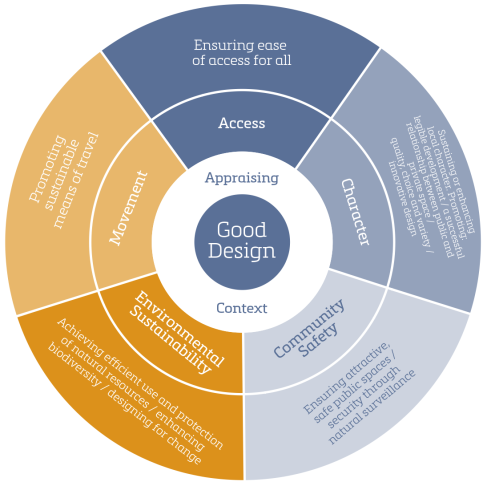
Promoting healthier places in Conwy
PL/6 promoting healthier places
- To promote healthier places, reduce health inequalities and contribute to the Conwy & Denbighshire Wellbeing Plan, development proposals are required to:
- Enable opportunities for outdoor activity and recreation in line with policies set out in Recreational Spaces Strategy of the RLDP;
- Reduce exposure of people to air and noise pollution in line with policies set out in the Environmental Qualities section of the plan;
- Promote active travel options in line with Sustainable Transport and Accessibility Strategy of the plan, and;
- Seek environmental and physical improvements, particularly in the built environment in-line with policies set out in the sustainable placemaking policy framework.
- Enable opportunities for outdoor activity and recreation in line with policies set out in Recreational Spaces Strategy of the RLDP;
- Site and context analysis should be submitted to determine the appropriateness of a development proposal in responding to health promotion. A Placemaking Compliance Statement should also be submitted, reflecting the requirements of this policy and policy PL/16 and site policies PL/17 to PL/25.
5.2.38 The built and natural environment are key determinants of health and well-being. The RLDP will play an important role in shaping the social, economic, environmental and cultural factors which determine health and which promote or impact on well-being in line with the Healthier Wales goal. The way places work and operate can have an impact on the choices people make in their everyday lives, including their travel and recreational choices and how easy it may be to socialise with others.
5.2.39 The Conwy RLDP is supported by a Health Impact Assessment (HIA) (BP71), which has informed policy development across all four strategic themes. The built and natural environment is a key determinant of health and well‑being. The Conwy RLDP has an important role in shaping the social, economic, environmental and cultural factors which determine health and which promote or impact on well‑being in line with the Healthier Wales goal.
5.2.40 The vision in Conwy and Denbighshire’s Well-being Plan seeks to ensure that Conwy is more equal, less deprived and resilient. The identified disadvantaged and deprived communities in Conwy County Borough tend to be disproportionately affected by health problems. There are links between the built and natural environment and health throughout a person’s lifetime and an understanding of the wider determinants of health are a key component of policy PL/1 and development plan preparation. The planning system should identify proactive and preventative measures to reduce health inequalities. This includes enabling opportunities for outdoor activity and recreation, reducing exposure of populations to air and noise pollution, promoting active travel options and seeking environmental and physical improvements, particularly in the built environment.
5.2.41 The Conwy RLDP has an important role to play in preventing physical and mental illnesses caused, or exacerbated, by pollution, disconnection of people from social activities (which contributes to loneliness) as well as the promotion of travel patterns which facilitate active lifestyles. The planning system must consider the impacts of new development on existing communities and maximise health protection and well‑being and safeguard amenity. This will include considering the provision of, and access to, community and health assets, such as community halls, libraries, GP surgeries and hospitals. Health impacts should be minimised in all instances, and particularly where new development could have an adverse impact on health, amenity and well‑being. In such circumstances, where health or amenity impacts cannot be overcome satisfactorily, development should be refused.
5.2.42 The RLDP seeks to develop and maintain places that support healthy, active lifestyles across all age and socio‑economic groups, recognising that investment in walking and cycling infrastructure can be an effective preventative measure which reduces financial pressures on public services in the longer term. The way a development is laid out and arranged can influence people’s behaviours and decisions and can provide effective mitigation against air and noise pollution.
5.2.43 Incorporating drinking water fountains or refill stations for reusable bottles in public spaces is a simple and effective way to make places healthier and reduce unnecessary waste. Effective planning can provide calming, tranquil surroundings as well as stimulating and sensory environments, both of these make an important contribution to successful places.
5.2.44 Green infrastructure can be an effective means of enhancing health and well‑being, through linking homes, workplaces and community facilities and providing high quality, accessible green spaces. In all development and in public spaces especially, there should be sensitive management of light. Exposure to airborne pollution should be kept as low as reasonably practicable. The compatibility of land uses will be a key factor in addressing air quality and creating appropriate soundscapes which are conducive to, and reflective of, particular social and cultural activities and experiences, particularly in busy central areas of towns and cities. Equally, the provision of quiet, tranquil areas which provide peaceful sanctuaries in otherwise noisy environments can help to reduce general levels of pollution and promote both mental and physical well-being in Conwy’s plan area.
5.2.45 Policy PL/6 should be supported by site and context analysis to determine the appropriateness of a development proposal in responding to health promotion. A Placemaking Compliance Statement should be submitted and include an appraisal of policy PL/6 in line with policy PL/16 and site policies PL/17 to PL/25. SPG will be prepared to set out guidance for developers in ensuring schemes are sustainable and conform to policy PL/6.
The Welsh language
PL/7 the Welsh language
- The LPA will ensure that new development promotes and enhances the long term future of the Welsh language. Development which, because of its size, scale, nature or location, will harm the character and linguistic balance of a community will be resisted, unless this harm can be mitigated.
- All sites must, as a minimum, provide bilingual signage and be sensitive to the linguistic and cultural heritage of the area when naming roads and buildings. Traditional Welsh names must be retained for new developments and street names. When naming new developments, Welsh names and/or local Welsh language names and meanings must be given to sites to depict and sum up the unique sense of that place and its history and identity.
- A Welsh language impact assessment, which sets out how the proposed development will protect, promote and enhance the Welsh language, including an action plan with details of any mitigation is required for sites in the Welsh language sensitive areas as designated on the proposals map for the following development types:
- Proposals in the Welsh language sensitive areas, as defined on the proposals maps, for:
- Unallocated housing sites with a net gain of 10 or more dwellings in the CDSA, or 5 or more in the RDSA;
- A commercial, leisure, industrial or tourist development on unallocated sites with a net gain in development area of 1,000 square metres or more;
- Development which will lead to the loss of a community facility in Tier 2 Main Villages, Minor Villages and Hamlets;
- New quarries or extensions to existing quarries;
- Proposals for large HMOs; and,
- Residential schemes providing below the required amount of affordable housing, in-line with policy HS/3 affordable housing provision due to the financial viability of the scheme.
- Residential schemes with a net gain in dwellings on windfall sites, which will provide more than the anticipated growth level for that strategy area, as defined in policies PL/2, PL/3 and PL/4.
- Proposals in the Welsh language sensitive areas, as defined on the proposals maps, for:
5.2.46 The Welsh language is an important part of Conwy County Boroughs social and cultural fabric. Overall 25.9% of the population of Conwy can speak Welsh (2021), which is above the national average of 17.8%. There are variances across the plan area, where the proportion of Welsh speakers is as high as 73% in Pentrefoelas, down to 11% in Towyn and Kinmel Bay.
5.2.47 The Conwy and Denbighshire well-being plan 2023-28 establishes nine principles, which are applied to all work areas. The language principle states: “Support and promote the Welsh language in all that we do, integrating the Welsh language strategies of partners”. The plan also has the goal: “Our communities can access support in their language of choice. The PSB will encourage and improve the use of Welsh language in everyday life”.
5.2.48 The Council’s Welsh language promotion strategy, Ein Llais Gymraeg has a vision for:
“A bilingual Conwy where people are confident and proud of their llais Cymraeg (Welsh voice), where Cymraeg is spoken in the family, the community and the workplace and where Welsh culture is celebrated and people feel they belong”.
5.2.49 The strategy shows how the authority will contribute towards meeting WGs aim of 1 million Welsh speakers by 2050 and promote the Welsh language and its use in accordance with the Welsh Language (Wales) Measure 2011. It sets a target to increase the number of Welsh speakers by 1,600 in Conwy County Borough by 2029 or 2% as a proportion. The RLDP contributes towards meeting this target through its planning decisions.
5.2.50 This RLDP contributes towards the national well-being goal of a thriving Welsh language, through enabling sustainable communities.
5.2.51 All decisions taken by CCBC, including planning decisions, must be in-line with the Welsh Language Standards (2015), through seeking to promote opportunities to use the Welsh language and to treat the Welsh language no less favourably than the English language. All policy decisions must consider both negative and positive effects on the Welsh language and its speakers and seek opportunities to promote and facilitate the use of Welsh.
5.2.52 The growth strategy of the RLDP is compatible with promoting, enhancing and protecting the Welsh language across all sub-areas. The growth apportionment for each sub-area allows an appropriate level of growth for each sub-area in appropriate locations, supporting the aim of sustainable communities.
5.2.53 TAN20 allows areas to be defined in LDPs that are particularly sensitive or significant for the Welsh language. This plan identifies a Welsh language sensitive area, where 25% or more of residents can speak Welsh (according to the 2021 Census), as informed by the evidence in BP42. In order to promote and safeguard the cultural and linguistic identity of this sensitive area and contribute to the growth in the Welsh language (in-line with the authority’s promotion strategy and Welsh Language Standards), WLIAs will be required from the specific development identified in the policy. This includes development on safeguarded sites as designated on the proposals map.
5.2.54 Community facilities, including shops, public houses and village halls are important to sustaining communities and provide an opportunity to speak and hear Welsh and are important to the sustainability and vibrancy of Welsh speaking communities. Proposals for the losses of these facilities in smaller settlements of Tier 2 Main Villages, Minor Villages and Hamlets, as designated in RLDP policy PL/4, in the Welsh Language Sensitive Area will be required to conduct a WLIA.
5.2.55 Applicants proposing new quarries or extension to existing quarries are required to conduct a WLIA and identify mitigation as part of the planning application process. The assessment should also consider the impacts of the creation of a new quarry buffer zone, or an extension to an existing one and provide mitigation accordingly. This is to ensure that the full impacts of the proposal and future required quarry buffer zone, which could affect existing properties and businesses, are considered and if necessary, mitigated for.
5.2.56 A WLIA will also be required for schemes for new large HMOs. A WLIA is not considered necessary for C4 use classes due to their smaller scale and size. There is an identified need for this type of accommodation and it has been found to be in short supply across the plan area (see BP12 for more details). Careful consideration is required to manage these appropriately, including assessing and mitigating any potential impacts on the Welsh language.
5.2.57 Should the level of residential development in a sub-area of the RLDP be higher than that anticipated and assessed for as part of the plan preparation process, all residential developments where there is a net increase of dwellings will be required to submit a WLIA, so that the cumulative impacts of this additional growth are assessed and, if necessary, mitigated appropriately. Residential completions will be monitored through Annual Monitoring Report and will inform this policy requirement.
5.2.58 In some instances, the financial viability of a residential scheme can mean that it is not possible to provide for the affordable housing requirements detailed in policy HS/3. The criteria for households registering for affordable housing includes priority in most instances for those with a local connection over households from outside of the area. This could have a different impact on the Welsh language and therefore, needs assessing and mitigating for appropriately.
5.2.59 WLIAs must include details of the mitigation that will be provided to mitigate, promote and enhance the Welsh language in an action plan together with completion dates. For commercial, industrial or tourism developments, the construction phase, employment generation and ongoing operating must be assessed and mitigated for. Mitigation must be proportionate with the size and scale of the proposed development, and harm caused to the Welsh language, so as to at least aim to achieve no overall harm and in line with the Standards to seek to promote the Welsh language so as not to treat it any less favourably than the English language. Mitigation measures must be selected on the basis of their appropriateness to address the potential impacts that have been identified during the impact assessment. The principle being to remove negative impacts on the Welsh language, or where not possible, to remove as far as possible and off set with positive and promotional effects in other ways.
5.2.60 Required mitigation will be secured through planning condition or legal agreement to ensure delivery. The final mitigation package provided should be specific to the site and impact of the proposed development: A list of suggested mitigation measures are below. This is not an exhaustive list. Other mitigation may be required dependent on the scheme proposed and resulting impact. Some are legal requirements, and all sites must provide them. SPG will be prepared to provide further guidance.
- Bilingual signs on development site, with Welsh above English.
- Phasing of sites.
- Regionally targeted marketing and communication bilingually.
- Promotion or provision of local Welsh language childcare.
- Sponsor, promote and support Welsh medium activities.
- Facilitate and support transport to and from Welsh medium schools.
- Welsh language learning classes for residents or staff.
- Scholarships for Welsh medium training at local colleges in related employment areas or trades.
Sustainable management of natural resources
PL/8 sustainable management of natural resources
To tackle the climate emergency and the sustainable management of natural resources, development proposals must support the transition to a low carbon economy by meeting the relevant policy requirements set in the Net Zero Planning Framework, the Natural Environment and Environmental Qualities sections of the plan. A Materials and Waste Management Plan (MWMP) must be submitted to accompany relevant planning applications to demonstrate that developments will minimise environmental impact.
5.2.61 The Environment (Wales) Act 2016 introduces the Sustainable Management of Natural Resources (SNMR) and sets out a framework to achieve this as part of decision-making. The objective of the SMNR is to maintain and enhance the resilience of ecosystems and the benefits they provide. Integrating the SMNR into the planning system is a key part of the essential components of sustainable places in Conwy and through encouraging approaches based on identifying and securing outcomes which deliver multiple ecosystem benefits.
5.2.62 WG must publish and implement a statutory natural resources policy setting out its priorities in relation to the SMNR while NRW is required to produce a State of Natural Resources Report and prepare Area Statements to inform place-based action. The Natural Resources Policy and Area Statements are a key piece of evidence which must be taken into account in development plan preparation.
5.2.63 The planning system is wide in its social, economic environmental and cultural scope and takes an all-embracing approach to sustainable development where decisions on short and long-term needs and cost and benefits come together. It secures outcomes where multiple benefits (more than one ecosystem benefit) can be provided as part of plan making strategies or individual development proposals. Policy PL/8 will be delivered via the implementation of related policies set out in the Net Zero Planning Framework, Natural Environment and Environmental Qualities sections of the Plan.
5.2.64 A Materials and Waste Management Plan (MWMP) will be required at planning application stage for schemes of 10 or more dwellings, or 1,000sqm and above of commercial or industrial development. The MWMP will ensure that development is carried out correctly by minimising environmental impact through sustainable waste management in line with this policy. In some cases, where it is considered necessary by the planning case officer, a MWMP may be requested below these thresholds.
Placemaking in rural areas
PL/9 placemaking in rural areas
- In line with the RLDP spatial framework, PL/4 growth distribution and hierarchy of settlements and placemaking policy framework, development proposals in rural settlements will be supported where they foster adaptability and resilience of our rural communities.
- Proposals must strike a sustainable balance between meeting the economic, social, cultural, environmental and recreational needs of local communities and visitors.
5.2.65 A strong rural economy will be promoted to support sustainable and vibrant rural communities in Conwy’s RLDP area. Fostering adaptability and resilience will be a key aim for rural settlements in face of the considerable challenge of maintaining the identity and vibrancy of communities. The Welsh language is an essential part of the social and cultural fabric and its future well‑being will depend upon a wide range of factors, particularly education, demographic change, community activities and a sound economic base to maintain thriving sustainable communities and places in rural Conwy, where people wish to live and work and can viably live there and feel part of that community. Rural Conwy has a crucial role when it comes to the Welsh language, having a high densities of people who can speak Welsh. Policy PL/7 sets out the necessary criteria to ensure the development proposals protect, promote and enhance the Welsh language in rural areas.
5.2.66 The establishment of new enterprise and the expansion of existing business is crucial to the growth and sustainability of rural areas, supported by the required housing and necessary community infrastructure. There is, however, an optimum balance to be struck, and new development needs managing in accordance with this policy to meet this balance.
5.2.67 For most rural areas, the opportunities for reducing car use and increasing walking, cycling and use of public transport are more limited than in urban settlements. Therefore, settlements falling in rural areas will focus on local growth and diversification dependent on their sustainability and position within the hierarchy of settlements (policy PL/4). A constructive approach towards agricultural development proposals will also be adopted, especially those which are designed to meet the needs of changing farming practices or are necessary to achieve compliance with new environmental, hygiene or welfare legislation. A positive approach to the conversion of rural buildings (policy PL/10) for business re-use, in addition to taking a positive approach to diversification projects in rural areas (policy ED/6) will be adopted. The aim being to support the long-term vibrancy and sustainable of rural communities, without causing harm to their character and the very reason why residents want to live there and remain living there.
5.2.68 The approach will ensure that rural areas are resilient to the impacts of climate change and plays a role in reducing the causes of climate change through the protection of carbon sinks and as a sustainable energy source.
5.2.69 The objective of this policy will be delivered in line with the RLDP spatial framework, hierarchy of settlements (policy PL/4) and the relevant policies set out in the Sustainable Placemaking section).
Rural conversions
PL/10 conversion and change of use of rural buildings
- The conversion and re-use of suitably constructed buildings of merit in the open countryside for permanent residential purposes, employment uses, short-term holiday lets and/or small scale farm shops will be supported provided that:-
- The existing building is structurally sound and is of permanent and substantial construction;
- The building is capable of conversion without complete or substantial rebuilding, disproportionate extensions or unsympathetic alterations and the proposed design is in keeping with its surroundings;
- The conversion uses appropriate materials and does not result in unacceptable impacts upon the structure, form, character or setting where the building is of historic and/or architectural interest;
- Safe access for pedestrians and vehicles can be provided without prejudicing the character and appearance of the area;
- The proposal represents a sustainable development in terms of the location and carbon reduction and energy efficiency in line with policy EN/1.
- Any ancillary works associated with the conversion will not have unacceptable or adverse effects on the rural and open character of the locality,
- The development would not result in the unjustified loss of a valued community service or facility or of an agricultural building that could be required to serve the long-term agricultural needs of the unit;
- There is no adverse impact on the Welsh language in line with policy PL/7, and;
- The proposal is in accordance with other development plan and national policies.
- Where the proposed conversion is intended to meet the dwelling needs of a rural enterprise, the development will be supported in accordance with this policy subject to the Rural Enterprise Dwelling occupancy condition being applied.
- For proposed residential development including holiday lets, the building should be worthy of retention due its appearance, historic, architectural or landscape value, and that the scheme of conversion retains the identified important features.
- Proposals which would result in a new unrestricted open market dwelling through either conversion or removal of occupancy condition (such as short-term holiday let, AHLN or RED) will not be permitted unless:
- A contribution is made towards AHLN, controlled via S106,
- Adequate evidence has been provided to justify removal of occupancy condition (where applicable); and,
- Criteria in policy HS/9 is met.
- A contribution is made towards AHLN, controlled via S106,
5.2.70 In the rural area where buildings are no longer required for their original, predominantly agricultural use, they can present a valuable opportunity to offer residential, employment, tourism or small-scale retail use as a means of supporting the rural economy and Welsh language and culture.
5.2.71 Due to their sensitive location, such developments must be carefully controlled. It is crucial that the proposed use and design takes account of the character and appearance of the existing building and the surrounding area. In the same way, there is a need to secure the future sustainability of Welsh speaking communities and a sustainable local economy can play an important role in this regard to retain local people in work and to support the use of Welsh in these communities. Therefore any proposed development needs to promote the use of Welsh and numbers of Welsh speakers and protect these from harm. Additionally, the LPA recognises that the plan area has a number of non-listed buildings and structures which by reason of their design, material and social and historical connections are important to the character and identity of their locality and merit retention by way of securing a future use. Such enhancements then are more likely to be used by local people and also attract visitors, again generating economic growth and sustainable communities.
5.2.72 LPAs should adopt a positive approach to the conversion of rural buildings for business re-use in line with PPW and TAN 23. It should be noted that there is a separate policy within the Economic Development section (ED/6) which includes criteria for new build premises for the purposes of expansion of existing rural businesses and farm diversification. Policy ED/3 provides guidance on new build employment premises within the rural area. Policy HS/10 may be applicable.
5.2.73 In most instances, a structural report prepared by a qualified structural engineer will be required to be submitted with applications for conversion schemes to demonstrate that the criteria in part 1b of the policy has been met.
5.2.74 Developments should be of a scale appropriate to their location. Large employment or retail developments in the countryside may conflict with the principles of sustainable development, resulting in unsustainable traffic movements and potential environmental harm. Developments resulting in significant numbers of employees or visitors should be located within or near to settlements and be accessible by public transport, cycling or walking. In areas without such access, small-scale business development may still be appropriate where it results in only a modest increase in vehicle movements. This may require the production of a Travel Plan and/or mitigation of traffic impact in accordance with policy STA/1.
5.2.75 Second homes will not be permitted due to the potential negative impact on the supply of housing in rural areas and the lack of economic benefit arising from the scheme.
5.2.76 Permanent residential uses includes both Rural Enterprise Dwellings (RED) (which will become AHLN if no longer needed) and open market houses. A financial contribution towards the delivery of AHLN in sustainable and appropriate locations will be sought for rural conversions to open market housing and for applications seeking to lift occupancy restrictions linked with a REDs. Short-term use (up to a 5 year period) of a RED as a short-term holiday let will be supported subject to justification in line with policy HS/9, as it protects the use and retention of a RED in the longer term. For the purposes of part 4 of policy PL/10, “new unrestricted open market dwelling” refers to any proposal that would result in a dwelling without any occupancy restrictions, whether this is through a new conversion, or by removal of occupancy restrictions from an existing dwelling.
Placemaking Plans and Place Plans
PL/11 Placemaking Plans and Place Plans
To promote collaborative action, improve well-being and placemaking in Conwy, Placemaking Plans and Place Plans will be supported where they are prepared in collaboration with the local community and are adopted as supplementary planning guidance in line with Conwy’s Placemaking and Place Plan Compliance Guidance.
5.2.77 Placemaking Plans and Place Plans are non-statutory documents. They may be prepared at the initiation of the local community and are a powerful tool to promote collaborative action to improve well-being and placemaking. They should support the delivery of RLDP policies and can be adopted as supplementary planning guidance. The Council has produced Place Plan Community Guidance and a Placemaking Plan and Place Plan Compliance Guidance to assist communities in preparing and adopting such plans.
5.2.78 Placemaking and Place Plans provide an opportunity for communities to engage in the plan making process at a local level. They are about delivering local outcomes, helping build consensus and buy-in within the wider development plan process. They can add the fine grain detail to an adopted LDP. They can be produced by Town and Community Councils or the LPA in conjunction with local communities. It is essential all parties involved have an appreciation of the resources required to prepare the Plans and early engagement with all parties will be essential. Conwy’s guidance assists communities in understanding these issues.
5.2.79 Placemaking Plans and Place Plans should be in conformity with the RLDP and can be adopted as SPG providing there is a sufficient ‘policy hook’ within the plan. They cannot duplicate or introduce new policy, nor can they de-allocate sites identified in the adopted development plan. Placemaking Plans and Place Plans are not part of the statutory development plan; instead, they add detail to the adopted plan. Conwy’s Compliance Guidance further assists communities in understanding these preparation issues.
Infrastructure and new development
PL12 new development, infrastructure and planning obligations
- All developments must make adequate provision to mitigate the social, economic, physical and/or environmental impact arising from the development. In accordance with the placemaking policy framework and other material considerations, developments must make suitable provision for:
- the Welsh language;
- affordable housing;
- recreational space;
- community facilities;
- net-zero carbon;
- biodiversity net benefit;
- active travel;
- meeting policy requirements as set out in Placemaking Plans and Place Plans adopted as SPG; and,
- any other on- or off-site requirements that are needed in relation to the development, and meet the relevant tests set out in national guidance.
- These will be controlled either through planning condition or planning obligations, as deemed most appropriate by the LPA.
5.2.80 Proposals for development in the Conwy RLDP area will be supported which have made suitable arrangements for the improvement or provision of on-site and off-site infrastructure, services and facilities made necessary by the development, including for their future maintenance.
5.2.81 It is important that provision is made for additional infrastructure, services and facilities resulting from new development and for their future maintenance, as well as for suitable access, parking, drainage, design, renewable energy and landscaping within the site. All new development contributes to demands on existing infrastructure, community facilities and public services. Developers will, therefore, be expected to contribute towards the necessary improvements or new provision to serve needs arising from their development. Development should not take place before the infrastructure needed by its occupants is in place. Development will only be permitted when agreement has been reached between the relevant parties on the funding and programmed implementation of required on-site and off-site provision as set out in the Planning Obligations SPG. However, it is apparent that some sites experience considerable constraints which could have an impact on the deliverability of a site financially. In these cases, a degree of flexibility will be applied in line with policy PL/13 and HS/3.
5.2.82 Where financial viability constrains the level of obligations that can be sought, the priority mechanisms set out in the Planning Obligations SPG will be applied.
Planning obligations and viability
PL/13 new development and viability
- Development proposals will not be supported where the applicant fails to meet the requirements as set out in policy PL/12, unless exceptional circumstances have been justified. Where the LPA is not satisfied that the applicant has used reasonable endeavours to meet planning policy requirements, or where the reduced planning obligations would result in the development having an unacceptable impact, the proposal will be refused.
- In exceptional circumstances, the LPA will accept Financial Viability Assessments (FVAs) in relation to sites which applicants consider to be unviable for development. FVAs will only be considered where the applicant has adequately demonstrated to the LPA’s satisfaction (with evidence where appropriate) that:
- The site or development represents a genuine exceptional circumstance, with more challenging financial viability than other comparable sites in the area;
- The purchase price or existing use value of the proposal site represents its current use and condition; and,
- Reasonable steps have been taken to meet planning policy requirements, including consideration of alternative schemes (e.g. alternative uses or housing mixes).
- The site or development represents a genuine exceptional circumstance, with more challenging financial viability than other comparable sites in the area;
- If, after considering all evidence provided by the applicant, the LPA agrees that the development is not financially viable to meet planning policy requirements in relation to planning obligations, a reduction may be accepted.
5.2.83 All developments are expected to make reasonable provision towards meeting the infrastructure and facilities required for that development. The onus is on developers, applicants and landowners to give due regard to planning policy requirements and other development costs (including abnormal costs), when negotiating the value of sites.
5.2.84 It is important that developers understand the financial viability of their project from the outset, and factor this into the design of developments. As a development proposal evolves and circumstances change (for example house prices, build costs), it is recommended that developers also re-visit their viability assessment to ensure it is still valid and that the development can meet all development costs including planning obligation costs.
5.2.85 Affordable housing targets have been set following viability assessment of sites, taking account of the known build costs in Conwy County Borough and the strength of the local housing market. Thresholds have also been set in some areas, to allow for the greater viability challenges of smaller sites, and particularly PDL.
5.2.86 National guidance in PPW is clear that viability assessments should only be undertaken in exceptional circumstances. The LPA will only consider reducing or waiving planning obligation requirements if applicants have clearly demonstrated that the site is an exceptional case, resulting in development costs that are significantly higher, and/or gross development value significantly lower than other comparable sites. Planning obligations will not be reduced or waived where viability concerns are due to the applicant having paid too much for a site.
5.2.87 Virtually any site can be made to look unviable through inappropriate development proposals. For example, building few, large houses on a site can increase developer’s profit but reduce the RV of a development compared to a development of smaller houses, making a development appear unviable for planning obligations. It is the applicant’s responsibility to seek to design a viable development, so the LPA will also require applicants to consider alternative housing mixes as part of the viability assessment process. Where the applicant has chosen a housing mix that makes a scheme unviable, this is unlikely to be a reason to reduce planning obligations when a reasonable alternative scheme on the site would be viable.
5.2.88 Any planning obligations being sought by the LPA must meet the relevant tests as set out in CIL regulations 122 or national guidance (Circular 13/97: planning obligations), as appropriate. One of the tests is that an obligation must be ‘necessary’. Financial viability is a material consideration, but it does not eliminate the requirements set out in policy for applicants to meet certain planning obligation requirements. Where a development has been shown to be unviable to provide certain obligations but its merits do not outweigh the harm of failing to provide planning obligations, development proposals will be refused.
Managing settlement form
PL/14 managing settlement form
Green Wedges and settlement boundaries are identified on the proposals map to protect open countryside and agricultural land. Development proposals must meet the relevant policies identified in the Sustainable Placemaking section, Housing and Affordable Housing Framework, Economic Development Strategy and Natural Environment section of the plan.
5.2.89 There is a need to protect open and agricultural land from development for the following reasons:
- Prevent the coalescence of settlements;
- Increase countryside access and encourage recreation to improve health;
- Manage urban form through controlled expansion of urban areas;
- Assist in safeguarding the countryside from encroachment
- Protect the setting of an urban area, and
- Assist in urban regeneration by encouraging the recycling of derelict and other urban land.
5.2.90 This can be achieved through the identification of Green Wedge designations and settlement boundaries differentiating between a settlement and open countryside.
5.2.91 Green Wedges are used to provide a buffer between the settlement edge and statutory designations and safeguard important views into and out of the area. Green Wedges (policy NE/5) are shown on the proposals map and evidenced in BP29/BP31. The general policies controlling development in the countryside apply in a Green Wedge but there is, in addition, a general presumption against development which is inappropriate in relation to the purposes of the designation. Green Wedges can have other beneficial effects including the provision of access to the countryside and sport and recreation opportunities.
5.2.92 Policy PL/14 sets the overarching strategic approach for the plan. Development proposals must meet the relevant policies of the plan.
Eastern Improvement Area
PL/15 Eastern Improvement Area
An Eastern Improvement Area is defined on the proposals map. A Plan will be progressed and adopted for this area to promote sustainable and resilient communities.
5.2.93 Parts of the East RLDP sub-area (Abergele, Pensarn, Towyn and Kinmel Bay) within the CDSA is highly constrained as a result of flood risk and highways infrastructure capacity resulting in limited opportunity to accommodate housing and employment growth over the plan period. The area also experiences pockets of deprivation, which could be exacerbated due the lack of land use opportunities to deliver the community’s needs over the plan period. These resilience risks are a priority for the plan and will be managed for via the production of the Eastern Improvement Area Plan working collaboratively with the community, public sector, investors, developers and WG. The area is subject to flood defence improvements; however this is only to hold the line as opposed to assisting growth opportunities and meeting community’s needs.
5.2.94 The Eastern Improvement Area Plan will be prepared in-line with the policies contained within the RLDP and, if applicable, be adopted as SPG.
Placemaking and sites
PL/16 placemaking and sites
- All sites of 10 or more residential units in the CDSA and Llanrwst, or 5 or more in the RDSA, or 0.1 hectares of land for all other development proposals, including site allocations and mixed-use developments, must prioritise people's long-term well-being and create vibrant, inclusive, and sustainable environments through the placemaking design process by:
- Meeting the relevant policies set out in the Placemaking Policy Framework of the plan;
- Where applicable, considering and incorporating the planning matters raised by communities through pre-application consultation, and the Planning Aid Wales Consultation Report for allocated sites;
- Engaging early with the LPA to prepare a Placemaking Compliance Statement in-line with the Placemaking Policy Framework. This should include a detailed framework for how the site will be developed, demonstrating how it delivers the RLDP Placemaking Policy Framework, site specific policy (where relevant) and associated policies; and,
- Prioritising a comprehensive approach to site development. Piecemeal development proposals will not be accepted where they impact on the delivery, viability and sustainability of the site or result in an uncoordinated form of development.
- Meeting the relevant policies set out in the Placemaking Policy Framework of the plan;
5.2.95 Early engagement with the community and the LPA is essential to deliver high quality places and the placemaking principles. Development proposals and planning applications that have been progressed without considering the Sustainable Placemaking policies will not be supported. A comprehensive approach to development must be taken in progressing the proposal having taken account of the placemaking considerations, viability and sustainability of the site. Piecemeal planning applications will not be supported where they impact on the delivery, viability and sustainability of the site. A Placemaking and Compliance Statement should be submitted for allocations and relevant applications. SPG will be prepared to set out the requirements of a Placemaking and Compliance Statement.
5.2.96 All sites of 10 or more residential units in the CDSA and Llanrwst or 5 or more in the RDSA, or 0.1 hectares of land for all other development proposals, including site allocations and mixed uses, must comply with policy PL/16. Applications below this threshold are generally those that fall outside these thresholds, such as smaller-scale housing, extensions, or changes of use that don't involve significant floor space or site area. A lower threshold for housing is applied in the RDSA due to the sensitivity of rural communities and the need to promote resilience and protect identity.
PL/17 site 157 Caeffynnon, Llanfairfechan mixed use housing and education site
- This site is allocated for residential (145 homes), a new primary school, recreational spaces and active travel routes. The school is to be located to the northeast of the site, adjacent Aber Road and Caeffynnon Road.
- Proposals must meet the following placemaking and infrastructure requirements:
- Highways – access for housing should be provided via Caeffynnon Road. Access to the primary school should be provided via Aber Road. Improvements to visibility splays will be necessary.
- Active travel – routes linking to the public rights of way network (off Caeffynnon Road) and nearest bus stops (Rhandir Hedd Cemetery and Bont Newydd) must be provided:
- Affordable housing – deliver on-site affordable housing in-line with policy HS/3 and HS/4.
- Infrastructure – deliver necessary infrastructure and planning obligations in-line with PL/12 new development, infrastructure and planning obligations, PL/13 new development and viability, and recreational space policy RS/2.
- Flood / surface water measures – the site is partially within Flood Zone 3 for surface water and small watercourses. An FCA is required to demonstrate that this flood risk is managed through the use of SuDS.
- Water supply and sewage capacity – a water main crosses the site. An appropriate easement will be required, and the site layout should reflect this.
- Utilities – a high-capacity gas pipeline crosses the site. An appropriate easement will be required. Housing and the school will not be permitted in certain zones, as identified by the Health and Safety Executive. The site layout should reflect this.
- Landscape – the site must be designed appropriately, including screening measures to ensure that the site contributes positively to viewpoints in the locality, including from Eryri National Park.
- Archaeology – archaeological features are highly likely to be present at the site. There are also known sites in close proximity. An archaeological assessment will be required at planning application.
- Historic environment – this is a sensitive site for historic assets. Planning applications should therefore ensure that the design, scale, layout and materials of buildings and associated infrastructure minimise impact on these historic assets.
- Green infrastructure – existing woodlands (to include along Caeffynnon Road, adjacent to Llannerch Road and along Aber Road) and tree lines must be maintained as continuous unfragmented features in the landscape. The two open growing oaks must be retained. Opportunities should be sought through landscaping design to join isolated parcels of ancient woodland with native woodland and/or hedgerow planting. A buffer (construction exclusion zone) of 15 metres for the Ancient Woodland parcels will be required.
- Welsh language – mitigation measures must be provided.
- Highways – access for housing should be provided via Caeffynnon Road. Access to the primary school should be provided via Aber Road. Improvements to visibility splays will be necessary.
5.2.97 The allocation of this site at Llanfairfechan provides the opportunity to meet the housing need for the West sub-area, whilst also resolving capacity and other issues at local primary school facilities. Key stakeholders and statutory bodies have been consulted on this site and the matters raised have been reflected in this site-specific placemaking policy.
5.2.98 There is a significant need identified for affordable housing both in Llanfairfechan itself and the wider West sub-area. The LHMA (2022-37) predicts that this need will continue through the plan period and beyond. Affordable housing provision to meet this locally identified need must be provided on-site. The final housing mix proposed should reflect the local identified need in Llanfairfechan and the West sub-area. Early engagement with CCBC Housing Services is recommended to ensure that this policy requirement is met.
5.2.99 Consultation with CCBC Education Services showed that there are capacity concerns at local primary schools. To resolve this, the Council has identified the Llanfairfechan area as a priority in its Sustainable Communities for Learning 9-year Strategic Outline Programme. This programme is reviewed every 3 years. Should CCBC Education Services confirm that the land is no longer required for a new primary school, the land can come forward in-line with other RLDP policies.
5.2.100 To ensure that health care provision can accommodate the new housing, the mitigation measures outlined in the BCUHB/CCBC statement of common ground will need to be carefully considered. Such measures include the creation of cluster-based services, the promotion of healthier lifestyles, remote care and technology and Section 106 financial contributions where appropriate. Refer to BP44 Population Change, Housing & Health/Primary Care Impact.
5.2.101 A Placemaking statement will be required detailing how the proposed scheme is policy compliant and reflects community priorities, as raised in the community engagement report.
5.2.102 A highways assessment will be required and must include the impact on the A55 trunk road junctions. Good quality, safe and fully accessible active travel routes should be provided through the spine of the site, linking the school and residential areas to the retail centre of Llanfairfechan, public transport and other key local amenities.
5.2.103 BP28: Recreational Spaces Assessment identifies deficits of playing fields, outdoor sports, formal play space and other outdoor provision in Llanfairfechan. Whilst this site allocation is not expected to overcome these deficits, it is vital that the site provides for the recreational space needs of residents who will live there. It is not considered appropriate to include the existing woodlands as formal recreational or children’s play spaces, so that the ground flora is conserved and disturbance is minimised. They can, however, providing biodiversity enhancements and should be included in the wider site scheme, and brought under a long-term positive conservation management schedule. This will be controlled through planning conditions or a legal agreement.
5.2.104 A preliminary ecological assessment and protected species survey, to include, but not be limited to, bat activity, overwintering birds and badgers will be required at planning application stage. There are confirmed Lesser Horseshoe and Brown Long-eared bat roosts (European protected species) at the site.
5.2.105 Llanfairfechan has been identified as a Welsh Language Sensitive Area in the RLDP (policy PL/7). Mitigation measures are suggested and will be required to be provided as part of the development of the site. These measures will be secured via planning condition or legal agreement.
5.2.106 An ASIDOHL has been prepared for the site, which concludes that there would be no significant impact on the Registered Historic Landscape.
PL/18 site 91 Pentywyn Road, Deganwy / Llanrhos housing site
- This site is allocated for residential (140 homes), recreational spaces and active travel routes.
- Proposals must meet the following placemaking and infrastructure requirements:
- Highways – access for vehicles and construction should be provided via Pentywyn Road.
- Net zero – an Energy Strategy will be required to inform the planning application to demonstrate measures towards achieving net zero carbon in line with policy EN/1-7.
- Active Travel – routes linking to the public rights of way network (off Pentywyn Road and via Bryn Lupus Road) and nearest bus stops must be provided and enhanced in line with the PL/1, PL/5 and the Sustainable Transport and Accessibility Strategy section of the placemaking framework.
- Affordable housing – deliver on-site affordable housing in-line with policy HS/3 and HS/4.
- Infrastructure – deliver necessary infrastructure and planning obligations in-line with policies PL/12, PL/13, CFS/2, RS/2.
- Water supply and sewerage – a Hydraulic Modelling Assessment will be required to inform the planning application,
- Flood / surface water measures –managed using a approved SuDS scheme.
- Landscape and trees – existing trees should be retained and the site layout designed appropriately, including screening measures to ensure that the site contributes positively to viewpoints in the locality. New tree planting will be required in line with policy NE/6.
- Archaeology – archaeological features are highly likely to be present at the site. There are also known sites in close proximity. An archaeological assessment will be required at planning application.
- Historic environment – this is a sensitive site for historic assets. Planning applications should therefore ensure that the design, scale, layout and materials of buildings and associated infrastructure minimise impact on these historic assets.
- Green Infrastructure – a GI statement will be required at application stage to demonstrate how GI assets have been retained and enhanced adding multi-functionality including community gardens, open space, woodland and active travel. Existing trees and hedgerows must be maintained as features in the landscape and to enhance habitat connectivity,
- Buffer zones – A buffer (construction exclusion zone) of 15 metres for existing trees will be required. A buffer between the existing houses on St Anne’s Gardens along the northern boundary and hedgerow
- Welsh language – mitigation measures must be provided, in line with policy PL/7.
- Highways – access for vehicles and construction should be provided via Pentywyn Road.
5.2.107 The allocation of this site at Llanrhos provides the opportunity to contribute towards meeting the housing need for the Creuddyn sub-area. Key stakeholders and statutory bodies have been consulted on this site and the matters raised have been reflected in this site-specific placemaking policy.
5.2.108 There is a significant need identified for affordable housing both in Llandudno Junction itself and the wider Creuddyn sub-area. The LHMA (2022-37) predicts that this need will continue through the plan period and beyond. Affordable housing provision to meet this locally identified need must be provided on-site. The final housing mix proposed should reflect the local identified need in Llandudno Junction and the Creuddyn sub-area. Early engagement with CCBC Housing Services is recommended to ensure that this policy requirement is met (HS/7 housing mix).
5.2.109 A placemaking plan and placemaking compliance statement will be required as set out in policy PL/16, detailing how the proposed scheme is policy compliant, sustainable reflects community priorities, as raised in the community engagement report.
5.2.110 A Hydraulic Modelling Assessment is required for the site. The Ganol WwTW has capacity to accept this site.
5.2.111 Consultation with CCBC Education Services showed that there are capacity concerns at local primary schools. To resolve this, the LPA has identified that contributions will be sought in-line policy PL/12.
5.2.112 A Transport Assessment will be required and must include the impact on the surrounding road junctions. Good quality, safe and fully accessible active travel routes should be provided through the site, linking the PROW and other key local amenities.
5.2.113 BP28: Recreational Spaces Assessment identifies deficits of playing fields, outdoor sports, formal play space, other outdoor provision and parks and gardens in Deganwy / Llanrhos. Whilst this site allocation is not expected to overcome these deficits, it is vital that the site provides for the recreational space needs of residents who will live there. This will be controlled through planning conditions or a legal agreement.
5.2.114 A preliminary ecological assessment and protected species survey will be required at planning application.
5.2.115 Llanrhos has been identified as a Welsh Language Sensitive Area in the RLDP (policy PL/7). Mitigation measures are suggested and will be required to be provided as part of the development of the site. These measures will be secured via planning condition or legal agreement.
5.2.116 Green Infrastructure and Biodiversity Statements are required for all development proposals. Strategic development should assess the sites, including available datasets to establish enhancement within the site in line with guidance in BP47 and policies NE/7, NE/8 and EQ/1.
PL/19 site 68 Peulwys Farm, Old Colwyn housing site
- This site is allocated for residential (250 homes during this RLDP period), recreational spaces and active travel routes.
- Proposals must meet the following placemaking and infrastructure requirements:
- Highways – access for the development should be provided via Peulwys Lane and onto Llanelian Road. Road widening and improvements to visibility splays may also be necessary. A Transport Assessment, to consider the wider highway network and active travel impacts will be required.
- Net zero – an Energy Strategy will be required to inform the planning application to demonstrate measures towards achieving net zero carbon in line with policy EN/1-7.
- Active Travel – routes linking to the public rights of way network (off Peulwys Lane / Llanelian Road) and nearest bus stops must be provided and enhanced in line with policy PL/1, PL/5 and the Sustainable Transport and Accessibility Strategy section of the placemaking framework.
- Affordable housing – deliver on-site affordable housing in-line with policy HS/3 and HS/4.
- Infrastructure – deliver necessary infrastructure and planning obligations in-line with PL/12, PL/13, CFS/2 and RS/2.
- Flood / surface water measures – The site is at very low risk of flooding from fluvial, tidal, surface water and small watercourse and groundwater flooding. An FCA is not required for this site due to the very low flood risk from all sources. Any surface water run off should be managed on site through the use of SuDS.
- Utilities – a water supply can be provided to the site and a Hydraulic Modelling Assessment will be required at planning application stage to assess any necessary sewerage upgrades. There are gas pipes in the vicinity, but none appear to cross the site.
- Landscape and trees – existing trees should be retained and the site layout designed appropriately, including screening measures to ensure that the site contributes positively to viewpoints in the locality. New tree planting will be required in line with policy NE/6.
- Archaeology – archaeological features may be present at the site. There is a known historical site in close proximity. An archaeological assessment will be required at planning application stage.
- Historic environment – The grade II listed Peulwys is close to the development site. Planning applications should therefore ensure that the design, scale, layout and materials of buildings and associated infrastructure minimise impact on this historic asset.
- Green Infrastructure - a GI statement will be required at application stage to demonstrate how GI assets have been retained and enhanced adding multi-functionality including community gardens, open space, woodland and active travel. Existing trees and hedgerows must be maintained as features in the landscape and to enhance habitat connectivity.
- Welsh language – mitigation measures must be provided, in line with policy PL/7.
- Highways – access for the development should be provided via Peulwys Lane and onto Llanelian Road. Road widening and improvements to visibility splays may also be necessary. A Transport Assessment, to consider the wider highway network and active travel impacts will be required.
5.2.117 The allocation of this site at Old Colwyn provides the opportunity to meet the housing need for the Central sub-area. Key stakeholders and statutory bodies have been consulted on this site and the matters raised have been reflected in this site-specific placemaking policy.
5.2.118 There is a significant need identified for affordable housing both in Old Colwyn and the wider Central sub-area. The LHMA (2022-37) predicts that this need will continue through the plan period and beyond. Affordable housing provision to meet this locally identified need must be provided on-site. The final housing mix proposed should reflect the local identified need and early engagement with CCBC Housing Services is recommended to ensure that this policy requirement is met.
5.2.119 Consultation with CCBC Education Services indicates that there is some available capacity at Ysgol Swn y Don and Ysgol T Gwynn Jones and there are no secondary schools’ capacity issues. Land at Ysgol Swn y Don will be safeguarded for any future expansion should it be required.
5.2.120 A Placemaking statement will be required detailing how the proposed scheme is policy compliant and reflects community priorities, as raised in the community engagement report.
5.2.121 In relation to health, there are presently capacity issues at the catchment GP surgery, Cadwgan in Old Colwyn. To ensure that health care provision can accommodate the new housing, the mitigation measures outlined in the BCUHB/CCBC statement of common ground will need to be carefully considered. Such measures include the creation of cluster-based services, the promotion of healthier lifestyles, remote care and technology and Section 106 financial contributions where appropriate. Refer to BP44: Population Change - Housing & Health/Primary Care Impact.
5.2.122 A highways assessment will be required and must include the impact on the local highway network and the ‘Marine roundabout’ (Llanelian Road / Abergele Road) in particular. Good quality, safe and fully accessible active travel routes should be provided through the spine of the site, linking the residential areas to the retail centre of Old Colwyn, public transport and other key local amenities.
5.2.123 Active travel routes are key to supporting walking and cycling to enable people to increase physical activity levels and the associated benefits of their health and well-being, including reducing stress obesity levels and improving general health. Routes should be segregated from traffic, well-lit and have natural surveillance to ensure safety. Routes should connect to existing facilities to promote health and well-being through increasing physical activity levels and social opportunities.
5.2.124 BP28: Recreational Spaces Assessment identifies deficits of playing fields, outdoor sports, formal play space and other outdoor provision in Old Colwyn. Whilst this site allocation is not expected to overcome these deficits, it is vital that the site provides for the recreational space needs of residents who will live there. It is not considered appropriate to include the existing woodlands as formal recreational or children’s play spaces, so that the ground flora is conserved and disturbance is minimised. They can, however, providing biodiversity enhancements and should be included in the wider site scheme, and brought under a long-term positive conservation management schedule. This will be controlled through planning conditions or a legal agreement.
5.2.125 In terms of biodiversity an initial assessment indicates the site is mainly improved grassland of negligible interest. Several of the field boundary hedges have some fine mature trees of very high biodiversity value and should be retained and incorporated into proposed layout from the outset. Existing hedge lines should be strengthened to provide ecological corridors across the site.
5.2.126 Green Infrastructure and Biodiversity Statements are required for all development proposals. Strategic development should assess the sites, including available datasets to establish enhancement within the site in line with guidance in BP47 and policies NE/7, NE/8 and EQ/1.
5.2.127 Mitigation measures for the Welsh language are suggested in BP42: Welsh Language Impact Assessment and will be required to be provided as part of the development of the site. These measures will be secured via planning condition or legal agreement.
PL/20 site 56 Penloyn, Llanrwst housing site
- This site is allocated for residential (100 homes), recreational spaces and active travel routes.
- Proposals must meet the following placemaking and infrastructure requirements:
- Highways – Vehicular access should be provided directly from the A470, Improvements to visibility splays will be necessary.
- Active Travel – routes linking to the existing active travel route along the A470 corridor must be provided. The development must also make provision for future active travel connections, including to the southeast of the site.
- Affordable housing – deliver on-site affordable housing in-line with policy HS/3 and HS/4.
- Infrastructure – deliver necessary infrastructure and planning obligations in-line with PL/12 new development, infrastructure and planning obligations, PL/13 new development and viability, CFS/2 new and existing allotments and recreational space policy RS/2.
- Flood / surface water measures –the site is partially within Flood Zone 3 for surface water and small watercourses. An FCA is required to demonstrate that this flood risk is managed through the use of SuDS.
- Water supply and sewage capacity – a water main crosses the site. An appropriate easement will be required, and the site layout should reflect this.
- Landscape – the site must be designed appropriately, including screening measures to ensure that the site contributes positively to viewpoints in the locality, including from Eryri National Park.
- Historic environment and archaeology – the site is in close proximity to the essential setting of Plas Madoc Grade II listed historic park and garden and the Grade II listed structures at Llanrwst North station. An archaeological assessment and heritage impact study will be required at planning application to inform the development. Planning applications should ensure that the design, scale, layout and materials of buildings and associated infrastructure minimise impact on these historic assets.
- Green infrastructure – existing trees within the site must be retained. Hedgerows must be maintained as continuous unfragmented features in the landscape, with gaps required to permit access through the site kept to a minimum.
- Welsh language – mitigation measures that must be provided, in line with policy PL/7.
- Highways – Vehicular access should be provided directly from the A470, Improvements to visibility splays will be necessary.
5.2.128 The allocation of this site at Llanrwst provides the opportunity to meet the housing need for the RDSA. Key stakeholders and statutory bodies have been consulted on this site and the matters raised have been reflected in this site-specific placemaking policy.
5.2.129 There is a significant need identified for affordable housing in Llanrwst, which is the main population centre within the rural area as identified in both the LHMA and the RLDP spatial strategy. The LHMA (2022-37) predicts that this need will continue through the plan period and beyond. Affordable housing provision to meet this locally identified need must be provided on-site. The final housing mix proposed should reflect the local identified need in Llanrwst and the RDSA. Early engagement with CCBC Housing Services is recommended to ensure that this policy requirement is met.
5.2.130 Consultation with CCBC Education Services showed that there are capacity concerns at Ysgol Bro Gwydir, although this is primarily due to pupils from outside the catchment attending the primary school. In the short term, this can be resolved through transport to nearby schools with capacity (e.g Ysgol Llanddoged, Ysgol Dyffryn yr Enfys) while in the longer-term pupils from within the catchment will be prioritised for attendance at the school.
5.2.131 A Placemaking statement will be required detailing how the proposed scheme is policy compliant and reflects community priorities, as raised in the community engagement report.
5.2.132 A highways assessment will be required and must include the impact on the A470 trunk road junction. Good quality, safe and fully accessible active travel routes should be provided through the spine of the site, providing opportunities for connection to future Active Travel routes, and to existing routes on the A470 linking the residential area to the retail centre of Llanrwst, public transport and other key local amenities.
5.2.133 BP28: Recreational Spaces Assessment identifies deficits of outdoor sports, formal play space, other outdoor provision, parks and gardens, and amenity green space in Llanrwst. Whilst this site allocation is not expected to overcome these deficits, it is vital that the site provides for the recreational space needs of residents who will live there.
5.2.134 A preliminary ecological assessment and protected species survey, to include, but not be limited to, bat activity, overwintering birds and badgers will be required at planning application.
5.2.135 Llanrwst has been identified as a Welsh Language Sensitive Area in the RLDP (policy PL/7). Mitigation measures for the Welsh language are suggested in BP42: Welsh Language Impact Assessment and will be required to be provided as part of the development of the site. These measures will be secured via planning condition or legal agreement.
PL/21 site 203 Queen’s Road, Llandudno housing site
- This site is allocated for residential (70 homes), recreational spaces and active travel routes.
- Proposals must meet the following placemaking and infrastructure requirements:
- Highways – Access for vehicles and construction should be provided via Queen’s Road.
- Net zero – An Energy Strategy will be required to inform the planning application to demonstrate measures towards achieving net zero carbon in line with policy EN/1-7.
- Active Travel – routes linking to the public rights of way network (off Queen’s Road and improved active travel links across Wormhout Way/Conwy Road junction) and nearest bus stops must be provided and enhanced in line with the PL/1 sustainable placemaking, PL/5 placemaking and good design and the ‘sustainable transport and accessibility strategy’ section of the placemaking framework.
- Affordable housing – deliver on-site affordable housing in-line with policy HS/3 and HS/4.
- Infrastructure – deliver necessary infrastructure and planning obligations in-line with PL/12 new development, infrastructure and planning obligations, PL/13 new development and viability and recreational space policy RS/2.
- Flood / surface water measures –managed through the use of an approved SuDS scheme.
- Landscape and trees – existing trees should be retained and the site layout designed appropriately, including screening measures to ensure that the site contributes positively to viewpoints in the locality. New tree planting will be required in line with policy NE/6.
- Archaeology – archaeological features are highly likely to be present at the site. There are also known sites in close proximity. An archaeological assessment will be required at planning application.
- Historic environment – this is a sensitive site for historic assets. Planning applications should therefore ensure that the design, scale, layout and materials of buildings and associated infrastructure minimise impact on these historic assets.
- Green Infrastructure – a GI statement will be required at application stage to demonstrate how GI assets have been retained and enhanced adding multi-functionality including community gardens, open space, woodland and active travel. Existing trees and hedgerows must be maintained as features in the landscape and to enhance habitat connectivity.
- Welsh language – mitigation measures that must be provided.
- Highways – Access for vehicles and construction should be provided via Queen’s Road.
5.2.136 The allocation of this site in Llandudno provides the opportunity to contribute towards meeting the housing need for the town and wider Creuddyn sub-area. Key stakeholders and statutory bodies have been consulted on this site and the matters raised have been reflected in this site-specific placemaking policy.
5.2.137 There is a significant need identified for affordable housing both in Llandudno Junction itself and the wider Creuddyn sub-area. The LHMA (2022-37) predicts that this need will continue through the plan period and beyond. Affordable housing provision to meet this locally identified need must be provided on-site. The final housing mix proposed should reflect the local identified need in Llandudno Junction and the Creuddyn sub-area. Early engagement with CCBC Housing Services is recommended to ensure that this policy requirement is met (policy HS/7).
5.2.138 A placemaking plan and placemaking compliance statement will be required as set out in policy PL/16, detailing how the proposed scheme is policy compliant, sustainable reflects community priorities, as raised in the community engagement report.
5.2.139 A Transport Assessment will be required and must include the impact on the surrounding road junctions and farm access. Good quality, safe and fully accessible active travel routes should be provided through the site, linking the PROWs and other key local amenities.
5.2.140 BP28: Recreational Spaces Assessment identifies deficits of playing fields, outdoor sports, formal play space, other outdoor provision and parks and gardens in Llandudno. Whilst this site allocation is not expected to overcome these deficits, it is vital that the site provides for the recreational space needs of residents who will live there. This will be controlled through planning conditions or a legal agreement.
5.2.141 A preliminary ecological assessment and protected species survey will be required at planning application.
5.2.142 Mitigation measures are suggested and will be required to be provided as part of the development of the site. These measures will be secured via planning condition or legal agreement.
5.2.143 Green Infrastructure and Biodiversity Statements are required for all development proposals. Strategic development should assess the sites, including available datasets to establish protection of species and enhancement of habitat and GI features within the site in line with national guidance and that in BP47 and policies NE/7, NE/8 and EQ/1.
PL/22 site 115 Llanddulas Quarry employment and renewable energy site
- Llanddulas Quarry comprises of four sites which are allocated for employment use and associated renewable (solar) energy generation. The breakdown of the proposed land uses are as follows:
Area 1 – 0.8ha B1, B2, B8 Area 2 – 4ha B1, B2, B8
Area 3 – 4ha B1, B2, B8. Area 4 –18 ha for renewable energy (solar)
- The phasing of areas 1 to 3 will be in line with policy ED/2. The development of Area 4 will only commence once buildings are constructed on areas 1, 2 and 3 to support the energy requirements of these sites, or earlier should connection to the national grid become feasible. The success of the solar allocation will depend upon its continued viability in relation to the development on areas 1, 2 and 3, and is therefore subject to variability regarding phasing.
- Proposals must meet all the placemaking and infrastructure requirements set below:
- Highways and Active Travel – The sustainable transport hierarchy should be applied to the design. Access to area 1 may require improved access works from the A547 due to a combination of existing physical constraints and private rights of way on the existing access. Improvements to visibility splays are therefore likely to be necessary. At planning application stage, capacity assessments are required in respect of junctions 22 and 23 of the A55. In addition, a Construction Traffic Management Plan is required prior to the commencement of any works on the site as are details of active travel links in line with policy STA/6.
- Design and layout – the design of the physical infrastructure and buildings will be guided by policies PL/1, PL/5 and PL/11, taking into account the accessibility, safety, security and permeability of the site. This will need particular consideration where there is phasing within the individual sites, and the overall phasing approach across the sites.
- Paths and boundaries – the need for improvement/provision of public footpaths and boundary fencing should be considered in line with policy STA/6 and as per the community engagement report.
- Green infrastructure – ensuring green and blue features are retained and integrated with habitat creation, native tree planting in line with NE/6, incorporating and connecting open space provision where appropriate, in line with policy NE/7. This requirement excludes the ponds within Area 2 lagoon within Area 3 which would be drained prior to the creation of a development platform.
- Biodiversity enhancement – the overall impact of the development will result in a net benefit for biodiversity, in line with the stepwise approach and policy NE/8. The proposals will also be accompanied by plans for nature retention and off-setting to improve and protect habitats on land around the quarry.
- Flood / surface water measures – an FCA will be required for the sites (areas 1 to 4 inclusive) in line with TAN15 guidance as the sites are partially within the Flood Zone 3 for surface water and small water courses. The FCA will need to demonstrate that the surface water and small watercourse flood risk at the sites and surrounding area is managed through the use of SuDS.
- Ground water protection – careful consideration is required with respect to inert backfilling in terms of impact on a principle aquifer. Reference should be made to Groundwater Protection Position statements: The Environment Agency’s approach to groundwater protection in addition to considering waste regulations.
- Drainage and infiltration – information is required at the planning application stage to ensure the prevention of any potential ingress into ground of potential contaminants resulting from development.
- Water supply and sewage capacity – understanding the sewage capacity for employment allocations can only take place once the type of development and occupier/end-user of a site is known. Once requirements are confirmed through the planning application process, further assessments / or hydraulic modelling assessments may be necessary to support development on this site.
- Existing water apparatus – a water main and sewer run along the eastern boundary of Area 1. Where necessary, easements/mitigation will therefore be required as per consultation with Dwr Cymru.
- Siting of solar panels within area 4 in line with EN/11 – Specific locational information, risk assessments and if necessary, mitigation plans will be required to accompany any planning application with regards to how the solar panels will be attached to the ground within area 4, with an assessment of the risk the foundations could have on the landfill engineering /ground stability. Revisions to the approved restoration arrangements need to be sought at planning application stage.
- Air Quality - Incorporate satisfactory air quality measures for mitigating and/or reducing emissions in line with policy EQ/3.
- Energy efficiency/Zero carbon – the employment premises on Areas 1, 2 and 3 should aim to achieve net zero operational regulated carbon emissions in buildings by implementing the energy hierarchy. Proposals should demonstrate application of the energy hierarchy through submission of an Energy Statement in line with policies EN/1 and EN/2.
- Protection of Historic Assets (Hoffman Lime Kilns on Area 1) – protect the remains of the Hoffman Lime Kilns and associated infrastructure as part of the development proposals for area 1. A detailed desk-based assessment combined with a walkover, mapping survey and level 3 historic building survey will be required at planning application stage.
- Assessment and protection of Historic Assets (historic stone structures on Area 2) – a detailed desk-based assessment combined with a walkover, mapping survey and level 3 historic building survey will be required at planning application stage to determine the extent and condition of any historic assets present.
- Welsh language – the scheme is required to protect and promote the Welsh language (as required by policy PL/7 and national planning policy on the Welsh language). Mitigation measures are required.
- Material Management – a Materials and Waste Management Plan will be required at the planning application stage, to ensure the development is carried out correctly by minimising environmental impact through sustainable waste management.
- Highways and Active Travel – The sustainable transport hierarchy should be applied to the design. Access to area 1 may require improved access works from the A547 due to a combination of existing physical constraints and private rights of way on the existing access. Improvements to visibility splays are therefore likely to be necessary. At planning application stage, capacity assessments are required in respect of junctions 22 and 23 of the A55. In addition, a Construction Traffic Management Plan is required prior to the commencement of any works on the site as are details of active travel links in line with policy STA/6.
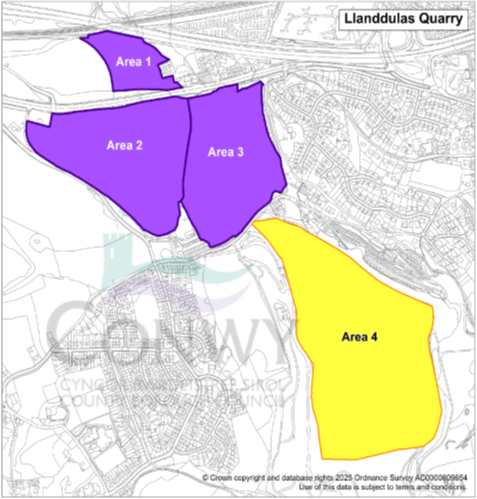
5.2.144 The Llanddulas quarry complex brings lot of potential as a development site in the RLDP. As quarrying and landfilling activities are no longer in operation at this location and the restoration phase being underway, there is scope to re-develop certain areas as shown on the proposals map for employment purposes with a solar energy farm that will provide renewable energy for the wider scheme. The development will be making use of areas of previous developed land (quarry void and former brickworks) and will involve the creation of platforms to increase accessibility and the area of developable land within the quarry voids.
5.2.145 Regarding development planned on any restored areas, for example, Areas 3 and 4, the overall impact of the development will achieve a net gain of biodiversity, with any losses being-off set on land adjacent to, and to the south of the quarry on land that is within the same ownership.
5.2.146 Consultation with statutory bodies has revealed a number of matters for consideration, which have been considered within this policy. Key matters raised by the statutory consultees include highways and active travel, green infrastructure, biodiversity enhancement including the need to produce bat surveys (tunnels and structures), eDNA surveys for Great Crested Newts, Habitat Surveys, Birds and Invertebrates. Water supply and treatment, flood / surface water measures and ground water protection, the assessment and protection of historic assets, the preservation and promotion of the Welsh language, and the overall management of materials on site.
5.2.147 To obtain suitable highways access to Area 1, improvements to visibility splays are likely to be needed as detailed in this policy. Regarding highways capacity, junctions 22 and 23 of the A55 will require assessments at planning application stage.
5.2.148 Other issues in terms of how the site might be improved and how it relates to the neighbouring villages of Llysfaen and Llanddulas were raised at a public engagement event. In particular the need for improved public footpaths and boundary fencing around the site was highlighted as an issue of concern, as was the development of areas that have since been restored. Both above matters are covered in this placemaking policy with a specific reference to revisions to the approved restoration arrangements needing to be sought at planning application stage, and the result of an overall net-gain in biodiversity. Where necessary, S106 agreements will be used to secure such improvements at the planning application stage.
5.2.149 In terms of sewage capacity, this can only be established for employment allocations once the type of development and occupier/end-user of a site is known. Once requirements are confirmed through the planning application process, further assessments will be undertaken.
5.2.150 The individual plots available for development can represent a substantial area of land for which the potential demands upon Dwr Cymru assets are unknown at present. The obligations of a water and sewerage undertaker extends to ‘domestic’ supplies only. It may be necessary for water and/or sewerage hydraulic modelling assessments (HMAs) to be undertaken at the developer’s expense to establish where the proposed development could connect to the existing networks, and to identify any required infrastructure improvements. Water mains and/or sewerage infrastructure required for any potential development site can be acquired through the requisition provisions of the Water Industry Act 1991 (as amended).
5.2.151 Although not currently designated as a scheduled monument, the remains of the Hoffman Lime Kilns are considered by Cadw to be of national importance and more than likely meet the criteria for designation as a scheduled monument. As such, development in Area A could have an impact on it and on its’ setting. However, Cadw have advised that if Area 1 was allocated, the preservation and conservation of the kiln in any development would mitigate any impact on its setting. Heneb have advised that further assessment work in the form of a detailed desk-based assessment combined with a walkover, mapping survey and level 3 historic building survey will be required. It is recognised that the remains of the kiln are currently covered in vegetation and this may hamper attempts to gain access to undertake the necessary surveys. Indeed, attempts to remove the vegetation may risk in damage to the kiln remains. Expert conservation advice therefore needs to be sought therefore prior to removal of vegetation from the site in the first instance. Any future development on Area 1 will need to take into account advice from Cadw and the Heneb –the Trust for Welsh Archaeology.
5.2.152 As advised by Heneb, similar desk-based assessment as outlined above will be needed for Area 2, to determine the extent and condition of any historic assets that may be present in this location.
5.2.153 Mitigation measures for the Welsh language are suggested in BP74: Welsh Language Impact Assessment and will be required to be provided as part of the development of the site. These measures will be secured via planning condition or legal agreement.
PL/23 site 103 Bryniau, Llandudno employment site
- Land measuring 3.85 hectares at Bryniau, Llandudno has been allocated for B1 employment.
- The phasing of this site will be in line with policy ED/2.
- Proposals must meet all the placemaking and infrastructure requirements set below:
- Highways and Active Travel – the sustainable transport hierarchy should be applied to the design. The main point of vehicular access should be taken from Conway Road (B5115) a minimum distance of 70m from the roundabout junction and should extend the footway from the southbound bus stop into the site. Footway provision should also be provided opposite the northbound bus stop adjacent the site. Active travel links should be provided in line with policy STA/6.
- Design and layout – the design of the physical infrastructure and buildings will be guided by policies PL/1, PL/5 and PL/11, taking into account the accessibility, safety, security and permeability of the site.
- Historic environment – the ASIDOHL concludes that the impact of development of this site on the registered historic landscape will be slight. Planning applications should therefore ensure that the design, scale, layout and materials of buildings and associated infrastructure minimise impact on the registered historic landscape.
- Archaeology – there are no known constraints within the site, however, archaeological assessment is required at planning application stage to understand the buried potential of this site. Depending on the outcome of this, it is possible that this would need to be followed by archaeological evaluation.
- Green infrastructure – ensuring green features, including hedges and trees are retained and integrated with habitat creation, native tree planting in line with NE/6, incorporating and connecting open space provision where appropriate, in line with policy NE/7.
- Biodiversity enhancement – the overall impact of the development will result in a net benefit for biodiversity, in line with the stepwise approach and policy NE/8.
- Air Quality - Incorporate satisfactory air quality measures for mitigating and/or reducing emissions in line with policy EQ/3.
- Energy efficiency/Zero carbon – proposals should demonstrate application of the energy hierarchy through submission of an Energy Statement in line with policies EN/1 and EN/2.
- Water supply and sewage – understanding the sewage capacity for employment allocations can only take place once the type of development and occupier/end-user of a site is known. Once requirements are confirmed through the planning application process, further assessments / or hydraulic modelling assessments may be necessary to support development on this site.
- Welsh language – mitigation measures must be provided.
- Highways and Active Travel – the sustainable transport hierarchy should be applied to the design. The main point of vehicular access should be taken from Conway Road (B5115) a minimum distance of 70m from the roundabout junction and should extend the footway from the southbound bus stop into the site. Footway provision should also be provided opposite the northbound bus stop adjacent the site. Active travel links should be provided in line with policy STA/6.
5.2.154 Allocating the land at Bryniau presents the opportunity to develop the site for B1 employment uses in one of the key growth areas as outlined in Future Wales, the National Plan 2040. Consultation with statutory bodies has revealed a number of matters for consideration in developing the site, which have been taken into account when writing this placemaking policy. Key matters raised by the statutory consultees include; highways and active travel, green infrastructure and biodiversity enhancement, minimising impact on the historic landscape, the preservation and promotion of the Welsh language, and the overall management of materials on site.
5.2.155 Concerning access to the site, the main point of vehicular access should be taken from Conway Road (B5115) at a minimum distance of 70m from the roundabout junction and should extend the footway from the southbound bus stop into the site. Footway provision should also be provided opposite the northbound bus stop adjacent the site. Active travel links should be provided in line with policy STA/6.
5.2.156 An ASIDOHL was undertaken prior to the site’s inclusion in the Deposit RLDP. This concluded that the impact of development of this site on the registered historic landscape will be slight. It is important therefore that planning applications should take impacts on the historic environment, including potential archaeology, in line with this policy and policy HE/2.
5.2.157 In terms of sewage capacity, this can only be established for employment allocations once the type of development and occupier/end-user of a site is known. Once requirements are confirmed through the planning application process, further assessments will be undertaken.
5.2.158 Existing green features and habitats should be retained wherever possible. The site is bounded and crossed at certain points by hedgerows and mature trees which provide an important habitat for many species. Hedges and trees should be retained and included in the site plans wherever possible in order to maintain this habitat.
5.2.159 The individual plots available for development can represent a substantial area of land for which the potential demands upon Dwr Cymru assets are unknown at present. The obligations of a water and sewerage undertaker extends to ‘domestic’ supplies only. It may be necessary for water and/or sewerage hydraulic modelling assessments (HMAs) to be undertaken at the developer’s expense to establish where the proposed development could connect to the existing networks, and to identify any required infrastructure improvements. Water mains and/or sewerage infrastructure required for any potential development site can be acquired through the requisition provisions of the Water Industry Act 1991 (as amended).
5.2.160 Mitigation measures for the Welsh language are suggested in BP42: Welsh Language Impact Assessment and will be required to be provided as part of the development of the site. These measures will be secured via planning condition or legal agreement.
PL/24 site 206 Nant y Coed, Llandudno Junction housing site
- This site is allocated for 100% affordable housing (50 homes) and associated works.
- Proposals must meet the following placemaking and infrastructure requirements:
- Highways – a traffic impact assessment will be required. Access for housing should be provided via Ronald Avenue.
- Active travel – routes linking to the public rights of way network, retail centre and community facilities and services must be considered and provided in line with the PL/1 sustainable placemaking, PL/5 placemaking and good design and the Sustainable Transport and Accessibility Strategy section of the RLDP
- Affordable housing – the scheme should provide for 100% affordable housing.
- Infrastructure – deliver necessary infrastructure and planning obligations in-line with PL/12 new development, infrastructure and planning obligations, PL/13 new development and viability and recreational space policy RS/2.
- Water supply and sewerage – a Hydraulic Modelling Assessment will be required to inform the planning application,
- Flood risk – a Flood Consequences Assessment (FCA) will be required to inform the planning application
- Landscape – the site must be designed appropriately, including screening measures to ensure that the site contributes positively to viewpoints in the locality.
- Green Infrastructure and Biodiversity – statements will be required to inform the planning application.
- Welsh language – the site falls within the designated Welsh Language Sensitive Area. A WLIA for the site will be required at planning application stage in line with policy PL/7.
- Highways – a traffic impact assessment will be required. Access for housing should be provided via Ronald Avenue.
5.2.161 The allocation of this site at Nant y Coed, Llandudno Junction provides the opportunity to contribute towards meeting the housing need for the Creuddyn sub-area through 100% affordable housing delivery. Key stakeholders and statutory bodies have been consulted on this site and the matters raised have been reflected in this site-specific placemaking policy.
5.2.162 There is a significant need identified for affordable housing both in Llandudno Junction itself and the wider Creuddyn sub-area. The LHMA (2022-37) predicts that this need will continue through the plan period and beyond. Affordable housing provision to meet this locally identified need must be provided on-site. The final housing mix proposed should reflect the local identified need in Llandudno Junction and the Creuddyn sub-area. Early engagement with CCBC Housing Services is recommended to ensure that this policy requirement is met (HS/7 housing mix).
5.2.163 A placemaking plan and placemaking compliance statement will be required as set out in policy PL/16, detailing how the proposed scheme is policy compliant, sustainable and reflects community priorities.
5.2.164 A highways assessment will be required and must include the impact on the surrounding road junctions. Good quality, safe and fully accessible active travel routes should be provided through and surrounding the site, linking to nearby schools, retail centre, public rights of way, public transport and other key local amenities within Llandudno Junction.
5.2.165 A Hydraulic Modelling Assessment and FCA are required for the site. The Ganol WwTW has capacity to accept this site.
5.2.166 BP28: Recreational Spaces Assessment identifies deficits of playing fields, outdoor sports, formal play space, other outdoor provision and parks and gardens in Llandudno Junction. Whilst this site allocation is not expected to overcome these deficits, it is vital that the site provides for the recreational space needs of residents who will live there. This will be controlled through planning conditions or a legal agreement.
5.2.167 Llandudno Junction lies in the designated Welsh Language Sensitive Area in the RLDP (policy PL/7). Mitigation measures for the Welsh language are suggested in BP42: Welsh Language Impact Assessment and will be required to be provided as part of the development of the site. These measures will be secured via planning condition or legal agreement.
5.2.168 Green Infrastructure and Biodiversity Statements are required for all development proposals. Strategic development should assess the sites, including available datasets to establish enhancement within the site in line with guidance in BP47 and policies NE/7, NE/8 and EQ/1.
PL/25 site 132 Dinerth Road, Rhos on Sea housing site
- This site is allocated for 100% affordable housing (50 dwellings) and associated works.
- Proposals must meet the following placemaking and infrastructure requirements:
- Highways – No highway objections in principle. Main vehicle access to development to remain on to Dinerth Road. Pedestrian accesses should connect in all directions possible in accordance with Active Travel with improvements also required to the local school sites. A Transport Statement will be required and possibly a TRO (Traffic Regulation Order) to improve visibility splay at access.
- Net zero – An Energy Strategy will be required to inform the planning application to demonstrate measures towards achieving net zero carbon in line with policy EN/1-7.
- Active travel – routes linking to the public rights of way network, retail and community facilities and services must be considered and provided in line with the PL/1, PL/5 and the Sustainable Transport and Accessibility Strategy section of the placemaking framework
- Affordable housing – the scheme should provide for 100% affordable housing.
- Infrastructure – deliver necessary infrastructure and planning obligations in-line with policies PL/12, PL/13, and RS/2.
- Flood/ surface water measures – a Hydraulic Modelling Assessment will be required to inform the planning application. Any surface water run-off should be managed on site through the use of SuDS.
- Landscape and trees – the site must be designed appropriately, including screening measures to ensure that the site contributes positively to viewpoints in the locality. New tree planting will be required in line with policy NE/6.
- Historic environment – the site is located close to the Scheduled Monuments of Llys Euryn and Bryn Euryn and therefore a Heritage Impact Assessment may be required.
- Green Infrastructure - a GI statement will be required at application stage to demonstrate how GI assets have been retained and enhanced adding multi-functionality, including community gardens, open space and active travel. Existing trees and hedgerows must be maintained as features in the landscape and to enhance habitat connectivity.
- Highways – No highway objections in principle. Main vehicle access to development to remain on to Dinerth Road. Pedestrian accesses should connect in all directions possible in accordance with Active Travel with improvements also required to the local school sites. A Transport Statement will be required and possibly a TRO (Traffic Regulation Order) to improve visibility splay at access.
5.2.169 The allocation of this site provides the opportunity to contribute towards meeting the housing need for the Central sub-area through 100% affordable housing delivery. Key stakeholders and statutory bodies have been consulted on this site and the matters raised have been reflected in this site-specific placemaking policy.
5.2.170 There is a significant need identified for affordable housing both in Rhos on Sea itself and the wider Central sub-area. The LHMA (2022-37) predicts that this need will continue through the plan period and beyond. Affordable housing provision to meet this locally identified need must be provided on-site. The final housing mix proposed should reflect the local identified need in Rhos on Sea and the Central sub-area. Early engagement with CCBC Housing Services is recommended to ensure that this policy requirement is met (HS/7).
5.2.171 A placemaking plan and placemaking compliance statement will be required as set out in policy PL/16, detailing how the proposed scheme is policy compliant, sustainable and reflects community priorities.
5.2.172 To ensure that health care provision can accommodate the new housing, the mitigation measures outlined in the BCUHB / CCBC statement of common ground will need to be carefully considered. Such measures include the creation of cluster-based services, the promotion of healthier lifestyles, remote care and technology and Section 106 financial contributions where appropriate. Refer to BP44: Population Change - Housing & Health/Primary Care Impact.
5.2.173 A highways assessment will be required and must include the impact on the surrounding road junctions. Good quality, safe and fully accessible active travel routes should be provided through and surrounding the site, linking to nearby schools, retail centre, public rights of way, public transport and other key local amenities in the locality.
5.2.174 A Hydraulic Modelling Assessment is required for the site. The Ganol WwTW has capacity to accept this site. A sewer easement/diversion may be required.
5.2.175 BP28: Recreational Spaces Assessment identifies deficits of playing fields, outdoor sports, formal play space, other outdoor provision and parks and gardens in Rhos on Sea. Whilst this site allocation is not expected to overcome these deficits, it is vital that the site provides for the recreational space needs of residents who will live there. This will be controlled through planning conditions or a legal agreement.
5.2.176 Green Infrastructure and Biodiversity Statements are required for all development proposals. Strategic development should assess the sites, including available datasets to establish enhancement within the site in line with guidance in BP47 and policies NE/7, NE/8 and EQ/1.
5.2.177 In view of the site’s proximity to the Scheduled Monuments, consultation with CADW is required to establish whether a Heritage Impact Assessment is required. There may also be features of archaeological interest and therefore early consultation with Heneb is also recommended.
5.2.178 Mitigation measures for the Welsh language are suggested in BP42: Welsh Language Impact Assessment and will be required to be provided as part of the development of the site. These measures will be secured via planning condition or legal agreement.
5.3 Strategic theme 2: healthy and social places in Conwy
Introduction
5.3.1 This strategic theme of the RLDP focuses on healthy, active and social places as key components of placemaking. They are complementary to all themes and policies set out in the placemaking policy framework. Healthy and social places are those which promote Conwy’s social, economic, environmental and cultural well‑being by providing well‑connected cohesive communities. Places which are active and social contribute to the seven goals of the Well‑being of Future Generations Act.
5.3.2 The healthy & social places theme of the Conwy RLDP covers housing and affordable housing, sustainable transport and accessibility, retailing and commercial centres, community facilities and services and recreational spaces.
5.3.3 This theme supports and enables the provision of a range of well‑designed and located new homes which are well connected to existing retail and commercial centres situated at the heart of our communities and job opportunities. Affordable housing delivery is a significant priority for the RLDP. We need to tackle homelessness, increase affordable housing, protect community identity, promote resilience and encourage a more balanced age structure throughout the plan area. The housing and affordable housing framework within this strategic theme puts in place the policies to tackle these priority issues, supported by the wider policies set out in the placemaking policy framework.
5.3.4 It promotes retail and commercial centres as hubs, for a range of activities, recognising their social, cultural and economic importance. It acknowledges the significance of community facilities and recreational spaces for health, well‑being and quality of life and specifically protects and promotes these uses in line with the overarching national sustainable placemaking outcomes. When planning and managing future development, the strategic theme ensures that planning proposals have good access to jobs and an appropriate range of community facilities including recreation, leisure, health and education.
5.3.5 This theme aims to ensure new development is located and designed in a way which minimises the need to travel, reduces dependency on the private car and enables sustainable access to employment, local services and community facilities. This will be achieved through integrating development with sustainable transport infrastructure and designing schemes in a way which maximises provision and use of sustainable forms of travel, including prioritising these modes over the private car.
5.3.6 The healthy and social places theme consists of the following policies:
Housing and affordable housing framework
HS/1 sustainable housing framework
HS/2 delivering the housing need
HS/3 affordable housing provision
HS/4 affordable housing-led sites
HS/5 affordable housing exception sites
HS/6 housing density
HS/7 housing mix
HS/8 local housing need schemes
HS/9 rural enterprise dwellings
HS/10 second homes and short-term holiday lets
HS/11 C3 permanent residences occupancy condition
HS/12 shared accommodation
HS/13 care homes, nursing homes, extra care, supported living and sheltered housing
HS/14 Gypsy, Romany and Traveller development
HS/15 meeting the needs for Gypsy, Romany and Travellers
Sustainable transport and accessibility strategy
STA/1 sustainable transport, accessibility and decarbonisation
STA/2ultra-low emission vehicles
STA/3 mitigating travel impact
STA/4 transport routes and schemes
STA/5 freight and waste consolidation hubs
STA/6 active travel and green infrastructure
STA/7 improvements to public transport interchanges and facilities
STA/8 parking standards
RTC/1 retail and town centre first
RTC/2 retail hierarchy
RTC/3 primary shopping area
RTC/4 shopping zones
RTC/5 retail and leisure parks
RTC/6 shop front design & security
RTC/7 new retail development
Community facilities & services strategy
CFS/1 community facilities and services
CFS/2 new and existing allotments
CFS/3 burial grounds
CFS/4 new community facilities
CFS/5 loss of community facilities
RS/1 recreational spaces
RS/2 development and recreational spaces
RS/3 safeguarding existing recreational spaces
RS/4 new recreational spaces
Housing and affordable housing framework
SO2: Promote a holistic and co-located employment and housing growth strategy by delivering new homes, including affordable homes and gypsy and traveller accommodation needs in sustainable and accessible locations, and ensuring that the right range of housing types, sizes and tenure are brought forward alongside the necessary community infrastructure.
5.3.7 This chapter provides the policy framework for delivering the housing and affordable housing needs of the RLDP area. It also includes policies for managing second homes and holiday lets, rural housing schemes, shared accommodation, care homes and other specialist housing and how the LPA will deliver the site needs of the Gypsy, Traveller and Showpeople communities.
5.3.8 Delivering an appropriate level of housing that meets the needs of the population of the plan area is a key issue for many of our communities. The shortage of affordable housing to rent or to buy is one of the greater challenges the Council faces.
HS/1 sustainable housing framework
The plan makes provision for 4,300 new homes to deliver a housing requirement of 3,600 (plus 20% contingency), of which at least 1,760 homes are affordable.
The sustainable housing will deliver this through:
- Allocating land for 1,320 new homes as identified in policy HS/2.
- Delivering 680 new affordable homes on site allocations in-line with policy HS/3.
- Maximise affordable housing on all sites through policy HS/4 affordable housing led sites.
- Support additional affordable housing delivery on appropriate sites outside of settlement boundaries in-line with policy HS/5.
- Ensure new homes are provided at the appropriate density, which makes the best use of land, as set in policy HS/6.
- Provide for an appropriate housing mix on sites, to meet locally identified need, as required by policy HS/7.
- Provide for housing to meet local need in some areas, guided by policy HS/8 local housing need schemes.
- Support applications for new Rural Enterprise Dwellings, and provide criteria for removing existing occupancy conditions, in-line with policy HS/9.
- Manage the level of second homes and short-term holiday lets in designated areas, in-line with policy HS/10.
- Restrict new homes to C3 permanent residences only in developments outlined in policy HS/11.
- Support the provision of new shared accommodation subject to the criteria set in policy HS/12.
- Support the provision of new care homes, extra care, supported living and sheltered housing schemes where needed and protect existing care homes through policy HS/13.
- The conversion of rural buildings to new homes will be supported in-line with policy PL/10.
- Address the need for gypsies and travellers in line with policy HS/14 and policy HS/15.
5.3.9 The accessibility and affordability of housing is an essential factor in securing the long-term sustainability of our communities and delivering the growth strategy of the RLDP. The average household size in the plan area is decreasing. The changing age and social structure of Conwy County Borough’s population may threaten the wellbeing of communities and the Welsh language and the viability of local schools, businesses, services and facilities. Therefore, it is crucial to the future of the area that the needs of predicted population and household changes are secured and a more balanced age structure promoted through the development of well-designed and accessible homes of the right type, size and tenure.
HS/2 delivering the housing need
Priority is given for new residential development to be in the CDSA (90%) and the Key Service Centre. Development is steered towards the larger settlements in line with PL/4 growth distribution and hierarchy of settlements.
The following sites are allocated for residential use:
|
Site |
Total units in plan period |
Affordable units in plan period |
Delivery timescale |
Units beyond plan period |
|
West Site 157 Caeffynnon, Llanfairfechan |
145 |
73 |
Year 11-15 |
0 |
|
Creuddyn Site 91 Pentywyn Road, Deganwy / Llanrhos |
140 |
70 |
Year 11-15 |
0 |
|
Site 206 Nant y Coed, Llandudno Junction |
50 |
50 |
Year 6-10 |
0 |
|
Site 203 Queen’s Road, Llandudno |
70 |
35 |
Year 11-15 |
0 |
|
Central Site 68 Peulwys Farm, Old Colwyn |
25 0 |
150 |
Year 11-15 |
50 |
|
Site 132 Dinerth Road, Rhos on Sea |
50 |
50 |
Year 6-10 |
0 |
|
Rural Site 56 Penloyn, Llanrwst |
100 |
50 |
Year 11-15 |
0 |
The following previous LDP sites are re-allocated, but are anticipated to have planning permission granted prior to adoption of the RLDP:
|
Site |
Total units in plan period |
Affordable units in plan period |
Delivery timescale |
Units beyond plan period |
|
West Site 86 Penmaen Park, Llanfairfechan |
55 |
11 |
Year 6-10 |
0 |
|
Creuddyn Site 210 Derwen Lane, Penrhyn Bay |
152 |
53 |
Year 6-10 |
0 |
|
Central Site 41 Heol Dirion, Colwyn Bay |
28 |
28 |
Year 6-10 |
0 |
|
East Site 113 Tandderwen Farm, Abergele |
277 |
110 |
Year 6-10 Year 11-15 |
0 |
No residential development will be permitted outside of settlement boundaries, except for affordable housing exception sites in-line with policy HS/5, rural conversions in-line with policy PL/10, Rural Enterprise Dwellings in-line with policy HS/9 and One Planet Development in-line with national guidance.
A sustainable level of new residential development is permitted in the RDSA (10%). The majority of this will be delivered at the Strategic Site in Llanrwst, the Key Service Centre. To support the housing needs of other rural settlements, sites delivering a minimum of 50% affordable homes will be permitted on suitable sites within Tier 2 Main Villages, Minor Villages and Hamlets will be supported subject to the following criteria:
Such sites must be located within the settlement boundary where applicable, or well located in relation to the existing settlement, comprising infilling or rounding off.
Affordable housing units must be provided on-site to meet an identified local need. Off-site provision or commuted sums will not be permitted. Where the requirement results in a partial affordable dwelling, it will be rounded up to the nearest full affordable dwelling to be provided on-site. Single open market dwellings will not be permitted, unless occupancy is restricted for local need, in line with policy HS/8 local housing need schemes.
There is no unacceptable impact on the local character of the area; and,
Sites of a maximum of 5 open market dwellings in Minor Villages and 2 open market dwellings in Hamlets will be permitted on schemes, where open market dwellings total a maximum of 50% of units on the scheme.
5.3.10 The sustainable housing strategy supports growth in the right location. The majority is anticipated to be delivered in the CDSA, reflecting the settlement hierarchy. An appropriate level of new housing is needed in the RDSA, which supports smaller settlements and the Welsh language whilst protecting them from overdevelopment.
5.3.11 The sustainable housing strategy prioritises development on PDL, however, it is not possible to deliver the full level of new homes needed on PDL alone. Some loss of greenfield site and green wedges is necessary to ensure deliverability of the RLDP. This reflects the findings of BP29/BP31 Green Wedge Assessment.
5.3.12 The RLDP must allocate land to deliver the level of new homes set out in the sustainable housing strategy. These will the phased accordingly as demonstrated in the housing trajectory. Dwellings already built since the start of this RLDP period, current commitments and a windfall allowance are also accounted for. A housing trajectory is available in Appendix 1. Further detail on commitments included and windfall assumptions are available in BP7 Housing Land Supply.
5.3.13 Some LDP (2007-22) allocations are currently in the pipeline for development and planning applications have been submitted. As these have not yet had permission granted, the housing numbers on these sites do not form part of the commitments figure in the RLDP housing supply. The principle of residential development has previously been agreed due to their current status as LDP allocations, so it is reasonable to assume that they will come forward for development and are likely to have permission granted prior to adoption of the RLDP. To make sure these sites in the pipeline are not missed out of the RLDP housing supply, they are re-allocated here as pipeline housing sites. If these sites have not received planning permission by the time of the RLDP Examination in Public, they will not be included in the plan as allocated pipeline sites or counted as commitments.
5.3.14 For smaller settlements (Tier 2 Main Villages, Minor Villages and Hamlets), the number of market homes to be delivered on a mixed residential scheme is limited in the policy to protect the Welsh language, character and rural nature of these settlements, whilst supporting a sustainable level of housing growth. The number of new affordable homes on schemes should be to meet an identified local need. Affordable homes must be provided on site to support the sustainability of the rural settlement. Commuted sums for affordable housing will not be acceptable in these settlements. Care should be taken to ensure that there is no unacceptable impact on the local character of the settlement and no overdevelopment of the site. The applicant should work proactively with CCBC Housing Services, RSLs and local community groups to identify a local need for the affordable housing. A rural housing survey or similar may be required in some instances to fully understand the affordable housing needs of the local area. Should an affordable housing need not be found a commuted sum in lieu will not be permitted. In order to prevent unnecessary development in the rural areas and protect and enhance the local character and Welsh language hinterlands, open market schemes, where there is no occupancy restriction in-line with policy HS/8 local housing need schemes will not be permitted.
HS/3 affordable housing provision
- Affordable housing will be sought from unallocated residential developments within the settlement boundaries of urban settlements, Tier 1 Main Villages and the Key Service Centre where there is a net gain of dwellings from the scheme, according to the following target percentages:
West strategy area:
Llanfairfechan, Penmaenmawr, Dwygyfylchi: 30%
Creuddyn strategy area:
Llandudno, Penrhyn Bay: 40%
Conwy, Deganwy, Llandudno Junction, Glan Conwy: 35%
Central strategy area:
Rhos on Sea, Mochdre, Colwyn Bay, Old Colwyn: 30%
East strategy area:
Llanddulas, Abergele: 20%
Pensarn, Towyn, Kinmel Bay: 0%
Rural strategy area:
Llanrwst: 40%
- The following schemes will not be required to provide affordable housing on-site or via off-site contributions
- Developments within the settlement boundaries of the CDSA and the Key Service Centre involving the loss of a dwelling, with a net gain of 4 dwellings or less;
- Abergele & Llanddulas: all small sites development (1-4 dwellings); and,
- In the West, Colwyn Bay, Old Colwyn and Mochdre: small sites development (1-4 dwellings) that involve demolition or conversion of an existing substantial and permanent building.
- Developments within the settlement boundaries of the CDSA and the Key Service Centre involving the loss of a dwelling, with a net gain of 4 dwellings or less;
- Affordable housing delivery should be on-site for all schemes, where the requirement is a full dwelling or more. Off-site delivery or financial contributions may be appropriate in exceptional circumstances, for example due to the nature of the site or the scheme proposed.
5.3.15 Delivering affordable housing on residential sites will make a vital contribution towards meeting the high level of affordable housing needed in the plan area both now and for the foreseeable future. Proposals should reflect the tenure and size of affordable housing needed in the area, as evidenced in the Local Housing Prospectus, LHMA and local affordable housing registers in order to deliver mixed and sustainable communities.
5.3.16 These affordable housing site targets are evidenced by a robust viability assessment (BP10) and will only be reduced if it is clearly demonstrated that there are site specific exceptional circumstances which justify the need for a viability assessment at the point of application. The applicant must provide all information, evidence and justification as part of the application process through an ‘open book’ basis. Early engagement with the LPA is recommended. Should the council be unable to reach an agreement with the applicant the council will commission an independent assessment. The applicant will be required to cover the costs associated with this.
5.3.17 Where the target requirement for affordable housing produces part of a dwelling, this will be required as a commuted sum, or the developer can choose to round up to the nearest whole dwelling.
5.3.18 All affordable homes are required to be fully integrated within a development. Affordable housing will be subject to a legal agreement or planning condition to control occupancy in perpetuity. Where open market housing is provided on the site, the legal agreement must also ensure timely delivery of the affordable housing for local community need.
5.3.19 Any off-site affordable housing provision will only be considered in exceptional circumstances. The schemes will be required to provide at least the same number of affordable homes due from the combination of both schemes. The schemes should also provide an additional community benefit for the community where the open market scheme is located. The schemes will be linked via a legal agreement to ensure delivery of the affordable homes. Within the CDSA, the off-site scheme should be delivered in urban settlements or Tier 1 Main Villages within the same Housing Market Area, as defined in the LHMA, as the original proposed scheme. Within the RDSA, off-site schemes should be within the same or adjoining Town or Community Council area. All schemes will need to provide affordable housing for identified need in the settlement and also meet priority needs identified by CCBC Housing Strategy where applicable.
5.3.20 Viability evidence has shown that some types of development are unlikely to be financially viable to meet the AHLN targets set out in part 1 of HS/3 affordable housing provision. These include small-scale developments, where demolition of existing structures is required due to the additional costs involved, small schemes that involve the loss of a dwelling due to higher existing use values, and sites in the weaker market areas of Conwy County Borough. For this reason exemptions to these AHLN requirements are identified in part 2 of the policy. Residential developments of all types and size that do not fall within the exemptions set out in the policy are expected to meet the AHLN requirements. Proposals that separate a site into multiple planning applications or phases with the result of avoiding AHLN requirements will be considered in policy terms as being a single site.
5.3.21 For the purposes of part 2 (c) of this policy, ‘demolition or conversion of an existing building’ relates to substantial, permanent buildings (generally brick or stone) which cover a significant portion of the site to be redeveloped only. This is due to the costs involved in converting or demolishing the buildings and redeveloping the site. Small, temporary or lightweight buildings, such as outbuildings, greenhouses, sheds or garages would generally not be relevant to the interpretation of this policy, as they would not add significantly to the development costs of the site.
Please see policy HS/2 delivering the housing need for the policy approach to affordable housing requirements in Tier 2 Main Villages, Minor Villages and Hamlets.
HS/4 affordable housing led sites
- All large sites within the settlement boundaries of the urban settlements, Tier 1 Main Villages and the Key Service Centre, as defined in policy PL/4 growth distribution and hierarchy of settlements, must be affordable housing led sites, where at least 50% of the new homes on the site will be affordable.
- Lower levels may be considered acceptable in the following circumstances:
- where the identified affordable housing need in the Housing Market Area is less than the number of affordable housing proposed; or,
- where subsidy is not available to fill the financial gap to provide above the developer contributions set in policy HS/3; or,
- Where the higher levels of affordable housing in the proposed development means that the housing mix in the locality would result in unsustainable communities.
- where the identified affordable housing need in the Housing Market Area is less than the number of affordable housing proposed; or,
- The Council will seek to achieve higher levels of affordable on Council and publicly owned sites.
5.3.22 The LHMA and affordable housing registers show a significant number of households in need of affordable housing across all areas of the County Borough. Not all of these can be accommodated in the existing stock, and so new build affordable homes are required. The Local Housing Prospectus and LHMA 2022-37 supports this approach and indicate that a high level of affordable housing will be required through the plan period. Should this change, and the affordable need is met in a Housing Market Area, or it is possible to meet the identified need through the existing housing stock alone, a lower level of affordable housing can be considered.
5.3.23 Maximising affordable housing on sites is a key part of supporting sustainable communities. Many local households are priced out of the housing market, resulting in them moving elsewhere for housing. Providing affordable housing is therefore, a key part to achieving the vision of the RLDP and balancing our local population structure through retaining young people. This in turn could lead to positives for the Welsh language, where local Welsh speakers are able to remain living in their local communities.
5.3.24 This policy approach applies to large sites, which are for 10 or more dwellings. It requires developer contributions towards affordable housing levels to those set out in policy HS/3. It is anticipated that subsidies will be required to fill the funding gap for provision to be increased to 50%. All options for this should be considered by the applicant, and a proactive approach with RSLs and CCBC Housing Strategy will be required. Should additional funding not be available, the applicant will be required to evidence this as part of the application. Views of CCBC Housing Strategy will be sought to confirm that there is no subsidy available. In these instances, lower levels of affordable provision will be acceptable, but the proposal must meet the requirements of policy HS/3 affordable housing provision.
5.3.25 The Local Housing Prospectus has been updated to reflect this approach and support delivery, ensuring that sites receiving subsidy from CCBC align with the RLDP vision, objectives and growth strategy.
5.3.26 Proposals must not result in unsustainable communities due to, for example, creating an unbalanced housing mix in the locality. In these instances, the policy requirements in that area must be provided, in-line with policy HS/3 affordable housing provision.
HS/5 affordable housing exception sites
- Sites for 100% affordable housing for local need will be permitted adjoining the confinements of the settlement as an exception to the housing policies, subject to the following criteria:
- The location of the proposal site is a logical extension to the settlement and integrates positively with the local community;
- The site is sustainably accessible by a range of transport options, including Active Travel network links, in-line with policy STA/6 active travel and green infrastructure;
- The scheme is of an appropriate scale, proportionate to the size of the settlement and in keeping with the character of the settlement and local landscape in-line with policies PL/1 and PL/5;
- The proposed housing mix provides for sustainable communities and would meet an identified affordable housing need for that Town or Community Council. Adjoining Town or Community Councils will be considered appropriate in some circumstances;
- There are no alternative sites within the confinements of the settlement available for development that could meet this identified need; and
- The site does not lie in a designated Green Wedge, as defined on the proposals map and policy NE/5 Green Wedges.
- The location of the proposal site is a logical extension to the settlement and integrates positively with the local community;
- A site threshold of 10 dwellings applies in Tier 2 Main Villages and Minor Villages. A site threshold of 5 applies in Hamlets. Sites above this threshold may be permitted subject to the additional following criteria:
- Affordable housing need evidence is higher than 10 for the settlement where the proposal site is located and the new dwellings would meet this identified need; or
- The increased scale of the site results in the development being financially viable that would otherwise be unviable.
- Affordable housing need evidence is higher than 10 for the settlement where the proposal site is located and the new dwellings would meet this identified need; or
5.3.27 There is a significant need for affordable housing provision across the plan area, as evidenced in the LHMA 2022-37. Whilst the preference is for this need to be met within the confinements of settlements or defined settlement boundaries, this is not always possible. In these instances, exception sites to meet identified local need may be an acceptable alternative.
5.3.28 Where there is a settlement boundary, the proposal site should adjoin it. Careful consideration will be needed to make sure that any proposal site is a logical extension to that settlement, and does not result in ribbon development, fragmented development or unacceptable encroachment into the open countryside and designated Green Wedge (where applicable). Proposals which result in an isolated concentration of affordable housing will not be permitted. Proposals should reflect the local character and be designed appropriately. Proposal sites will need to be accessible to local services and facilities and provide for Active Travel Routes to improve connectivity. The impact on community facilities has been assessed as part of the RLDP evidence base. Mitigation and new facilities will be required as per policy PL/12, PL/13 and CFS/1.
5.3.29 The scheme should link to and meet the identified affordable housing need for that Town or Community Council, in-line with policy HS/7. It may be considered acceptable to meet a need for affordable housing from a neighbouring Town or Community Council, should there be no appropriate sites available there. The applicant will need to demonstrate and evidence as part of the planning application that there are no available sites that are deliverable to fully meet this identified need within the settlement boundary where the need is identified, including any RLDP allocations.
5.3.30 For the purpose of this policy, local is defined as a household who has a connection to the Town or Community Council the site is in, or adjoining Town and Community Councils. Connection is considered as:
- Has lived in the relevant area for a 5-year period. This could be at any point in their life;
- Has employment in the relevant area;
- Has caring responsibilities for family members living in the area; and / or
- Require care/support from family members living in the area.
5.3.31 Flexibility can be applied, for example where households are considered to be in urgent priority need for affordable housing but have no local connection. The occupation of these dwellings will be secured for affordable use in perpetuity. This will include a cascade mechanism to widen the definition of local to ensure future occupancy.
5.3.32 It is important for proposals to contribute towards mixed and sustainable communities through providing for an appropriate mix of house types, sizes and tenures. The proposal must integrate well with the local existing community to protect the character and distinct sense of place.
5.3.33 The policy provides flexibility for sites to be delivered above the identified thresholds in the rural settlements, where the identified first choice need for that settlement is higher or where a larger scale site assists significantly with financial viability of the scheme and without this impact, the scheme would be undeliverable. The applicant will need to provide detailed viability information to evidence this.
5.3.34 Open market or local need market dwellings will not be permitted on these sites.
HS/6 housing density
- Residential development should make the best use of land, including developing at an appropriate density in-line with national policy. Good design and placemaking principles must be applied to provide higher densities, without compromising the design or quality of the scheme and living accommodation.
- Higher densities will be sought in urban areas, the Key Service Centre and Tier 1 Main Villages where it represents a sustainable use of land, provides mixed use development, or is near public transport hubs and stops, where this does not result in an unacceptable visual impact. Higher density schemes which result in a negative residual value and lower affordable housing provision will not be supported.
- Lower densities may be acceptable where:
- any unacceptable impact on the character and appearance of the local area in-line with policy PL/5 and HE/1 where applicable, as a result of higher densities is overcome;
- site or infrastructure constraints impact the site layout resulting in higher densities being undeliverable;
- there is a demonstrable requirement to achieve a net benefit for biodiversity in line with policy NE/8, tree planting target in line with policy NE/6, or on-site sequestration and renewable energy generation in-line with policy EN/1 and EN/9, SuDS or other community benefit, which cannot be met without reducing development density,
- it is necessary to facilitate the delivery of identified specific affordable housing needs required in that housing market area; or,
- a lower density scheme has a positive impact on overall viability, which results in higher affordable housing delivery.
- any unacceptable impact on the character and appearance of the local area in-line with policy PL/5 and HE/1 where applicable, as a result of higher densities is overcome;
5.3.35 Building at higher densities enables best use to be made of development sites and maximises the development potential and level of affordable housing on sites. It also helps to safeguard the countryside from inappropriate development. Large scale, dense forms of development can support higher numbers of people that may be needed to support local facilities and services.
5.3.36 Well-designed higher densities should not compromise the quality of new development. Adequate space, SuDS, an appropriate housing mix and other policy requirements should not be compromised. All development is required to demonstrate a net benefit for biodiversity in line with national guidance.
5.3.37 Specific housing needs are detailed in the LHMA and housing registers. The types of accommodation required can mean that lower densities are necessary to deliver this identified specific housing need. Applicants must work with CCBC Housing Strategy and Social Care to ensure that the scheme meets specific identified needs for the housing market area, to ensure that a lower density is justified.
5.3.38 At very high densities (50dph+) financial viability can start to decrease as density rises. Where higher density development would be to the detriment of the viability of affordable housing provision, designing the development to maximise AH provision should take priority, due to the high demand for affordable accommodation across all parts of the plan area.
HS/7 housing mix
- Residential development proposals should reflect the identified local affordable housing need for tenure, house size and specific housing needs as set out in the Local Housing Market Assessment, affordable housing registers and Local Housing Prospectus.
- Development proposals should provide an appropriate mix of housing types to support delivering sustainable communities.
- Proposals for specialist accommodation, such as accommodation for the elderly or accommodation providing care will be supported, subject to need evidence.
- A proposed mix or type of dwellings which results in a negative residual value and lower affordable housing provision will not be supported.
5.3.39 Providing an appropriate housing mix is a key part of sustainable communities. As set out in PPW it is desirable in planning terms that new housing development in both urban and rural areas should incorporate a reasonable mix and balance of types and sizes of affordable housing to cater for a range of housing needs and contribute to the development of sustainable communities. All housing developments in the plan area should be inclusive and accommodate a diverse range of residents' household size and housing need to create mixed communities. All housing developments, therefore, need to provide a balanced range of housing types and size to reflect identified community need. Schemes dominated by an excessive number of single tenures or dwelling size will not be supported.
5.3.40 PPW also states that it is important that authorities have an appreciation of the demand for different dwelling sizes and types of affordable housing in relation to supply, so that they are well informed in negotiating the required appropriate mix of dwellings for new developments. The LHMA and the affordable housing registers provide this evidence and will inform negotiations for ensuring that an appropriate mix of housing type to meet the needs of the community is provided on all proposed residential sites.
5.3.41 The LHMA and affordable housing registers also provide details for more specialist and adapted affordable housing needs. Where there is an identified need locally, provision may be required on site as part of the affordable housing provision, subject to site specific matters such as location and/or topography.
5.3.42 Conwy County Borough has an ageing population structure, with higher proportions of elderly when compared with the Welsh average. The population projections show this trend is likely to continue. A housing mix which supports the elderly will be required, through providing for bungalows and other types of accessible homes.
5.3.43 Specialist accommodation to meet the needs of the local area, through providing specific support for older people or other care or supported accommodation will be supported where the LHMA or other evidence suggests there is a need for that accommodation type. RLDP policy HS/13 care homes, nursing homes, extra care, supported living and sheltered housing may also be relevant.
5.3.44 Some housing mixes can have a negative impact on the financial viability of schemes. This in turn can impact on the delivery of affordable housing, which there is significant need for. Schemes where the housing mix has a negative impact on the financial viability of the scheme will, therefore, not be permitted, unless it is to accommodate a specific affordable housing need (for example, adapted properties with a larger floorspace).
HS/8 local housing need schemes
Schemes for single local market dwellings in Tier 2 Main Villages, Minor Villages and Hamlets of the RDSA as defined in policy PL/4 growth distribution and hierarchy of settlements will be permitted where the following criteria are met:
- The site must be located within the confinements of the settlement and where proposals represent a form of infilling or relate physically and visually to the settlement; and,
- The occupancy of the new dwelling must be secured in perpetuity for people with a local connection as their principal or main residence only.
5.3.45 Few new dwellings have been built in some rural communities of the RLDP area. Other dwellings are in use as holiday lets or second homes. A constrained housing market, with limited new supply has meant that some local residents have been unable to stay living in their local community. These residents are key to maintaining and enhancing sustainable rural communities and also link with the Welsh language goals of the RLDP and the Council’s Welsh language promotion strategy and Welsh Government’s national strategy Cymraeg 2050. Evidence will be required as part of the planning application to demonstrate that the applicant or occupier is unable to meet their housing need from the existing local housing stock and schemes granted planning permission but not yet built.
5.3.46 In order to promote sustainable rural communities, provision will be made for people with a local connection to meet their housing needs more easily, where they are not eligible for affordable housing, and are unable to meet their housing needs on the open market. This will need to be evidenced as part of the application.
5.3.47 Proposal sites must be located within the settlement boundary where applicable, or within the confinements of the settlement where no boundary is drawn. The site should relate well to the existing settlement, representing infill or development of a site that is not considered outside of the built-up area, where policy HS/5 affordable housing exception sites apply. The design of the proposal should be in-keeping with local character and appearance.
5.3.48 ‘Local’ for the purposes of this policy is defined as a person who has a connection to the Community Council the site is located in, or adjoining Community Councils. Connection is defined as a person who:
- Has lived in the relevant area for a 5 year period. This could be at any point in their life;
- Has employment in the relevant area;
- Has caring responsibilities for family members living in the area; and / or
- Require care/support from family members living in the area.
5.3.49 The occupation of any dwellings provided for local market needs will need to be controlled for the initial occupier and any subsequent occupiers. The preference is for this to be through a legal agreement, which will include a cascade mechanism to widen the eligibility of occupiers. Evidence will be required as part of the planning application to show that the intended occupier has a local connection and has been unable to have their housing need met locally through open market or affordable housing.
5.3.50 Proposals for lifting local need occupancy restrictions from dwellings in these areas will not be permitted. Updating existing occupancy restrictions to reflect this policy and updated approach will be supported.
5.3.51 Due to an increase in the number of dwellings used as a second home or holiday let, an additional restriction will be placed on these dwellings to prevent occupation as a second home or holiday let. It must be used as a C3 use only, in-line with policy HS/10.
HS/9 rural enterprise dwellings
- New Rural Enterprise Dwellings (RED) will be supported in line with national policy and other material considerations. Use of existing buildings suitable for conversion in line with policy PL/10 rural conversions should be considered and demonstrated to be unfeasible before any new build schemes are proposed.
- Proposals to remove agricultural/forestry workers occupancy restrictions will be supported; subject to a RED condition (as defined in national planning policy) being applied.
- Where it can be demonstrated that there is no current demand for a RED in the locality, proposals for temporary use of the RED as C6 short-term holiday accommodation (for up to 5 years) will be supported.
- Proposals for removal of a RED Condition must:
- Clearly demonstrate through appropriate marketing at a price that realistically reflects the dwelling’s value as a RED that there is no demand for the property for either a RED or Affordable Housing (in line with the RED Practice Guidance) and,
- Provide for AHLN through a commuted sum in-line with the local affordable housing discounts.
5.3.52 Our rural businesses play a key role in the local economy and community. The RLDP seeks to support those requiring staff accommodation on site through provision of REDs. Preference is given to existing buildings over new builds, in-line with national planning guidance to make use of previously developed land and to avoid any potential negative impact on the local landscape. A RED occupancy condition will be applied to these proposals, to secure their occupancy for future tenants.
5.3.53 The circumstances of rural enterprises will vary over time. Changes to family structure, market demand, labour requirements and finances can all affect the need for dwellings on rural enterprises. Removing old-style agricultural or forestry workers occupancy restrictions to replace with the RED condition allows a broader range of potential occupants if the houses are no longer required for their original purpose. The RED condition provides flexibility in use, and every effort should be made to find alternative appropriate uses rather than allow REDs to become open market dwellings.
5.3.54 In some instances, changes to business or family structure means that a RED is not needed in the short-term in the locality, however it is likely to be required again in the future. In this case, it would be inappropriate and unnecessary to seek to remove the occupancy restriction or to advertise the property for sale. Eligible occupiers should be sought first by advertising the property for rent for 6 months. If no suitable tenants are found (either for use as RED or AHLN), the temporary use as C6 holiday accommodation will be supported. This allows flexibility for the rural business, prevents a dwelling being stood empty and helps to avoid the occupancy restriction of a RED being lifted. A short-term use of 5 years for holiday accommodation allows for the accommodation and financial needs of the enterprise to be re-assessed after this period.
5.3.55 Where it can be clearly demonstrated that a RED is no longer required either for its original purpose, or by eligible occupiers in line with the RED Condition, the occupancy restriction can be removed, subject to payment of a commuted sum towards AHLN. In order to demonstrate this, applicants will need to advertise the property for sale and/or rent in line with TAN6 and the RED Practice Guidance for a price (where marketed for sale) in-line with the recommended discounts off open market value. This marketing must make it clear that the house could be occupied either as a RED or AHLN. If marketing evidence shows that no eligible occupiers have been found to buy or rent the house, the occupancy condition can be removed in-line with the RED guidance. This will be subject to payment of a commuted sum, equivalent to the discount applied to Section 106 properties for that housing market area.
5.3.56 As REDs can provide AHLN in line with the RED Condition, payment of the commuted sum ensures that the property continues to support AHLN even if the occupancy condition is removed. In addition, the commuted sum removes the financial incentive for an owner to remove occupancy condition, helping to retain REDs for eligible occupiers in the future. CCBC Housing publish local affordable housing discounts for each housing market area annually. These are calculated using median house price and household income data. The commuted sum required will be in-line with these discounts.
HS/10 second homes and short-term holiday lets
- In designated areas, planning permission will only be granted for new second homes (C5) or short-term holiday lets (C6) if it would not lead to more than 15% of Class C properties in use as 5, C6 or mixed C5/C6 uses within:
- The Town and Community Council area;
- The designated Article 4 Direction area, or,,
- A 50 metre radius of the proposal site.
- Proposals for rural conversions to C6 uses, which would be above the thresholds identified above will be permitted in line with policies ED/6, HS/9 and PL/10 if applicable.
- Any changes to C6 uses, including partial uses, must also comply with the following criteria:
- Dedicated areas for refuse and cycle storage are provided;
- Adequate car parking and, where appropriate, charging facilities can be provided in-line with policy STA/1;
- No adverse impact on neighbouring amenity from noise, light or overlooking in-line with policies PL/1, PL/5, EQ/3 and EQ/4; and
- The proposal would not result in a Class C3 dwelling being ‘sandwiched’ between two adjoining Class C6 holiday lets.
- Dedicated areas for refuse and cycle storage are provided;
To clarify the lawful use class of any new open market and local need market dwellings granted permission where an Article 4 Direction preventing occupation as a second home (C5) or holiday let (C6) applies will be conditioned to ensure occupancy for C3 use only.
5.3.57 Tourism is an important part of the local economy. The area is popular as a choice for second homes and short-term holiday lets. Whilst there are benefits to these uses, an over-concentration, however, can lead to a range of problems, such as constraining the local housing market and the number of properties for sale or long-term rent. In more urban areas, a small scale localised concentration can lead to issues affecting neighbourhood amenity from noise, a lack of parking and a lack of appropriate refuse storage. Dwellings which are empty for parts of the year can affect the viability of local businesses, where the customer base is reduced. Other community facilities can also be impacted. The character of an area can be affected negatively through there being fewer permanent local residents and empty dwellings at times. These impacts are not compatible with creating mixed and sustainable communities.
5.3.58 Data collected and analysed in BP52 indicate that it may be necessary to introduce specific areas where planning permission would be needed to change from C3 permanent residences to C5 second homes or C6 holiday lets. This policy applies to those designated areas only and will apply to changes of use from existing residential and commercial uses and any new build development. BP52 also considers what an appropriate threshold would be where planning permission is refused and informs the 15% threshold identified in the policy.
5.3.59 The policy identifies a threshold, where any further concentration of these uses is considered to cause unacceptable impacts on both the character of an area and also the supply of permanent homes. The exception to this is in rural areas, where allowing conversions to C6 uses only as part of an existing business can have positive impacts on the rural economy. Policy PL/10 rural conversions will also be applicable.
5.3.60 To assess whether this 15% threshold has been reached, the LPA will assess the concentration of second homes and short-term holiday lets (as defined in land-use planning terms). To calculate the percentage, all C3 (dwellinghouses), C5 (dwellinghouses used otherwise than as sole or main residences) and C6 (short-term holiday lets) in the Article 4 Direction area, town and community council or 50 metre radius area will be counted. Where applicable, the radius point will be measured from central point of the property’s street frontage. The Council’s registers of second homes and holiday lets and planning history of the area will be the basis of the calculation. If available in future, licensing records of holiday accommodation will also be used.
5.3.61 Additional criteria are applicable to C6 holiday let uses to manage the potential localised impact from a concentration of these uses. Adequate parking must be provided. In exceptional circumstances, some flexibility may be applied, should the proposal demonstrate that there would be no negative impact on parking provision locally.
HS/11 C3 permanent residences occupancy condition
The following residential developments will be restricted to C3 permanent residences use only:
- Open market dwellings which are flats or apartments on schemes of 5 and above in the CDSA and the Key Service Centre;
- All new open market dwellings through both new build or change of use / conversion in the Tier 2 Main Villages, Minor Villages, Hamlets and the open countryside in the RDSA;
- All open market dwellings in designated areas in-line with policy HS/10; and,
- All local need market dwellings in-line with policy HS/8.
5.3.62 Household sizes are smaller than average and there is a larger proportion of single person households across the County Borough when compared with Wales. Flats and apartments are generally smaller properties. Analysis of local schemes for flats and apartments shows that there are some with very high levels of C5 second homes and C6 holiday lets uses. It is, therefore, considered necessary to protect any new stock of these property types to meet the needs of the local community. Schemes for new flats or apartments where there is a net increase of 5 or above new dwellings will be restricted to C3 use only.
5.3.63 In addition, BP69 has shown that smaller settlements in our rural communities have different housing pressures to our more urban areas. For this reason, all new open market and local need dwellings or conversions to these uses in the RDSA Tier 2 Main Villages, Minor Villages, Hamlets and the open countryside will be restricted to C3 use only. The restriction to C3 use only will also be applied to applications to lift occupancy restrictions, such as Rural Enterprise Dwellings, agriculture workers etc. to unrestricted open market dwellings. This will increase the availability of local housing stock, leading to sustainable communities and safeguarding our Welsh hinterlands.
5.3.64 In order to support RLDP policy HS/10, any new build in an area where there is an Article 4 Direction preventing changes of use from C3 to C5 or C6 will also be restricted to C3 use only. It is not considered necessary to restrict other dwellings to C3 occupancy only, as reflected in the evidence detailed in BP52.
5.3.65 C3 occupancy will be secured via planning condition or legal agreement.
HS/12 shared accommodation
- Proposals for the change of use / conversion of a dwelling or non-residential property to a House in Multiple Occupation (HMO) will only be permitted where all of the following criteria are satisfied:
- It would not lead to more than 10% of all residential properties and ground floor commercial properties within a 50 metre radius of the proposal being HMOs (rounded to the nearest whole number of dwellings).
- The development would not result in a Class C3 dwelling being ‘sandwiched’ between two adjoining HMO properties unless specific evidence is provided to demonstrate that the intervening C3 property:
- Has been unsuccessfully marketed at a reasonable asking price for a period of at least six months for its current use; or,
- Cannot be viably returned to C3 use; or,
- Is not suited to continued use as a C3 property; or,
- Is already subject to noise disturbance due to the neighbouring property’s use in planning terms that would undermine its amenity.
- Has been unsuccessfully marketed at a reasonable asking price for a period of at least six months for its current use; or,
- The property is suited for use as a HMO, through providing satisfactory private amenity space, dedicated areas for refuse storage and appropriate room sizes.
- There would be no unacceptable adverse impacts caused by noise nuisance, overlooking or general disturbance.
- The site can be adequately accessed and serviced, and adequate provision can be made for car parking and cycle storage or it can be demonstrated that the proposed HMO would not have an adverse effect on local parking provision.
- The proposed HMO will not have an adverse effect on the supply of the type of property that is proposed for conversion.
- Change of use / conversion is possible without significant detrimental impact on the character and appearance of the building and locality.
- The change of use from C1 (Hotels) use class to a HMO will not be permitted in the Holiday Accommodation Zone as defined by Policy TO/3 (1) and outside the Holiday Accommodation Zone in Llandudno must comply with Policy TO/3 (2).
- All HMO proposals should accord with the guidance set out in the Council’s adopted HMO Licensing Policy.
- It would not lead to more than 10% of all residential properties and ground floor commercial properties within a 50 metre radius of the proposal being HMOs (rounded to the nearest whole number of dwellings).
- HMO proposals that would lead to a breach of the maximum thresholds identified in point 1 above, will only be permitted where there are exceptional circumstances or overriding material considerations that demonstrably outweigh any concerns regarding harmful concentration or intensification.
5.3.66 This policy sets out the circumstances where the Council would allow the conversion of existing buildings to high quality Houses in Multiple Occupation (HMOs), as defined in planning terms. The policy applies to changes of use from existing residential and commercial uses across the plan area and is also applicable to any new build development proposals for HMOs.
5.3.67 The conversion of buildings to shared HMOs contributes towards providing sustainable housing choices for the area and helps to meet the need identified in the Conwy Local Housing Market Assessment for smaller/shared residential units of accommodation. Shared accommodation can provide a beneficial solution for those people that do not qualify for affordable housing yet are unable to access the private market and who might also be reluctant to enter into lengthy private tenancies with people that they do not know. Evidence suggests that this need is highly likely to continue for the entire RLDP period.
5.3.68 Shared HMOs are also a way to combat the chronic loneliness that people can face, particularly if they move to a new area and live alone. Shared HMOs are commonly being re-branded as co-living schemes and whilst many are aimed at younger people, they can equally be targeted at people in later life who are downsizing and would welcome the combination of private accommodation and being part of a community.
5.3.69 By their nature, buildings used for shared accommodation are more intensely used. Given this, it is best to locate them in areas with good public transport accessibility which are in close proximity to local shops and services. Additionally, the appropriate provision of residential accommodation above commercial properties within the designated retail centres can also make more efficient use of building(s) and improve the vitality and viability of those centres, in particular within Llandudno and Colwyn Bay town centres.
5.3.70 While the Council acknowledges the important role such housing provides in meeting housing needs, it also recognises concerns from a number of existing residents that a concentration of such forms of housing can have a detrimental effect on the character and amenity of an area. For example, large numbers of flats can lead to problems such as a shortage of on street parking and bin storage issues. In addition, areas with high levels of flats are often associated with low levels of owner occupation which in some instances can lead to lower standards of maintenance and associated environmental degradation issues (thereby prejudicing environmental improvement and regeneration objectives). Furthermore, the cumulative impact of converting larger dwellings to shared accommodation can have a detrimental impact on creating mixed and balanced communities by reducing the number of family homes available within an area. This policy is considered necessary to prevent the over concentration of such uses and ensure that development is meeting identified needs.
5.3.71 For this reason, the policy identifies a threshold, where any further shared HMOs are considered to be a harmful concentration. The threshold is evidenced base, and considered matters including current HMO provision, likely future demand and other evidence. The approach will allow for an appropriate level of shared HMOs across the plan area.
5.3.72 To assess whether this 10% threshold has been reached, the LPA will assess the concentration of shared HMOs (as defined in land-use planning terms), in a 50 metre radius of the application property. The radius point will be measured from central point of the property’s street frontage. To calculate the percentage, all C3 (dwellinghouses), C4 (small HMOs) and large HMOs in the radius area will be counted. Should the number of properties of this use fall below 10, all separate ground floor properties of any use class will be included in the calculation. The Council’s register of licensed HMOs and planning history of the area will be the basis of the calculation.
5.3.73 Should an application be submitted to change the use of a property from a small HMO, to a large one, or to increase the size of a large HMO, permission will be required, but this policy would not apply as there would be no change to the number overall in the radius area. Other policies in the plan will apply and the application will be assessed on its merits.
5.3.74 There may be specific circumstances where overriding the 10% threshold and going above it, will be of benefit. For example, if the shared HMO will provide accommodation to healthcare staff, tourism, or employment sectors that are finding recruitment difficult due to a lack of housing choices. In these instances, permission may be granted, should the applicant be able to demonstrate robust evidence to justify the deviation from the threshold.
5.3.75 It may be considered necessary to attach planning conditions for noise insulation measures. This will be considered on a case-by-case basis.
5.3.76 Proposals should comply with all criteria of the RLDP policy, and not just the 50-metre radius element.
5.3.77 Proposals that result in cramped living conditions, or a lack of private amenity space will not be granted. Further guidance on these matters will be included in SPG if necessary.
5.3.78 Proposals for HMO should provide a management plan. The effective management of a HMO can significantly reduce the negative impacts on amenity of neighbouring properties and improve the quality of living for occupants. The management plan could address issues related to waste and recycling collection, management of communal areas (both internal and external), appropriate health and safety checks and management of excessive noise.
5.3.79 Tourism, and the provision of serviced accommodation, is an important employment sector in the plan area, particularly in Llandudno. The Council believes it is essential to keep appropriate levels of serviced accommodation within Llandudno to retain its unique character, vitality, and continued growth towards all-year round tourism. Therefore, within the designated HAZ, as defined on the proposals map, there will be no loss of serviced holiday accommodation in-line with policy TO/3 and the proposals map and HMO’s will not be permitted within the HAZ.
5.3.80 Proposals for large HMOs will be required to submit a Welsh language impact assessment if the proposal site lies in the designated Welsh language sensitive area, as defined on the proposals map and policy PL/7.
Care homes, nursing homes, extra care, supported living and sheltered housing
HS/13 care homes, nursing homes, extra care, supported living and sheltered housing
- Within the Plan Area proposals for new, replacement or extensions to existing residential care homes, nursing homes, extra care, supported living and sheltered housing schemes will be supported, subject to the following criteria being met:
- The proposal will meet the type of care needed in that RLDP Sub-Area and will not result in an over-provision;
- Priority for occupancy is given to residents living in Conwy County Borough as a starting point, followed by those with a local connection to the area, before residents with no local connection are considered.
- The proposal will meet the type of care needed in that RLDP Sub-Area and will not result in an over-provision;
- Proposals for new care homes and nursing homes will also need to meet the following requirements:
- The new care home or nursing home is located within or adjoining the settlement boundaries identified in the CDSA, Key Service Centre, Tier 1 or a Tier 2 Main Village;
- Proposals for new sites outside of the settlement boundary must demonstrate that it could not be accommodated within the settlement boundary;
- The proposed site is sustainably accessible to the local community it will serve by public transport, walking and cycling;
- The new use is compatible with neighbouring uses.
- The new care home or nursing home is located within or adjoining the settlement boundaries identified in the CDSA, Key Service Centre, Tier 1 or a Tier 2 Main Village;
- Proposals resulting in the loss of a care home, nursing home, extra care, supported living or sheltered housing schemes will be resisted, unless it can be demonstrated that:
- There is no significant on-going demand for the type of care offered. Evidence will be required; or,
- The building is no longer suitable for this use and cannot be reconfigured to make it so.
- There is no significant on-going demand for the type of care offered. Evidence will be required; or,
5.3.81 Conwy County Borough has an ageing population structure with a higher than average proportion of elderly. With that comes a higher need for social care, and care homes. The social care needs of the County Borough are considered in BP66 RLDP and Social Care and the North Wales Market Stability Report (2022) and 2023 update. The type of care offered by care homes varies and there is a shortage of some types of care needs in the County Borough. There are also shortages in the rural areas of the County Borough and concerns around the provision available in the Welsh language, and there is a right enshrined in the Welsh language (Wales) Measure 2011 as well as a duty on the authority to facilitate the use of Welsh in everyday life. There are also particular health and wellbeing reasons interlinked with the Welsh language use. This is particularly important for people living with conditions such as Dementia, for example, as they can lose any learned languages as part of the condition. Access to Welsh language care is therefore, vital to their wellbeing. This new policy approach supports new care home provision in a managed way in our rural areas, leading to positives for the Welsh language and local community in meeting their care needs.
5.3.82 Supported living premises are in very short supply and there are difficulties with finding provision for local residents in need. There are few placements in rural areas. New provision here would contribute towards sustainable communities and support the Welsh language through providing jobs and placements for local Welsh speakers. Children’s care home placements are also in demand, and at the time of writing, local residents are placed outside of County, due to a lack of provision closer to home. This comes with negative consequences for wellbeing for the child involved, where they are removed from their established positive social networks with family and school. A lack of placement stability (where children and young people are moved on after short periods of time) can also have a detrimental impact for children and young people.
5.3.83 The majority of care homes in Conwy County Borough are privately owned and are not restricted in any way to prioritise local residents in need. For these reasons, it is important that proposals for new care homes (for both elderly and children) meet an identified need in that RLDP sub-area and offer places to local residents as a priority.
5.3.84 For the purposes of this policy, ‘local’ is defined as a person who has a connection to the County Borough. Connection is defined as a person who:
- Has lived here for the previous 12 months;
- Has lived in the County Borough for a 2 year period. This could be at any point in their life; or
- Has family members living in the County Borough.
5.3.85 To facilitate meeting these requirements, providers will need to liaise and work proactively with CCBC Social Care and Housing Services to identify eligible residents. Should a person meeting these criteria not be found, the occupancy can be widened to adjoining local authorities. If no resident meeting these criteria can be found, after 28 days, the provider can find an occupier without a local connection. The eligibility criteria will apply to both initial and subsequent occupiers.
5.3.86 Some care homes are in buildings, which are not configured in a way that can be adapted easily to provide appropriate space and accessibility to meet the care needs of residents. Proposals to extend, reconfigure or replace current care homes will be supported subject to other RLDP policy requirements, where they are unable to meet the care needs of their residents. Where this is not possible, or new provision is needed, new care homes within or adjoining settlement boundaries will be supported subject to other policy requirements. Proposals will need to demonstrate that they have considered the sequential approach, and ruled out other sites available within the centre, adjoining the centre, out of centre sites within the settlement boundary, followed by sites adjoining the settlement boundary.
5.3.87 As part of the decision making process, views of CCBC Social Care, Housing Services and/or the local health board will be considered regarding the need for the development. In areas that are considered to have a sufficient level of care facilities, proposals will be resisted. This is to prevent excessive pressure being placed on CCBC Social Care and ensures the best use of land in our settlements.
5.3.88 Development should be at an appropriate scale, reflecting the local area. Large care homes, which are likely to result in significant numbers of employees and visitors should be located in the larger urban settlements so that they support sustainable transport options. Proposals for care homes in smaller settlements will be permitted where they reflect the size and need of that area and are served by a range of transport options.
5.3.89 Care home closure in Conwy County Borough is a concern highlighted in the Market Stability Report. Where a proposal would result in the loss of a care home, applicants should demonstrate that there is no longer a demand for the care home through a six months marketing at a reasonable market rate. Applicants will also need to demonstrate that it is not practical or financially viable to make the required changes for the care home to be suitable. This is to protect the stock of existing care homes that we have in the area and prevent losing them to competing land uses.
Gypsies, Travellers and Show people
5.3.90 The Council is committed to ensuring equality of opportunity for all of the community. Accommodation is a fundamental issue that affects the lives of all people across the County Borough, including the Gypsy, Traveller and Showpeople communities. Therefore, in addition to ‘bricks and mortar’ housing provision, the RLDP recognises the specific accommodation needs of Gypsies, Travellers and Showpeople as part of a holistic approach to delivering well-connected, sustainable and cohesive communities. The RLDP seeks to ensure Gypsies, Travellers and Showpeople will have equal access to culturally appropriate accommodation.
HS/14 Gypsy, Traveller and Showpeople accommodation
- Proposals for new Gypsy, Traveller and Showpeople sites, and extensions to existing authorised sites, will be permitted within or adjoining settlement boundaries where:
- Necessary physical, transport and social infrastructure is accessible or will be readily provided;
- The site is designed in accordance with appropriate national guidance and Circulars if proposed by a public body;
- The scale of the proposal is appropriate with regard to the site’s surroundings and setting, ensuring it is in proportion to local settled communities;
- The development will have no significant adverse impacts on people’s amenity; and
- In the case of a transit or touring site, it has good access to the A55.
- Proposals for Gypsy, Traveller and Showpeople sites in the countryside, away from existing settlements, will be permitted where:
- There are a lack of suitable sustainable locations for sites within or adjoining existing settlement boundaries;
- Necessary physical, transport and social infrastructure is accessible or will be readily provided;
- The scale of the proposal is appropriate with regard to the site’s surroundings and setting, ensuring it is in proportion to local settled communities; and
- There would be no loss of important recreational, amenity or natural heritage value.
- There are a lack of suitable sustainable locations for sites within or adjoining existing settlement boundaries;
5.3.91 Policy HS/14 will be applicable to proposals submitted to meet the need identified in the GTAA plus any additional need that may arise during the plan period. WG requires the RLDP to incorporate a detailed criteria based policy in order to meet any future or unexpected Gypsy, Traveller or Showpeople site needs over the plan period. Policy HS/14 provides a fair, reasonable, realistic and effective means of determining planning applications to enable delivery of appropriate sites in sustainable locations.
5.3.92 Site proposals must be in accordance with advice in Welsh Government Circular 005/2018: Planning for Gypsy, Traveller and Showpeople Sites, which will be a material consideration as appropriate in the determination of any planning applications. In addition, sites being developed by a public body, such as a local authority, should be designed in accordance with the Welsh Government Guidance: Designing Gypsy and Traveller Sites.
5.3.93 Proposals must demonstrate that they are of an appropriate standard and design to allow residents of the site to have access to appropriate facilities and live in safe, cohesive and sustainable communities. The development must not have a significant adverse impact on people’s amenity. Where business uses are proposed, the site will be required to be able to accommodate home-based business uses without detracting from the amenity, appearance, character and environment of the area or neighbouring occupiers. This may include the provision of adequate facilities and space for such activities.
5.3.94 Proposals will be required to demonstrate that through the siting, layout and access of the site, there would be no detriment to pedestrian or highway safety. Furthermore, proposals must demonstrate the site is able to provide a sufficient standard of physical infrastructure facilities and access to utilities, including an adequate water supply, power, drainage, waste disposal and sewage disposal to ensure the development of the site will not pose risks to human health and well-being of residents. The site should also have adequate accessibility, including by walking and cycling, to necessary social infrastructure including education and health. Sites for new transit schemes should be located in a sustainable location, where they have good access to the A55 due to the nature of the transient use. Consideration will be given to environmental factors including flood risk, ground stability, land contamination and proximity of hazardous installations to ensure the site is appropriate for development.
5.3.95 Proposals outside or immediately adjoining the identified settlement boundary, or confinements of the settlement where there is no boundary, will be permitted where all of the policy criteria are satisfactorily met.
5.3.96 Any future Gypsy, Traveller and Travelling Showperson accommodation requirement, and take-up of, pitches will be closely monitored, using the RLDP Monitoring Framework and Annual Monitoring Report. In accordance with the Housing (Wales) Act 2014, the Council will also undertake a new GTAA every five years. Schemes to meet any newly arising need identified within a reviewed GTAA will be assessed against policy HS/14.
HS/15 accommodation provision for Gypsy, Traveller and Showpeople
- The following local authority site is allocated, as shown on the proposals map, to meet the identified need for Gypsy, Traveller and Showpeople accommodation:
- Bangor Back Lane, Conwy (2 pitch permanent residential extension)
5.3.97 PPW requires the Council to assess the accommodation needs of Gypsy, Traveller and Showperson families and have policies for the provision of appropriate sites in the RLDP. This position is reinforced by Circular 005/2018, which guides the planning aspects of identifying sustainable sites for these families. The Housing (Wales) Act 2014 also places a legal duty on the Council to ensure the accommodation needs of Gypsies, Travellers and Showpeople are correctly assessed and the identified need for additional pitches is met.
5.3.98 To meet this duty, the Council produced a Gypsy and Traveller Accommodation Assessment (GTAA) in 2021, which was completed in 2022. The GTAA covers the RLDP period 2018-2033 and identifies the additional pitch provision needed for Gypsies, Travellers and Showpeople in the County Borough covering the first 5 years of the RLDP up to 2026 and beyond to 2033.
Gypsy and Traveller provision
5.3.99 For the first five years of the GTAA period, a need for 1 additional permanent pitch was identified at the existing Bangor Back Lane site for Gypsies and Travellers. Following further consultation with the existing Gypsy and Traveller families at the existing permanent site, a further single pitch was identified after the adoption of the GTAA, taking the total need to two additional permanent pitches up to 2026. The GTAA concludes that there is no further need beyond this period up to 2033.
Travelling Showpeople provision
5.3.100 Based upon the evidence presented in the GTAA, the estimated additional pitch provision needed for Travelling Showpeople in Conwy County Borough to 2026 is 7 pitches. The need for the remainder of the RLDP period up to 2033 is for a 1 further pitch, giving a total need of 8 pitches. A scheme for 8 travelling showpeople pitches was approved and developed in 2022. As such, there is no further need over the lifetime of the RLDP up to 2033.
Transit site provision
5.3.101 The GTAA recommends that the LPA does not need to provide a transit site in Conwy County Borough due to the low numbers of unauthorised encampments, and the short-term transient nature of these encampments.
5.3.102 The table below clearly sets out the different categories of need over the RLDP period.
Figure 16: table showing Gypsy, Traveller and Showpeople accommodation need in Conwy County Borough (2018-33)
|
Type and location of need |
Up to 2026 |
2026 - 2033 |
Total need |
Allocation required in RLDP |
|
Gypsy and Traveller permanent residential (Bangor Back Lane, Conwy) |
2 pitches |
0 pitches |
2 pitches |
Yes – Extension to Bangor Back Lane, Conwy |
|
Travelling Showpeople permanent residential (Gors Farm, Gors Road, Kinmel Bay) |
7 pitches |
1 pitch |
8 pitches |
No – Planning permission granted (0/49403) and site developed in 2022. |
|
Transit site |
0 pitches |
0 pitches |
0 pitches |
No action required |
|
Total need |
9 pitches |
1 pitch |
10 pitches |
2 pitches (Gypsy and Traveller permanent residential) |
5.3.103 Based on this evidence of need, the Council has made site specific provision for two additional pitches to be accommodated at the existing Bangor Back Lane permanent residential site as set out in policy HS/15 and allocated on the RLDP proposals map. The site selection process to provide for the identified pitches is based on the guidance contained in Circular 005/2018 and as detailed within BP14: Gypsy and traveller site options feasibility study (2025). This site allocation has also been informed by and been subject to close consultation with the respective members of the Gypsy, Traveller and Showpeople community.
Sustainable transport and accessibility strategy
SO6: deliver sustainable development and seek to tackle the causes of climate change by extending the choice of sustainable transport to enable Conwy’s communities to access jobs and key services through the promotion of shorter and more active and efficient walking, cycling and public transport use and by influencing the location, scale, density, mix of uses and design of new development.
5.3.104 This chapter supports the RLDP Placemaking Policy Framework and sets out how the Welsh Government targets of net zero-emissions by 2050 along with active travel, green infrastructure and freight will be addressed at a local level in Conwy. The UK Climate Change Committee has proposed a carbon reduction pathway for surface transport that means that emissions need to be roughly halved between 2020 and 2030.
- Attract shift to active modes and micro-mobility options;
- Attract shift to public/shared transport;
- Deliver demand management to encourage shift away from road travel;
- Support the behaviour change required for mode shift.
5.3.106 Transport carbon emissions depend directly on the number of vehicle kilometres travelled and the emissions produced per vehicle kilometre. Therefore, to achieve decarbonisation, measures implemented need to:
- Reduce vehicle distance travelled; and/or
- Reduce the emissions produced on remaining vehicle kilometres which will depend on changes in fuel/energy type, vehicle design and factors such as driving speed.
5.3.107 Local land use planning has the potential to reduce transport carbon emissions by increasing the opportunity for people to access services, activities, and opportunities without using a car by improving access in two ways:
- Increasing local access, through planning for localisation of activity using the 20-minute neighbourhood principles, typically reducing the length and number of trips made (as people combine purposes in individual trips) and increasing the likelihood of walking and cycling as trip lengths reduce; and
- Increasing access by public transport, through planning for transit-oriented development around public transport hubs.
5.3.108 The Net Zero Wales Carbon Budget 2 (CB2) focuses on Wales’ second carbon budget (2021–2025), and beyond to start building the foundations for Carbon Budget 3 and the 2030 target. Meeting Carbon Budget 2 and setting Wales on a pathway to deliver net zero emissions by 2050 will require action in three broad areas for passenger and freight transport:
- Demand reduction and modal shift – how behavioural and societal shifts could reduce or change demand for travel.
- The technological options available and the uptake of transport with low or zero emissions.
- Improvements to fuel efficiency and type in conventional vehicles.
5.3.109 Linked to CB2, Llwybr Newydd – Wales Transport Strategy plans for better physical and digital connectivity, more local services, more home and remote working and more active travel, to reduce the need for people to use their cars on a daily basis. It sets out three headline priorities for the next five years:
- Bring services to people in order to reduce the need to travel: plan ahead for better physical and digital connectivity, more local services, more home and remote working and more active travel, to reduce the need for people to use their cars on a daily basis.
- Allow people and goods to move easily from door to door by accessible, sustainable and efficient transport services and infrastructure: actively aim to achieve a shift away from private car use to more sustainable transport modes for the majority of journeys. Invest in low-carbon, accessible, efficient and sustainable transport services and infrastructure that enable more people to walk, cycle and use public transport, and low-emissions vehicles.
- Encourage people to make the change to more sustainable transport: encourage people to change their travel behaviour to use low-carbon, sustainable transport, by making sustainable transport more attractive and more affordable, and by adopting innovations that make it easier to use.
5.3.110 The Strategy identifies the ways in which transport should contribute to the long term (over the next 20 years) wider WG ambitions and to the four goals in the Well-being of Future Generations (Wales) Act 2015:
- “Good for people and communities: A transport system that contributes to a more equal Wales and to a healthier Wales that everyone has the confidence to use.”
- “Good for the environment: A transport system that delivers a significant reduction in greenhouse gas emissions, maintains biodiversity and enhances ecosystem resilience, and reduces waste.”
- “Good for the economy and places in Wales: A transport system that contributes to our wider economic ambitions, and helps local communities, supports a more sustainable supply chain, uses the latest innovations and addresses transport affordability.”
- “Good for culture and the Welsh language: A transport system that supports the Welsh language, enables more people to use sustainable transport to get to arts, sport and cultural activities, and protects and enhances the historic environment.”
5.3.111 The sustainable transport hierarchy (see figure 17 below) prioritises walking, cycling and public transport and ultra-low emissions vehicles over other private motor vehicles and is enshrined in Llwybr Newydd - Wales Transport Strategy and PPW.
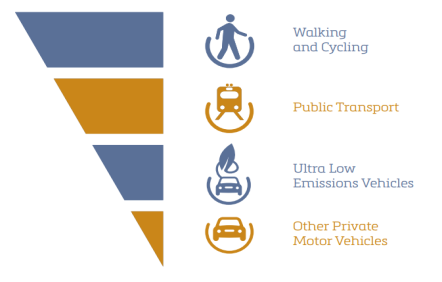
Source: Planning Policy Wales, Welsh Government
5.3.112 Shift measures encourage a mode-shift in journeys up the sustainable transport hierarchy, to use more efficient, less energy and emissions intensive modes for the majority of the journeys. This typically involves moving away from car journeys to public transport and active modes such as walking and cycling and requires investment in low-carbon, accessible, efficient and sustainable transport services and infrastructure that enables more people to walk, cycle and use public transport, and low-emission vehicles. Transport technologies are advancing significantly in recent years, with ultra-low emission vehicles (ULEVs) and plant-based fuels capable of having a transformative effect on the decarbonisation of transport. Llwybr Newydd, along with the associated transport policies and projects, have directly contributed to the spatial strategy, outcomes and policies of Future Wales 2040.
Strategic Development Plans and Local Development Plans
5.3.113 Future Wales 2040 contributes the national tier of the development plan. Strategic Development Plans cover regional and sub-regional scales and Local Development Plans consider issues at the local scale.
5.3.114 SDPs, which have not yet been prepared in any region, are required to be in conformity with Future Wales. Similarly, LDPs must be in conformity with Future Wales and the SDP for the areas they cover. Strategic and LDPs must be kept up to date to ensure they and Future Wales work together effectively. Planning decisions at every level of the planning system in Wales must be taken in accordance with the development plan as a whole.
5.3.115 The Conwy RLDP cannot address every single transport issue as it can only include policies and proposals in so far as they relate to the development and land-use. The responsibility for overseeing the wider transport system lies with Welsh Government at the national level, with Taith at the regional level and the Council at the local level. Nevertheless, the broad strategy, policies and proposals in the RLDP must be in line with the plans, programmes and strategies of these bodies as well as those of transport operators such as bus and rail companies.
- SDP (in preparation)
- North Wales Regional Transport Plan (prepared jointly)
- North Wales Energy Strategy and Action Plan
5.3.116 Ambition North Wales produced this regional energy strategy, in November 2021, with support and input from the WG, and regional stakeholders. The overall objective is to develop a strategic pathway identifying key interventions to deliver on the region’s ambitions for decarbonising its energy system, ensure the region benefits from the transition, and to set out a potential decarbonisation route that will put the region on track to achieve a net zero energy system by 2050.
- Active Travel Plan and map
- Conwy Rights of Way Improvement Plan 2019-2029
- Local Area Energy Plan (LAEP) and related interventions.
- Green Infrastructure Assessment (GIA)
5.3.117 Key transport issues for Conwy:
- The urgent need to support infrastructure, technology and skills which prioritise de-carbonising the motorised transport sector;
- The ability of the strategic trunk road and rail corridors to provide the necessary direct connectivity, for people and freight, within Conwy and North Wales, to the ports and to the wider network to support the economy, jobs, tourism and sustainable places;
- The lack of resilience of the road and rail networks to planned and unplanned events including extreme weather especially flood risk;
- Opportunity to promote and expand safe Active Travel routes whilst integrating Green Infrastructure throughout the Plan area;
- The lack of viable and affordable alternatives to the car to access key employment sites and other services; and
- The need for good transport links to/from the trunk road network into rural areas to help retain the viability of local businesses and to support the Welsh language, education and health facilities, retail and culture.
5.3.118 Conwy shares key through-routes including the North Wales coast railway line which links Holyhead to Chester almost entirely alongside the A55 European trunk road through its section in Conwy. National Cycle Route 5 similarly follows the coast west to east linking Holyhead and Chester. Inland the A470 and A5 provide key road links and the Conwy Valley railway links Llandudno Junction to Llanrwst and beyond, out of the Plan area, to Betws-y-Coed and Blaenau Ffestiniog.
5.3.119 As such the key concentration of facilities and services are along these routes and new development should be located as close to these existing routes as possible. However, there is a need to improve Active Travel routes to reduce the use of motorised travel especially single-person trips. COVID-19 (C-19) highlighted several issues regarding how we work and shop, along with seeing an increase in active travel and the overall need for it to contribute to health, wellbeing and environmental benefit.
5.3.120 With the Active Travel (Wales) Act 2013, the Welsh Government have set Wales on a path to help transform the country into an ‘active travel nation’. We face major challenges in securing our nation’s physical and mental well-being, now, and that of future generations. The Act aims to make active travel the most attractive option for most shorter journeys. Its purpose is to enable more people to undertake active travel, meaning more people can enjoy the benefits of active travel. WG want to encourage people to leave their cars behind and use active travel options where it is suitable for them to do so. The C-19 pandemic has also shown that commuting patterns have changed and that more people can and will be working from home. Increasing levels of walking and cycling offers a very straightforward way of achieving multiple benefits to people of Conwy and its visitors. In many instances active travel needs prioritising over motorised options, especially carbon-based travel.
5.3.121 New development is required to address the transport implications that arise from the development. Larger schemes may be required to prepare Transport Assessments to illustrate how the amount of trips generated will be accommodated and how accessibility to and from the site by all modes of transport will be achieved. For non-residential proposals which are likely to have significant transport implications, the Government also requires the submission of travel plans; the purpose of which is to promote more sustainable forms of transport in relation to the activities of a particular development (for example, encouraging reductions in car usage and increased use of public transport, walking and cycling through Green Infrastructure).
5.3.122 The detailed specification and impact of transport carbon reduction measures will vary between individual developments. Additionally, the impact of the interventions on the transport mode share and mileage cannot be forecast in detail at an early stage. This will depend on the behavioural choices made by the residents, employees, employers and visitors associated with the development and on whether similar measures are implemented across the town and local travel region. New development should actively aim to achieve a shift away from private car use to more sustainable transport modes for the majority of journeys. Development will be expected to demonstrate low or zero-carbon, accessible, efficient and sustainable transport services, active travel infrastructure linked to public transport hubs, and low-emissions vehicle charging facilities.
5.3.123 Further information is provided in BP65: Achieving Net Zero in Buildings.
5.3.124 Maximisation of the benefits to society alongside carbon sequestration can be evaluated using the Natural Capital and Ecosystem Services approach.
STA/1 sustainable transport, accessibility and decarbonisation
- The LPA will support development proposals which minimise the need to travel by private car, and maximise opportunities for walking, cycling and public transport in line with policies STA/6 and STA/7. Proposals should create places and streets where traffic and other activities are integrated and where buildings, spaces and inclusivity shapes design, incorporating the 20-minute neighbourhood principles in line with the Placemaking Policy Framework.
- Major developments must show how they applied the Sustainable Transport Hierarchy through the preparation of a Transport Plan for the development which should promote in order of priority:
- High quality, accessible walking, cycling, scooting routes both within the development and connectivity with key destinations outside the development such as health centres, schools, areas of retail and employment and other Active Travel routes in line with policy STA/6;
- Good quality public (or shared) transport network within new development through the provision of clear, safe, direct and attractive active travel routes to bus stops in the development and adjustments to public transport services to serve the development in line with policy STA/4, STA//6 and STA/7;
- Creation of focal points for transport and other services (mobility hubs), connecting people to multiple modes of public or shared transport as well as acting as consolidated delivery points for parcels or freight where appropriate in line with STA/5;
- Creation of a low traffic environment (with low speeds and limited traffic movement) to achieve mode switch away from private car use.
- Demand management of private car or road vehicles by limiting car parking spaces generally and creating priority parking for car club vehicles and multi occupancy vehicles at employment sites, and;
- Provision of appropriate charging infrastructure to support EV uptake in line with STA/2 alongside supporting the roll out of EV car clubs to provide affordable access to EVs when required.
- High quality, accessible walking, cycling, scooting routes both within the development and connectivity with key destinations outside the development such as health centres, schools, areas of retail and employment and other Active Travel routes in line with policy STA/6;
- All new major transport development to undertake an appraisal to ensure high quality broadband connection and provide digital hubs to reduce commuting and to access other activities/opportunities online. All major development should be supported by behaviour change plan providing people with incentive and encouragement through, for example, the use of smartphone apps to incentivise particular forms of travel behaviour with digital rewards.
- New major development will be required to calculate embodied and operational carbon emissions associated with transport development and demonstrate how these have been minimised. These will be included in a Carbon Reduction Statement accompanying a planning application in accordance with policy EN/6.
5.3.125 The LPA will seek to improve accessibility and promote a change in travel behaviour working with developers and service providers; including infrastructure and health. To address health inequalities and ensure that all communities benefit from sustainable transport, particular attention will be given to improving active travel infrastructure in deprived and underserved areas. It will also support new infrastructure where it helps to achieve net zero carbon and complies with other policies on the plan. This will be achieved by working to ensure development contributes to the 80% reduction in surface transport emissions needed by 2030, as part of a pathway to net zero by 2050.
5.3.126 The LPA will safeguard land and Active Travel routes to promote accessible communities that encourage integrated sustainable modes of travel in line with policies STA/6 active travel and green infrastructure, STA/7 improvements to public transport interchanges and facilities, and policy STA/4. The LPA will further promote sustainable modes and support improvements to public transport services.
5.3.127 Improvements to rail and bus stations will be sought to assist as interchanges between modes and promote sustainable travel behaviour especially with the North Wales Metro linking to local services. Development shall contribute towards improvements where need is required in line with the policies PL/1 to PL/25. Improvement routes identified in the Regional Transport and Active Travel Map for Conwy shall be safeguarded and enhanced as well as local routes identified in the GIA.
5.3.128 This placemaking policies emphasise that efficiency, connectivity, diversity and inclusiveness of transport links are critical components in the creation of a successful place and an efficient transport network is critical to support economic growth. The ‘transport network’ refers to the links and services that help people move across the County, including the highway, public transport, pedestrian and cycle routes, PROWs including bridleway routes.
5.3.129 Good accessibility means that communities can access their needs (for example, shopping, education, recreation and employment) easily and without the need for a car. Single car-person journeys in a non ULEVs are to be discouraged. Accessibility can be improved by locating development in appropriate locations and by improving public transport, walking and cycling facilities and services. The development needs of the community will be met by locating the majority of development in the accessible locations, predominantly along the A55 and Rail Network corridor where there are key links to regular transport. Providing good accessibility can change travel behaviour towards more sustainable modes, however, travel-planning, education and demand management are essential elements of the overall transport strategy. Improving accessibility and reducing car dependence helps to improve equality, health, reduce congestion and responds to the challenges of climate change and environmental sustainability. To improve the offer of sustainable modes of travel, health of the community and the environment, the Council will support, in principle, future interchange facilities and local distribution centres.
5.3.130 For relatively short journeys walking and cycling are both highly desirable means of sustainable transport which also support a healthy lifestyle. Census data (2021) shows 58% of Conwy residents who are economically active use their car to travel to work and whilst 8% of residents walk to their place of work, only 1.1% cycle.
5.3.131 Unfortunately, walking and cycling to some areas will be obstructed because major roads and roundabouts act as barriers to pedestrians and cyclists. Walking is part of almost every trip, and people are less likely to walk to a local shop or bus stop if the pedestrian environment is poor or appears threatening. Some roads, streets and junctions have been designed as such that walking and cycling have become subordinate to the free flow of traffic. Improvements to walking and cycling options and their safety will be targeted within all settlements, primarily where access to employment and retail is required, in Llandudno, Llandudno Junction, Colwyn Bay and Abergele and for leisure and tourism purposes throughout the plan area. Examples would be the implementation of the Wales Coastal Path Improvement Programme and the Conwy Rights of Way Improvement Plan.All new major developments will need to provide quality walking and cycling facilities and contribute towards sustainable GI improvements in the surrounding community as appropriate.
5.3.132 Walking and cycling are particularly important in centres where there are many people shopping, working, living and playing in close proximity. These centres can accommodate very large numbers of walkers and cyclists without the congestion, noise and pollution problems that can be created by a relatively small number of motor vehicles. To encourage the use of sustainable modes of transport, contributions towards improvements in health and protection of the environment will be sought.
5.3.133 The RLDP, therefore, seeks to make significant improvements to sustainable transport to improve walking and cycling options and their safety and to improve links to other sustainable modes of transport in the Plan Area and beyond. To achieve this, the Council will work with partners to secure developer contributions and seek funding for improvements to cycling and walking, where required. The completion of the National Cycle Route 5 at Llandudno is also being progressed.
5.3.134 In accordance with the Wales Transport Act 2006, the Taith consortium, which is a partnership of Local Authorities with transport responsibilities in North Wales, are required by the Welsh Government to produce a Regional Transport Plan (RTP). The RTP is a strategy for identifying and delivering improvements to our transport system over the next 25 years. The North Wales RTP has been produced and became operational in April 2010.
20-minute neighbourhoods and low traffic environments
5.3.135 20-minute neighbourhoods are areas that provide most of residents’ daily needs within a 20-minute walk or cycle ride. Key features include local shopping and health facilities, education, green spaces, affordable and diverse housing, safe streets, active travel and public transport, and employment. The concept has gained momentum as an important component of a green recovery from COVID 19, recognised by bodies such as the Town and Country Planning Association, Sustrans and the Royal Town Planning Institute.
5.3.136 Creating 20-minute neighbourhoods and low traffic environments includes:
- Ensuring that new development is a low traffic environment (with low speeds and limited traffic movement) would support the measures to achieve mode switch away from car use. It would also bring wider benefits including ensuring that core areas of space in the development are not allocated to prioritise traffic and parking, bringing the potential for other uses such a green space or active travel routes.
5.3.137 Measures contributing to a low traffic environment would include:
- Prioritising walking and cycling on routes within the development so that they are designed to feel primarily pedestrian. Speed limits, design and restrictions would mean that road traffic access to buildings would only be allowed at very low speed;
- Locating parking away from housing and buildings, with allowance for low speed drop offs/access as required for accessibility needs; and
- Selling parking spaces separately to housing and commercial space so that it is not the default to have parking space. Charges for parking could include and up front purchase cost and ongoing annual fee, with the potential to buy permits for visitor parking.
Electric, ultra-low and zero emission vehicles
5.3.138 It is essential that charge-points for electric vehicles are integrated within new developments from the design stage. This ensures that charge-points are conveniently placed and is less expensive and disruptive than installing charge-points at a later date. A high-quality network of charge-points at home and places where people regularly park is essential to unlocking electric vehicle (EV) uptake.
5.3.139 From 1 April 2019, permitted development rights came into force in Wales to allow the installation of off-street charging infrastructure, with some exceptional criteria. On-street infrastructure can also be installed by local authorities without requiring planning permission.
Targets
5.3.140 The targets for new development have been set based on CCBC’s target to achieve Net Zero Carbon and the rapid changes in the transport sector needed to decarbonise it sufficiently to contribute to meeting that target. Measures to reduce transport carbon emissions can be considered in terms of three categories:
- Avoid (reduction in energy demand) – reduce transport demand by reducing the number and/or length of trips;
- Shift (reduction in energy consumption) – cause-demand to shift from less to more energy and emissions efficient transport modes (i.e. primarily from private car to public transport or walking/cycling or road freight to rail); and
- Improve/Fuel (reduction in energy consumption) – improve the efficiency/emissions performance of the remaining fleet through efficiency improvements and/or changing energy source (electrification).
5.3.141 To achieve the Net Zero target and manage demands on the energy network, measures for new development will need to reduce vehicle travel (to address congestion and energy demand) and ensure that remaining trips are undertaken by zero tail-pipe emissions vehicles (to address carbon and also local air pollution).
5.3.142 Relevant measures to support the change include:
- Rapid development of charging/fuelling infrastructure.
- Accelerating uptake in vehicle fleets.
- The future transport system is likely to require up to 110 rapid and 1,630 fast chargers by 2025, and up to 150 rapid and 2,000 fast chargers by 2030.
STA/2 ultra-low and zero emission vehicles and infrastructure
- All new major non-residential and major housing developments should undertake an appraisal of the anticipated future EV infrastructure needs to inform a planning application informed through the Energy Strategy. This appraisal needs to consider the number and type of appropriate charging points at both individual building level and the wider development and the site impact of such measures on the local electricity grid. A minimum of 10% of parking spaces should have EV charging facilities.
- The LPA will support the provision of infrastructure for ZEVs/ULEVs where proposals comply with other RLDP policies and the LAEP. Adequate infrastructure must be provided for development.
- Development will be required to provide appropriate number of charging points with parking spaces, including a mix of slow and rapid charger or ultra-rapid chargers (the latter to support car club vehicles in particular) that serve all relevant vehicle types.
- Where possible charging provision should integrate chargers with local renewable electricity generation in line with policy EN/4 and EN/8 and ensure maximum advantage is taken of the potential of the batteries to provide storage.
5.3.143 The cost of retrofitting EV charging points is higher than installing during initial construction, so there is an opportunity cost if charging points are not installed.
5.3.144 Through this plan the LAEP will, where possible, identify sites for battery storage and hydrogen refuelling stations and undertake assessment of where public EV chargepoints would best be located, and what type of chargepoints would be most appropriate (e.g. slow vs rapid chargers). In general, the suitability of chargepoint types depend on where they are located, and what activities the surrounding area supports (e.g. shopping centres may be more suited to slower chargepoint infrastructure that those located in short-stay carparks, since the ‘residence time’ of the vehicle owners is likely to be longer). These assessments should consider not just EV charging facilities on Council-owned assets (e.g. Council-owned car parks), but also on other principal locations, especially those under public sector ownership (e.g. rail stations, hospitals, and education facilities). Engagement with potential strategic partners should be encouraged, in order to realise the potential opportunities for EV charging infrastructure.
5.3.145 Active provision is defined as an actual, ready-to-use socket, connected to the electrical supply system. Passive provision is defined as the network of cables and power supply necessary so that at a future date a socket can be added easily
Mitigating travel impact
5.3.146 It is important that all development mitigates its transport and environmental impact. 'Major development' proposals or development proposals with 'significant transport implications', as set out in TAN18, will be required to produce a Transport Assessment and a Travel Plan. A Transport Statement should be submitted alongside all other development proposals to enable the applicant to demonstrate to the Council that they have properly considered the transport impact of the proposal and taken into account how to mitigate them. The level of detail of the Transport Statement will vary according to the scale and complexity of the application in line with national guidance.
5.3.147 A primary planning consideration is to ensure that development proposals achieve a suitable connection to the highway and active travel network that is safe for pedestrians, cyclists, drivers and other road users. Equally important is the need to ensure that road safety is not jeopardised by allowing proposals which would generate levels of traffic beyond the capacity of the surrounding road network.
STA/3 mitigating travel impact
- New developments will be required to address and mitigate for the negative effects of travel such as carbon emissions (in line with EN/6), noise, impact on amenity, including Active Travel route connection, wellbeing and environmental impacts in line with policies NE/7, NE/8 and STA/6. This will either be on site or by off-site works or contributions to ensure that essential work is carried out.
- Where a proposed development is likely to have significant transport, social or environmental implications, the Council will require developers to submit a Transport Assessment, Travel Plan and/or Active Travel Route Audit with a planning application in line with national guidance. A Road Safety Audit and Construction Method Statement may also be required.
- Where the proposed development is considered by the LPA to have significant transport network implications on a wider area, financial contributions and/or offsite works will be required towards improvements in transport infrastructure, in particular to support public transport, Active Travel and Green Infrastructure, in accordance with the Sustainable Placemaking policies.
- The LPA may also require developers to submit a Transport Statement for other development proposals where there is need to understand the traffic impact of the proposal.
- A Carbon Management Statement covering the construction process, any transport infrastructure and associated buildings will be required in line with policy STA/1, EN/1 and EN/6. The process will allow the elements that generate the most carbon emissions to be identified, allowing the designer to focus attention on areas where greater carbon mitigation interventions are possible.
5.3.148 It is important that all development mitigates its transport impact. 'Major development' proposals or development proposals with 'significant transport implications', as set out in TAN18, will be required to produce a Transport Assessment and a Travel Plan (as set out in Policy STA/1). A Transport Statement should be submitted alongside all other development proposals to enable the applicant to demonstrate to the Council that they have properly considered the transport impact of the proposal and taken into account how to mitigate them. The level of detail of the Transport Statement will vary according to the scale and complexity of the application in line with national guidance and RLDP policy.
5.3.149 A primary planning consideration is to ensure that development proposals achieve a suitable connection to the highway that is safe for pedestrians, cyclists, occupants of vehicles and other road users. Equally important is the need to ensure that road safety is not jeopardised by allowing proposals which would generate levels of traffic beyond the capacity of the surrounding road network.
Transport routes and schemes
5.3.150 The availability and use of public transport is a very important element in determining planning policies designed to reduce the need for travel by car. To this end, national policy requires local planning authorities to explore the potential, and identify any proposals, for improving public transport by rail, including the re-opening of rail lines. Such routes could also provide walking and cycle routes as an interim measure prior to the introduction of rail services.
5.3.151 Great care must be taken to minimise the adverse impacts of new or improved transport infrastructure on the natural, historic and built environment and on local communities, including on public health resulting from community severance and airborne pollution. Green infrastructure measures to mitigate negative effects and enhance environmental quality and connectivity should be considered at an early stage.
STA/4 transport routes and schemes
- Development must be supported by appropriate infrastructure, public transport links and related facilities, digital service and other requirements considered necessary as part of the proposal. Proposals will be required to satisfactorily demonstrate that:
- Existing provision is safeguarded and capacity is sufficient to support the proposed development; or
- Where there is a deficiency in provision or capacity directly related to the proposal, new or improved infrastructure, facilities or other measures will be required to support the development.
- Routes and schemes will be required to be accessible and meet the relevant policy and regulatory standards on equality, access, human rights and the Welsh language, and aim to remove the physical, attitudinal, environmental, systemic, linguistic and economic barriers that prevent people from using sustainable transport services and infrastructure.
- Where necessary, planning obligations will be sought to ensure that the negative adverse impacts of developments are fully addressed in order to make the development acceptable, which will include addressing any identified deficiencies in provision and/or capacity directly related to the proposal. A range of infrastructure may be required, having regard to the nature, scale, location and financial viability of the proposed development. The delivery of new and/or improved infrastructure, or other appropriate measures, must be undertaken in a timely and coordinated manner to meet the needs of existing and planned communities prior to, or from the commencement of, the relevant phases of development (whichever is considered the most appropriate).
- The LPA will support a mode-shift to walking/wheeling, cycling and other forms of micro-mobility (such as e-bikes) which are a core requirement for decarbonising transport. The measures also improve; health, air quality, public realm improvements and GI enhancement.
- The LPA will seek to achieve an improvement and progress in reduction of embodied carbon emissions over time to achieve 100% reduction by 2050 for all new transport infrastructure. Transport schemes will be required to calculate energy and carbon reduction in line with EN/1 and EN/6. Any residual emissions will need to be offset in line with policy EN/7.
5.3.152 The LPA will prepare a Carbon Offsetting Strategy and fund as a mechanism to provide flexibility for off-site mitigation.
5.3.153 The switch to active modes is likely to most effective where there is a high quality, integrated network that directly serves key desire lines for travel, for instance; linking residential areas to destinations including high streets and local centres, employment centres and healthcare. Public transport hubs are another important destination, helping to encourage mode shift on longer journeys where walking or cycling can be used for the first and last leg to and from the public transport network.
5.3.154 To be attractive the walking and cycling network should follow good practice design standards and be well maintained. It is typically considered that cycle routes should be segregated where possible. In some cases, this could be achieved through removing on street parking (linking to demand management measures, described further below). Elsewhere, it may require wholly new high-quality cycle lanes to be built or reallocation of existing road space to active modes. Reallocation of space requires careful design to ensure that it does not result in increased carbon emissions from traffic due to additional congestion.
5.3.155 Where segregation is not possible, reduction in speed limits and traffic calming measures help to provide a suitable and safe environment for cycling or scooting and have the benefit of requiring limited construction (and associated cost and embodied carbon).
5.3.156 Provision of priority and good quality facilities at junction and crossings for pedestrians and cyclists are another important component of a high-quality network, along with clear signage and wayfinding.
5.3.157 Further improvements, to link to, or expand upon the above bus priority infrastructure measures will be required where these are necessary to provide sustainable travel options and address the impacts of any new development.
Freight and waste consolidation hubs
5.3.158 The RLDP is required to identify and, where appropriate, protect routes required for the sustainable movement of freight and protect existing transport infrastructure from encroachment from other types of development.
5.3.159 Freight and waste consolidation hubs work by collecting goods headed for an urban destination into a single hub and consolidating the deliveries into a smaller number of larger loads in order to relieve congestion and air quality impacts that result from many smaller HGV trips. It also reduces the number of empty or partially empty freight containers on the network.
5.3.160 These consolidation solutions are often used in the construction industry and work by sharing the benefits of a ‘last mile’ solution between different freight and waste companies and/or materials providers. The vehicles which go between the consolidation hubs and any urban/end destination are ULEVs which further reduces the air quality impact.
STA/5 freight and waste consolidation hubs
- The council support in principle development which reduces delivery trips to reduce fuel/energy consumption and emissions by encouraging use of the consolidation/delivery hubs and using alternative modes for last-leg of deliveries such as e-cargo-bikes and smaller ULEVs.
- Land alongside the railway at Llandudno Junction and Penmaenmawr is safeguarded for rail freight and designated on the proposals map. Disused railways and disused or unused rail sidings should, in collaboration with Transport for Wales and Network Rail, be safeguarded from development that would impede future use for freight or active travel.
- Road freight initiatives will be supported where they provide carbon and congestion reduction benefits. Schemes will use ULEVs and incorporate charging infrastructure in line with STA/2 as well as maximising renewable energy production and storage on or near the site.
- Green infrastructure measures to mitigate negative effects on, and enhance, environmental quality and connectivity should be considered at an early stage of any freight and storage in line with policies NE/7 and NE/8.
- New development for waste and freight consolidation will be supported in principle providing that it conforms to other policies in the LDP and material planning considerations.
- New development will be expected to be carbon neutral or phased to meet net zero carbon targets in line with policy EN/1 and EN/6.
5.3.161 For many years, the movement of freight by rail had been in decline, primarily because of competition from road transport. However, in recent years, there has been a resurgence in the use of rail nationally for the movement of freight but this has not been reflected locally. Many of the previously existing rail freight facilities in the Plan Area have been either removed or redeveloped except for the facilities that remain at Llandudno Junction and Penmaenmawr. These facilities consist of:
- sidings alongside Llandudno Junction Railway Station,
- the adjacent railfreight terminal at Llandudno Junction,
- the ballast loading facility at Penmaenmawr. The railfreight terminal is currently unused, and part of the site has temporary planning permission for storage.
5.3.162 The LPA supports the transfer of freight from road to rail and considers there is potential for the movement of freight by rail. Opportunities to create alternative rail freight facilities in the Plan Area are almost non-existent. The North Wales Joint Transport Board (TAITH) commissioned a strategic study into the potential for rail freight in North Wales in association with the development of the Regional Transport Plan. The study concluded that there was potential at Llandudno Junction for the movement of supermarket goods by rail, and for the movement of waste by rail as part of a wider North Wales initiative. TAITH supports the retention of rail freight facilities, and the Council is mindful to safeguard all such facilities in the County, while there is the prospect of the further use of these facilities for rail freight purposes.
5.3.163 Freight consolidation hubs work by collecting goods headed for an urban destination into a single hub and consolidating the deliveries into a smaller number of larger loads or loads in ULEVs in order to relieve congestion and emissions.
5.3.164 For residential areas, delivery hubs work on a similar basis, providing a single drop off point for parcels to the area either to be picked up or delivered by electric van or e-cargo bike
Active travel and green infrastructure
5.3.165 Active travel and green infrastructure go hand-in-hand in benefiting people’s health and biodiversity whilst improving our active travel network.
5.3.166 The objective of the Active Travel (Wales) Act 2013 is to “promote and provide improved infrastructure for walking and cycling. By connecting key areas such as workplaces, schools, leisure centres, health and public services, town centres and local neighbourhoods with Active Travel routes, the Act aims to reduce reliance on the private car for everyday travel.”(The Active Travel Act (Wales) 2013).
5.3.167 The planning system has an important role to play in delivering active travel networks, reducing congestion and thereby creating liveable streets. Green infrastructure often goes hand in hand with Active Travel networks but can also provide for habitat connectivity and flood alleviation.
5.3.168 The Council seeks to improve the current Active Travel Network and exploit the County’s potential for further routes, by ensuring developments include design features, links and facilities that make it easy and safe for people to walk and cycle for everyday journeys instead of travelling by car. Encouraging ‘Active Travel’ will help to minimise car use, support the Conwy Health and Wellbeing agenda and enable the Council to fulfil its legal duty under the Active Travel (Wales) Act to develop, improve and maintain local walking and cycling networks. Standards of good practice include the Active Travel Act Design Standards and other relevant guidance that provide a steer for developers to ensure key principles of design are employed to deliver Active Travel.
STA/6 active travel and green infrastructure
- Where appropriate, development must take opportunities to enhance active travel and GI by incorporating within the site, and/or making financial contributions towards the delivery off-site, along with the following measures as appropriate:
- a GI Statement informing site layout and design; permeable, legible, direct, convenient, attractive and safe walking and cycling routes that connect the proposed development to: surrounding settlements; public transport nodes; PROW, community facilities; commercial and employment areas; tourism facilities; and leisure opportunities in line with policy NE/8;
- comprises high quality, sustainable adaptive design which makes a positive contribution to the distinctiveness of communities and provides permeable and legible networks of safe, convenient and attractive walking and cycling routes meeting the requirements and goals of the GIA;
- improves connections and extensions to the Strategic Cycle Network;
- incorporates measures to minimise vehicle speed and prioritize to pedestrians and cyclists;
- enhancement of biodiversity and habitat quality in line with policy NE/7, NE/8 and NE/9;
- provides new facilities including signing, secure cycle/e-scooter parking and, where necessary, shower and changing facilities; and
- where appropriate, includes Car-Free Zones.
- a GI Statement informing site layout and design; permeable, legible, direct, convenient, attractive and safe walking and cycling routes that connect the proposed development to: surrounding settlements; public transport nodes; PROW, community facilities; commercial and employment areas; tourism facilities; and leisure opportunities in line with policy NE/8;
- Developments must not have a significant adverse impact on PROWs or existing routes identified by the Active Travel (Wales) Act (2013’s) Conwy Integrated Network Map and should be designed to help deliver the Council’s Active Travel Plan. Contributions may be sought where offsite improvements are considered necessary as a result of the development. New routes and improvements will be supported at:
- Conwy town – River Conwy crossing improvements to existing bridge.
- Colwyn Bay – town centre GI and improved links between the town centre and seafront.
- Kinmel Bay- Parc Hanes link across the River Clwyd and disused railway bridge linking Green Avenue to Denbighshire.
- Glan Conwy to Llandudno Junction
- Conwy Valley AT scheme from Llandudno Junction to Betws-y-Coed linking to
- Dolgarrog station.
- Town Centre GI and Active Travel interventions identified in BP58.
- Conwy town – River Conwy crossing improvements to existing bridge.
5.3.169 In addition to the provision of a high-quality network, supporting measures that further encourage active mode use include:
- The provision of supporting facilities in residential and commercial areas and at cycle destinations, including cycle parking facilities, storage, changing and charging for e-bikes, including safe and secure cycle storage for each household or transport or commercial hub; and
- Bike, e-bike and e-scooter hire schemes. These provide the opportunity for single way connecting trips and the ability to cycle or scoot without the responsibility and cost of ownership, maintenance and storage.
5.3.170 The policy should be read in conjunction with RLDP policies relating to placemaking, regeneration and masterplanning to ensure that developments give priority to walking and cycling within their design and layout. High quality design will be essential to ensure walking and cycling is seen as an attractive, viable and convenient travel option. Strategic Development Areas present a particularly valuable opportunity to integrate Active Travel measures and enhance connectivity to the existing network as identified in the AT Network Map (as updated).
5.3.171 National Cycle Network Routes 5 passes through the County. Additions have been made and improvements will be supported. However, there are a number of links and improvements that the Council will seek. These are illustrated in the Appendices and include implementing new footbridges or improved AT links as listed in the policy above.
5.3.172 In addition to transit benefits the policy will also help encourage horse riding, walking and cycling for leisure, however the main aim is to ensure a County wide strategic network of connected, convenient and safe routes for commuters, not a proliferation of unconnected leisure trails.
5.3.173 The County’s segment of the All Wales Coast Path will be safeguarded from development along its route. Meaningful connections to the coast path from settlement areas and beyond will be sought to improve connectivity to the coastal landscape. Connections to other access routes, inclusive of the Cycle Network, will also be encouraged to further add to the connectivity of the Coastal Path. Proposals for additional connections to the Coast Path must ensure that there will be no detrimental impacts to the All Wales Coast Path, inclusive of character, safety and convenience. Any anticipated issues must be fully mitigated against or improvement measures undertaken in advance of any connections being developed.
5.3.174 Bridleways also contribute to connectivity within the County, not merely to facilitate horse riding, but they are enjoyed and utilised by a range of users, inclusive of walkers and cyclists. Any development must not jeopardise existing bridleways, and, as for any other existing Active Travel route, must seek to facilitate connections appropriate to the setting of the existing bridleway.
5.3.175 Development is required to comply with the Design Guidance - Active Travel (Wales) Act 2013 and incorporate Conwy’s Active Travel Existing Route Map (ERM) and Integrated Network Map (INM) into their proposed developments. In doing so, developers should recognise and consider the needs of pedestrians, cyclists and vulnerable users from scheme conception. This should be inclusive to all users, including the blind/partially sighted, mobility scooter/wheelchair/pram users, children and adults. Active Travel routes should follow natural, direct desire lines, be attractive, and encourage their use by walking and cycling as a viable option to car travel.
Improvements to public transport interchanges and facilities
5.3.176 The RLDP will promote and facilitate the provision of high quality public transport infrastructure and set out policies to increase the use of public transport. It will identify and facilitate appropriate public transport routes, measures and facilities taking into account proposals in the Local Transport Plan, which could include improved facilities for bus passengers, park and ride schemes, new rail lines (including light rail), the re-opening of rail lines, the provision of new stations and enhanced passenger services on existing lines.
5.3.177 A transport interchange allows the transfer of travel modes to either bus, rail, or in limited circumstances water based transport. Providing for convenient and efficient interchange between transport modes is vital for making sustainable travel options more attractive and practical. The policy provides for all forms of transport interchange that could help deliver the shift from the private car, including encouragement to use local rail services. It supports a stable and coherent network of bus services that are fully integrated with other modes of public transport that are reliable, affordable, flexible, easy to use, low carbon and encourage more people to use the bus rather than their cars.
5.3.178 Shifting journeys away from using single or low occupancy cars to using more efficient public transport and other shared transport is another important component in reducing transport emissions.
5.3.179 The switch to public transport is likely to be greatest where there is provision of reliable, high quality, affordable services providing connections between key locations.
5.3.180 Mobility hubs and points provide a focal point for transport options and other services, connecting communities to multiple modes of public or shared transport as well as for instance acting as consolidated delivery points for parcels or freight. They are defined by:
- Co-location of public and shared mobility modes.
- The redesign of space to reduce private car space and improve the surrounding public realm.
- Clear branding that identifies the space as a mobility hub and information and wayfinding to demonstrate the links to the wider transport network.
5.3.181 Good quality connections between services are required, both in terms of physical connections and timetable alignment for bus and rail services are also important in encouraging mode switch. The development of mobility hubs or interchanges can promote integration by providing clearly distinguished, attractive foci for public and shared transport access and connections, focussed around an existing rail or bus station or stop where possible and providing easily accessible information on travel options as well as access to other services and opportunities (such as shops, digital hubs and package delivery points).
5.3.182 Measures to improve the environment of stops and stations and on-board vehicles can also help to attract usage.
5.3.183 Demand responsive transport (DRT) services typically serve an identified route and timetable but only run if passengers pre-book and only serve those parts of the routes required. Bookings are made with a central dispatch, either online or by phone, and vehicles are often equipped with fleet telematics technology which allows the location and timings of the vehicle to be known either by the dispatcher or by the customer. DRT could work ‘backwards’ from a known shift start time, train timetable or other fixed end point, and design its route to maximise patronage. If well designed, DRT can provide an efficient and flexible service. However, some risks need to be avoided such as reduced visibility of the service (as it is no longer at set bus stops at identified times), potentially reducing viability.
5.3.184 Other shared transport modes such as car share, car clubs and demand responsive transport help to provide alternatives to private car use on routes that do not have sufficient demand to support public transport services.
5.3.185 Mode shift can also be encouraged through technology-based measures such as provision of Mobility as a Service (MaaS), made possible by increasing data availability and mobile phone technology. Well-designed MaaS frameworks integrate public and shared transport modes and provide ease of payment, ease of access to reliable information and improved integration between services. The system makes planning and paying for trips as a single journey from start to finish easier, increasing the attractiveness of the option and mode shift.
5.3.186 MaaS applications bring together information on a wide range of transport modes and services for instance in a smartphone application. They provide features such as end-to-end journey planning, multi-modal ticket purchasing and the ability to earn and spend rewards. Each system provides a unified framework for accessing shared travel alongside timetabled public transport, reducing complexity and cost, and making the options more attractive and accessible to users.
5.3.187 MaaS will combine different services to put together the whole trip from door to door, including micro-mobility service booking, taxis, and tickets for public transport.
5.3.188 MaaS usually involves either a single monthly subscription, which will then cover the cost of all of the transport booked within the month, or a ‘pay as you go’ system.
Demand management measures
5.3.189 Demand management of road vehicles plays an important role in decarbonisation through rebalancing the costs and convenience of road-based modes relative to sustainable modes. The result is to reduce the priority given to the convenience of road vehicle use over other objectives. The favouring of road vehicles has been built into transport and urban design over several decades. This long-term influence has led to the current position of high levels of road vehicle use and their dominance in urban areas, despite their widely recognised negative impacts. The wider impacts include those on air quality, noise, public realm and equality of access to facilities.
- Increasing parking charges.Decisions are not taken lightly with regards to charges. However, on a national level increases and incentives are a mechanism to:
- Reducing parking spaces available and relocating them to less central locations, freeing up areas in the centre for other uses.
- Expanding the coverage of parking charges
- Traffic calming, including 20 mph zones and low traffic neighbourhoods which reduce the time advantage of car use and deter goods vehicles.
- Road user charging/eco-levy meaning that road users pay a charge for the environmental damage each kilometre of travel causes, rather than the costs being absorbed by wider society as they are now.
- Creating freight consolidation centres.
- Efficient driving and network management may require some minor road capacity increases to alleviate congestion hotspots or to provide connections to new developments that are well designed to reduce travel distances and encourage multi-modal travel.
- Speed limit reductions in key areas.
STA/7 improvements to public transport interchanges and facilities
- The LPA promotes and will facilitate the provision, decarbonisation, and accessibility; in particular for meeting the needs of disabled people, to enhance and link public transport infrastructure and digital service. The RLDP identifies and safeguards appropriate public transport routes, measures and facilities.
- The RLDP supports improved facilities for bus passengers, park and ride schemes, new rail lines, including light rail, the provision of new stations, and enhanced passenger services on existing routes. This will include the provision of clear, accessible, safe, direct and attractive active travel routes to link hubs in the development and enhancement to public transport services to serve the development.
- Where necessary, developers will be required to provide appropriate enhancements to existing bus or rail interchange facilities, and the delivery of high quality and convenient linkages to relevant interchanges in order to attract users and reduce journeys by car.
- Mobility hubs and points should provide a focal point for transport options and other services, connecting communities to multiple modes of public or shared transport as well as acting as consolidated delivery points for parcels or freight.
- The LPA will seek to ensure all public transport services purchased for new development have the potential to produce zero tail-pipe emissions (electric or hydrogen).
- A Green Infrastructure Statement should support a development proposal and outline biodiversity and green infrastructure enhancement, including through the provision of for example; SuDS, green roofs and substrate use which will be expected for all transport interchange schemes in accordance with policy NE/7, EQ/2 and EQ/4.
5.3.190 The LPA will support and promote a stable and coherent network of bus services that are fully integrated with other modes of public transport that are reliable, affordable, flexible, accessible, easy to use, low carbon and encourage more people to use public transport rather than private cars.
5.3.191 The development of mobility hubs or interchanges can promote integration by providing clearly distinguished, attractive foci for public and shared transport access and connections, focussed around an existing rail or bus station or stop where possible and providing easily accessible information on travel options as well as access to other services and opportunities (such as shops, digital hubs and package delivery points).
5.3.192 Mobilityhubs and points should provide:
- Co-location of public and shared mobility modes.
- The redesign of space to reduce private car space and improve the surrounding public realm.
- Clear branding that identifies the space as a mobility hub and information and wayfinding to demonstrate the links to the wider transport network.
STA/8 parking standards
- Proposals must be served by appropriate provision, in accordance with the revised Parking Standards SPG and national guidance, and consider the requirements for cycles, cars, ZEV and ULEVs, e-scooters, motorcycles and service vehicles. In those instances where sufficient parking cannot be provided on site, or is judged not to be appropriate, the developer will be required to provide a financial contribution and/or improvement towards alternative transport measures and facilities where appropriate.
- On employment sites, demand management of road vehicles should be controlled by limiting car parking spaces generally and creating priority parking for shared/multi occupancy vehicles and ULEVs.
- The provision of secure and carefully sited cycle parking and associated facilities will be sought in all appropriate development schemes, inclusive of residential, business and retail in addition to any proposed transport interchanges. Proposals should include cycle parking facilities including storage, changing and charging for e-bikes, including safe and secure cycle storage. In larger schemes bike, e-bike and e-scooter hire schemes should be established. These provide the opportunity for single way connecting trips and the ability to cycle or e-scoot without the responsibility and cost of ownership, maintenance and storage.
- Proposals on car parks that would reduce parking provision will not be permitted where the loss of the parking facility would:
- Compromise highway safety;
- Adversely affect accessibility and/or the free flow of traffic; or
- Significantly reduce parking provision for residents, businesses or visitors in the absence of any appropriate alternative parking opportunities.
- Compromise highway safety;
- New car parking areas should include infrastructure for ULEV charging points including a mix of slow and rapid chargers (the latter to support car club vehicles in particular) that serve all relevant vehicle types in line with policy STA/2. Where possible chargers should be integrated with local renewable electricity generation and ensure maximum advantage is taken of the potential of energy storage in line with policy EN/4 and EN/8.
- Biodiversity and Green Infrastructure enhancement, including through the provision of SuDS will be expected to be incorporated in all parking schemes in accordance with policy NE/7, EQ/2 and EQ/4.
5.3.193 The availability of car parking can have a significant effect on people's choice of transport. Accordingly, Government policy seeks to restrict levels of parking associated with new development in order to reduce the use of the private car and promote more sustainable modes of transport. Car parking can also occupy a great deal of space and, therefore, impacts upon the appearance of development and the efficient use of land. TAN18 section 4 states ‘controls of parking, charging and limits on provision or time may be appropriate when they complement land use policies, contribute to the reduction in congestion and safeguard amenity’. The purpose of this policy and SPG is to manage demand for certain types of parking, in order to promote the environmental, social and economic goals of the plan. Where opportunities arise, for example on mixed use sites, shared-use parking and car-pooling will be encouraged to minimise provision. The LPA will review its parking standards in light of and updates to the Regional Transport Plan.
Public Rights of Way and recreational routes
5.3.194 The Council is committed to its statutory duty to protect the County’s PROW network for public access and recreational purposes. Furthermore many PROWs are historic features in their own right and are part of the Green Infrastructure network supporting many ecosystems through habitat connectivity. The grant of planning permission does not provide consent to alter a PROW. It must be diverted or stopped-up by order and a separate application must be made to the Council for any alteration. A diversion order must be confirmed before the development takes place. Where necessary, planning conditions will be used to ensure that development does not commence before arrangements have been made to provide an adequate alternative route. If diversion of a PROW is necessary to allow development to take place, an alternative route must be identified and incorporated into the planning application.
5.3.195 In addition to statutory responsibilities for the PROW network, the policy seeks to facilitate new or improved off road public access routes. Any development that would unacceptably obstruct and/or adversely affect the enjoyment of an existing or proposed new route will be resisted, unless an acceptable alternative route is confirmed and agreed in advance of development taking place. This is in accordance with the Council’s Countryside Access Plan. It also supports aims to promote recreational access to urban greenspace and the countryside.
Retail and town centre first strategy
Strategic objective3 (SO3) retail and commercial centres: achieve vibrant, attractive and viable town and commercial centres in Conwy by redefining their role and by encouraging a diversity of activities and uses.
5.3.196 PPW states that LPAs should develop a clear strategy and policies for retail development through their development plans, which seek to achieve vibrant, attractive and viable retail and commercial centres. They should set out a framework for the future of retail and commercial centres in their area which promotes a successful retailing sector supporting existing communities. The guidance outlines the following objectives for retail and commercial centres:
- Promote viable urban and rural retail and commercial centres as the most sustainable locations to live, work, shop, socialise and conduct business;
- Sustain and enhance retail and commercial centres’ vibrancy, viability and attractiveness; and
- Improve access to, and within, retail and commercial centres by all modes of transport, especially walking, cycling and public transport.
5.3.197 Retail A1 (shop) uses should continue to underpin retail and commercial centres, but local policies should encourage a diversity of uses in centres, including financial and professional services (A2), food and drink (A3), offices (B1), hotels (C1), educational and other non-residential establishments (D1), leisure (D2) and certain other sui generis uses such as launderettes and theatres. Mixed use development should be encouraged. Leisure and social facilities are also appropriate if neighbouring amenity is appropriately safeguarded.
RTC/1 retail and town centre first
Retail and commercial centres in the Conwy RLDP area are hubs of social and economic activity and the focal point for a diverse range of facilities and services which support the needs of local communities. This will be encouraged and protected by:
- Establishing a hierarchy for retail centres, which will guide the location of new retail development, policy RTC/2.
- Designating Primary Shopping Area and Shopping Zone boundaries in larger retail centres, policies RTC/3 and RTC/4 to protect their retail health.
- Safeguarding the specific retail function at Parc Llandudno and Mostyn Champneys Retail Parks and the leisure function of Llandudno Junction Leisure Park, policy RTC/5 to protect the town centres.
- Encouraging high quality shopping street frontages and shop front security, policy RTC/6.
- Providing criteria based policies for new retail proposals outside the retail centres and for changes of use in town centres, policy RTC/7.
5.3.198 Retail centres are social and economic hubs of activity. They contain a wide range of services and uses, including shopping, leisure, employment, education, civic identity and opportunities for social interaction. These support both the needs of the local community, and in the case of the larger centres, the wider community too. Consideration should also be given to the use of social spaces to facilitate and promote the use of Welsh in line with the Council’s Welsh language strategy.
5.3.199 PPW requires LPAs to establish a retail and commercial centre hierarchy. The retail centres in the Conwy RLDP area are identified below, as informed by BP26: Retail Hierarchy. They have been categorised according to guidance in PPW and TAN4: Retail & Commercial Development based on the level of facilities and services that they provide, the catchment areas of their retail offer and the size of population that shop there.
RTC/2 retail hierarchy
- The RLDP establishes a retail hierarchy for shopping centres within Conwy RLDP area in accordance with national planning guidance. The following retail hierarchy is established and is illustrated in Figure 18 below:
Sub-Regional Shopping Centre: Llandudno
Town Centres: Abergele, Colwyn Bay, Conwy, Llanrwst
Local Centres: Craig y Don, Deganwy, Kinmel Bay, Llanfairfechan, Llandudno Junction, Old Colwyn, Penmaenmawr, Rhos on Sea, West End (Colwyn Bay)
- Proposals for retail development will be considered in accordance with this hierarchy. Llandudno, as a Sub-Regional Shopping Centre is the favoured location for new retail development, followed by the designated Town Centres and then the Local Centres. Any retail proposals outside of these centres will be assessed in accordance with policy RTC/7 and national planning guidance.
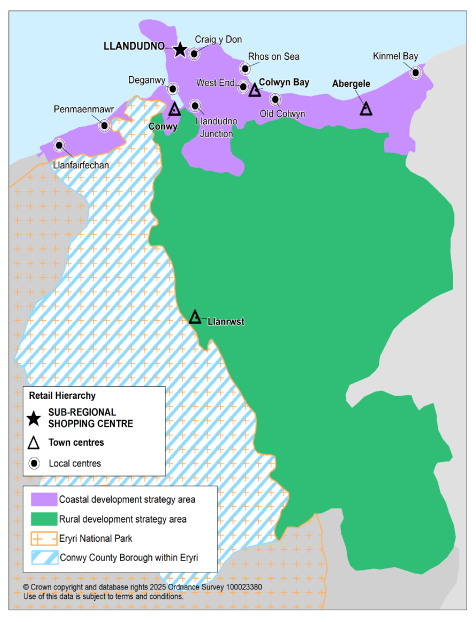
5.3.200 The identification of the hierarchy of retail centres in the RLDP is required by PPW and is important in terms of:
- ensuring the vitality and viability of town and local centres is maintained and enhanced as important hubs for the community, through the application of the impact test;
- directing retail and main town centre uses to appropriate accessible and sustainable locations, through the application of the sequential approach to site selection; and,
- identifying a viable role and strategy for each centre.
5.3.201 New development in the retail centres (including new build, redevelopment, extensions and change of use) will need to be in keeping with the scale and function of that centre, and have regard to the centre’s position in the hierarchy. Proposals for uses appropriate for a town centre, as defined in PPW, will need to adopt a sequential approach to development, giving priority to sites in the centre of the Sub-Regional and Town Centres, followed by edge-of-centre sites, out of centre and then the Local Centres.
5.3.202 Llandudno is the largest retail centre in the RLDP area and attracts a large number of shoppers and visitors, including from outside of the County Borough. The sub-regional role of Llandudno will be protected and enhanced to ensure that it remains a sustainable place to live, work and visit, through guiding new retail and other town centre uses to this locality.
5.3.203 BP61: Town Centres First Study provides a quantitative assessment of the scope for new retail and food/beverage floor space in the plan area up to 2033. The projections link with those in BP1 and adopt Experian’s latest forecasts for population growth, average expenditure per person, special forms of trading and sales density growth rates. A further consideration is the potential longer-term implications of the Covid-19 pandemic.
5.3.204 BP61 shows a comparison goods expenditure deficit is projected at all years up to 2033, which suggests an over-supply of retail floor space, resulting in negative floor space projections. Surplus expenditure up to 2033 indicates that there is capacity for additional convenience goods floor space in some locations in the plan area, but in other areas there is a projected over-supply of floor space. Overall the capacity for convenience goods floor space across the County is low at 509m2 up to 2033.
5.3.205 The floor space projections suggest, on balance, that there is no need to identify site allocations for major new retail or food/beverage uses. The existing stock of premises should accommodate most if not all future growth and only small-scale developments are envisaged. Therefore, it is considered that capacity in the existing retail centres and the flexible approach outlined in policy RTC/7 will address any retail need over the plan period.
RTC/3 Primary Shopping Area
Primary Shopping Areas are designated in Llandudno as shown on the proposal map. Changes of use of the ground floor of premises in these areas from Class A1 Shops to any other uses will only be permitted where;
- It can be demonstrated that the ground floor premises are no longer needed for Class A1 Shop use and the retention of such has been fully explored, without success, by way of marketing evidence at a reasonable and realistic market rate for a minimum of 6 months; and,
- The proposed change of use does not have an unacceptable impact on the retail function and the vitality, attractiveness and viability of the designated Primary Shopping Area.
5.3.206 Shopping not only contributes to the vitality, attractiveness and viability of town centres, but provides benefits to the local economy and can complement the leisure and tourism objectives of this plan. It is therefore vital to protect the retail core and prime shopping frontages of the main shopping centres and oppose developments which harm or undermine this function.
5.3.207 PPW encourages a mix of uses to deliver vibrant, viable and attractive retail centres, as A1 uses are only part of what secures a centre’s vibrancy.
5.3.208 Leisure and entertainment and food and drink uses can benefit retail and commercial centres. Careful regard must be paid to safeguarding amenity when contributing towards an evening economy. PPW encourages mixed use schemes, which are planned in an appropriate way. It also encourages a vibrant and viable evening economy and night-time economy, and cultural experiences and spaces, which have the potential to contribute positively towards regenerating a centre.
5.3.209 TAN4 says, the role that residential uses can play in supporting centres should also be recognised and, whilst residential use is unlikely to be appropriate at ground floor level in primary areas due to negative impacts of blank frontages, such a use on upper floors can add to a centres vibrancy and viability, increasing footfall and contributing to both the daytime and evening economies of a centre.
5.3.210 While it is necessary to protect the retail function within town centres, it is also important to consider how long term vacancy rates could be avoided or reduced. In such cases, where a change of use from A1 is requested, the applicant would need to provide evidence of marketing the premises for a 6 month period at a reasonable market rate to demonstrate that there is no longer demand for a class A1 use at that location.
5.3.211 The LPA will also need to be satisfied that the proposed new use will comply with criterion b) and balance the need for reducing the number of vacant units whilst protecting the integrity of the primary shopping area. In particular, special care must be taken to prevent the clustering of uses which may be detrimental to the attractiveness of the centre.
5.3.212 Policy RTC/3 will be subject to annual monitoring and review to prevent over-concentrations of uses which are detrimental to the centre. The overall level of vacancies and mix of uses within centres will be monitored on an annual basis to determine whether there is a need to adjust the policy criterion from 6 months to 12 months.
RTC/4 Shopping Zones
- Shopping Zones are designated on the proposals map in Llandudno, Colwyn Bay, Abergele, Conwy and Llanrwst. These are designated Town Centres in policy RTC/2.
- Changes of use of the ground floor premises in these areas from Class A1 Shops to other uses will only be permitted where the proposed change of use maintains or enhances the vitality, attractiveness and viability of the town centre and complies with the placemaking policies.
5.3.213 Within the designated Shopping Zones, there is a presumption in favour of retaining class A1 uses, but it is recognised that other uses, in particular class A3 uses (such as cafes/restaurants), commercial, leisure and service sector uses may be acceptable where this enhances the vitality, attractiveness and viability of the centres. PPW states that planning policies should encourage a diversity of appropriate uses in centres. Particular attention, therefore, should be given to avoid the clustering of certain uses where these are detrimental to the attractiveness of the centre such as blank frontages during the day time, amenity issues, etc.
5.3.214 For changes of use to A3, the LPA will need to be satisfied that the proposal will not have a detrimental effect on the attractiveness of the centre arising from an over concentration of A3 uses, and/or cause unacceptable adverse impact on residential amenity, public safety, noise and crime. Relevant evidence supplied by other Council departments and external bodies such as the Police will also be taken into account where this forms a material planning consideration.
5.3.215 BP/61: Town Centres First Study outlines centre specific recommendations, including changes to Primary Shopping Areas and Shopping Zones in order to allow more flexibility for alternative uses to reduce the high vacancy rates in some centres. Within town centres, with their good transport links, residential development can play an important role, on suitable sites, to increase the amount of people living in and supporting the town centre’s services and facilities.
RTC/5 retail and leisure parks
- The following retail and leisure parks, as identified on the proposals map, are safeguarded for their particular uses and formats:
- Mostyn Champneys Retail Park, Llandudno
- Parc Llandudno Retail Park
- Llandudno Junction Leisure Park
- Proposals at these sites, including changes of use, extensions, the merger or subdivision of existing units, mezzanine floors or variations/removal of existing planning conditions will only be permitted where:
- It can be demonstrated that there is an additional need for the proposal which cannot be provided within the existing designated Sub-Regional Shopping Centre or Town Centres, as defined in policy RTC/2;
- The proposal would not, either individually or cumulatively with the existing consented developments and/or the proposed development in other planning applications, have an unacceptable impact on the retail function and the vitality, attractiveness and viability of the town centres, the Primary Shopping Areas and Shopping Zones (where identified).
5.3.216 Champneys Retail Park and Parc Llandudno are situated on the edge of Llandudno town centre and perform different retail functions to those which are typically found within town centres. Mostyn Champneys and Parc Llandudno Retail Parks consist of predominantly large format retail stores with associated car parking. These retail parks will be safeguarded to retain their large format character and to complement the historic Primary Shopping Area and Shopping Zone of Llandudno.
5.3.217 In the case of Mostyn Champneys Retail Park, retailing is focused on the sale of bulky goods and in-bulk goods, whereas Parc Llandudno consists of large format retailers selling non-bulky goods. As stated in PPW, the scale, type and location of such retail developments should not undermine the vitality, attractiveness and viability of town centres. Also, legal agreements and planning conditions are in place to restrict the change of use and subdivision of units at these locations.
5.3.218 Llandudno Junction Leisure Park is an established leisure and entertainment facility comprising a multi-screen cinema and associated food outlets and parking. PPW highlights that these leisure uses can benefit retail and commercial centres and can contribute to a successful evening economy. The safeguarding of such mixed use leisure developments is encouraged where appropriate to promote lively centres during both the day and the evening.
RTC/6 shop front design and security
- The LPA will only allow proposals for new shop fronts or alterations to existing shop fronts where they are in keeping with both the building and its surroundings.
- Applications for installation of solid or perforated roller shutters on fronts of shops, or on other properties in shopping street frontages will not be allowed.
- The LPA will support applications for external roller grilles and removable grilles on shop fronts and commercial properties only where the grilles are integrated into the design of the shop front without adverse visual impact, and are compatible with the rest of the elevation of the building and the street scene.
5.3.219 Shop fronts are critical in forming the character and appearance of shopping frontages. The LPA attaches considerable importance to suitably designed and accessible shop fronts, not only to preserve the character of buildings, but also to retain the overall attractiveness of streets and to maintain their commercial viability. Inappropriate developments can have a severe detrimental effect not only on the building but also the street scene, and the street’s trading potential.
5.3.220 Both customers and businesses benefit if the environment of the street scene is enhanced by well-designed, accessible and well maintained shop fronts. In villages it will be important to respect the existing street and village character, while in larger shopping centres within the urban settlements and Key Service Centre, the emphasis will be on creating and maintaining a quality and vibrant environment. It should be acknowledged that many shop fronts may be listed buildings and located within designated Conservation Areas. In line with the Council’s Welsh language strategy, the use of bilingual signage should be considered, especially in the RLDP designated Welsh Linguistic Sensitive Areas, such as Llanrwst.
5.3.221 Provision should be made where possible for easy access for people with disabilities as well as prams and pushchairs. Doorways and entrances should be levelled and/or ramped and wide enough for entry. Where a building is listed, proposals will be judged on their own merit, as it may not be possible to create full level access without adversely affecting the character of the building or surviving historic fabric. Advice in relation to inclusive access is included in Part M of the Building Regulations. SPG will also be drafted to support this policy.
RTC/7 new retail development
New retail development will only be permitted outside the designated Sub-Regional, Town and Local Centres, where:
- There is a proven need for the proposed floor-space;
- The need cannot satisfactorily be accommodated within or adjacent to the designated Sub-Regional, Town and Local Centres;
- The proposal would not cause unacceptable harm to the vitality, attractiveness or viability of the Sub-Regional, Town and Local Centres; and,
- The proposal is in a sustainable location and would be readily accessible to the local community it is intended to serve by public transport, walking and cycling in line with STA policies on public transport and active travel.
5.3.222 Where no retail sites are allocated, PPW states that, to allow for flexibility, a criteria based policy should be included in development plans which proposals can be assessed against. This approach allows for any changes to retail need arising from unanticipated changes in the retail market but also protects the designated retail hierarchy (policy RTC/2).
5.3.223 Retail development applications must provide evidence of either a quantitative or qualitative need to support the proposal in the form of a Retail Needs Test, in line with national planning guidance.
5.3.224 PPW recognises that retail and commercial centres are the focal point for shopping, leisure and tourism, local services and business/employment opportunities. This ‘town centres first’ approach ensures that retail and commercial centres should be the first choice location for a wide variety of developments. The co-location of these uses and their high levels of accessibility by a range of transport options make them sustainable locations.
5.3.225 The sequential test as detailed in PPW and TAN4 aims to direct retail developments to existing centres wherever possible or to the edge of such centres if sites within the centres are not available. Only where need for additional retail floor space has been demonstrated and there are no locations in or adjacent to designated centres that could accommodate that need, should out of centre locations be considered.
5.3.226 National planning guidance also states that retail applications of 2,500 m2 or more, gross floor space proposed for edge and out-of-centre development, that satisfy the retail need and the sequential approach tests, must provide a Retail Impact Assessment provided by the developer. Proposals that introduce additional retail floor space, including redevelopment, extensions, mezzanine floors, subdivision, and changes of use may also be relevant to this policy.
Community facilities and services strategy
SO4: Contribute to a sense of place and overall health, wellbeing and amenity of local communities by ensuring that the existing and future population groups have access to a sustainable mix of community facilities.
5.3.227 Community facilities and services are key to creating viable and sustainable places and supporting the Welsh language and culture through facilitating and promoting the use of Welsh. These include schools, cultural facilities, health services, libraries, allotments, burial grounds, leisure centres, community buildings and places of worship. They can be owned by the public, private and third sector parties.
5.3.228 PPW requires development plans to take a strategic and long-term approach to the provision of community facilities, ensuring that the requirements of the community continue to be met. Population projections show that Conwy County Borough has an ageing population structure. The RLDP will support community facilities to accommodate their needs and others living locally. In addition, new house building will need to ensure that the needs of the new residents for certain community facilities are met.
CFS/1 community facilities and services
To contribute to the health, well-being and amenity of local communities, the LPA will:
- Enhance and protect community facilities and services.
- Allocate land for allotments and provide criteria-based policies to meet identified need and supporting proposals subject to set criteria in policy CFS/2 new and existing allotments.
- Allocate and support the use of appropriate land for burial grounds to meet an identified need in policy CFS/3 burial grounds.
- Allocate and safeguard land for new school sites. New community facility proposals will be supported to meet identified need subject to set criteria in policies CFS/4 new community facilities.
- Protect rural facilities from other uses in line with policy CFS/5 loss of community facilities.
5.3.229 Community facilities and services contribute to a sense of place which is important to education, health & social care, well-being, Welsh language and culture and the amenity of local communities and their existence is often a key element in creating viable and sustainable places. Access to these facilities, particularly in the rural areas, provide an opportunity to be a part of community life helping to create a sense of belonging, which contributes towards cohesive living. Supporting existing and new community facilities is a key factor in creating active, social and sustainable places. Opportunities to use Welsh in social settings within the community in which you live is extremely important and providing the supporting infrastructure for this to take place is crucial in planning terms.
CFS/2 new and existing allotments
- Land is allocated to meet identified need for allotments within the following site locations:
- Llanrhos site 91
- Old Colwyn site 68
- Llanrwst site 56
- Proposals for new allotments outside of the allocated sites or extensions to existing sites will be supported on suitable and accessible sites in communities where there is an identified need.
- Planning permission will not be granted for development which results in the loss of existing or allocated allotment sites, except:
- Where suitable, alternative provision is made in the local community that is at least equivalent in size, accessibility and quality to that which will be lost;
- Where it can be demonstrated that there is no longer a long-term community need for the allotments;
- Where there is an overriding economic, social or cultural benefit to the local community.
- Where suitable, alternative provision is made in the local community that is at least equivalent in size, accessibility and quality to that which will be lost;
5.3.230 Allotments and community growing spaces are an important community resource, which have a wide range of positive benefits. As outlined in PPW, these range from environmental, health, social to economic impacts. Community growing spaces can be a means of bringing together food producing, consumer and community groups to work together, with the overall objective of making locally grown and surplus food available to local communities. They can contribute towards a sense of place and community, can help regenerate community and open spaces, contribute towards food production, provide a habitat for wildlife and have health and wellbeing benefits.
5.3.231 Local authorities have a statutory duty to provide land for allotments to meet locally identified demand. PPW states that land should be allocated for allotments and BP30: Allotment Site Demand and Supply Report details that there are a significant number of Conwy’s residents on the waiting list for an allotment in all areas of the County Borough.
5.3.232 Further allotment sites may become available during the RLDP period. These sites will be assessed at the time for their suitability. The sites must be accessible to all, with appropriate ground conditions for allotment use.
5.3.233 The Council can take responsibility for the future management of any allotment sites, provided that there no onerous future on-costs for the Council and full, unfettered access is provided. If this cannot be agreed, the Council can assist with managing the site and finding appropriate tenants.
5.3.234 Statutory allotments have legal protection and Welsh Ministers must consent to their disposal. PPW requires allotments to be retained and protected, particularly where they are an important part of the green infrastructure or have community value.
5.3.235 Planning permission will not be granted for the redevelopment of allotments simply because they have been allowed to fall out of use and become neglected.
5.3.236 Development which would remove allotments from use altogether will only be allowed if it has been demonstrated that there is no need for the allotments, where better or same quality alternative provision is provided or where the loss provides significant economic, social or cultural benefits to the local community. This may include the provision of a satisfactory level of affordable housing, community or other leisure facilities, nature conservation/green infrastructure or other socio-economic use to the benefit of the local area.
CFS/3 burial grounds
Proposals for new burial grounds or extensions/improvements to existing burial grounds will be supported on environmentally suitable and accessible sites subject to being in accordance with the placemaking policies and national planning guidance.
5.3.237 To meet the need for burial capacity in the RLDP area, the LPA has undertaken work to identify suitable locations for either extensions to existing cemeteries, or new burial grounds.
5.3.238 Cemeteries and crematoria are both subject to strict environmental protection regulations contained within the Crematoria Act (1902) and amendments and other environmental legislation. Other guidelines should be adhered to in the planning and administration of burial facilities including the NRW guidelines.
5.3.239 Cemeteries and churchyards are identified as open space typologies in TAN 16 Sport, Recreation and Open Space and in BP28 Recreational Spaces Assessment as they can be havens of green space and tranquillity in otherwise built-up areas. Although any use for recreation must be clearly subsidiary to, and compatible with, their main function as places of burial, they are one aspect of the public realm that can provide places for walking or quiet reflection. They can also serve as a valuable habitat for trees and other flora and fauna and as part of the green infrastructure network.
5.3.240 Conwy County Borough Council has 12 cemeteries in total, 6 of which have available burial and cremation space. A newly constructed extension at Llanrhos Cemetery provides about 10 years of burial space. Meadow burial sites are also under consideration by the Council’s Environment, Roads & Facilities Service. The positive and pro-active policy approach supports the use of environmentally appropriate and accessible sites for such uses where need arises.
5.3.241 It is considered that the four-yearly major LDP reviews will enable the burial land position to be reviewed allowing for any potential significant shortfalls towards the end of the RLDP period to be addressed where required.
CFS/4 new community facilities
- Land is allocated or safeguarded as indicated on the proposals maps for the purposes of new or extended school facilities in the following locations;
- Allocation at Llanfairfechan site 157 (see policy PL/17);
- Safeguarded land adjacent to Ysgol Swn y Don, Old Colwyn.
- Allocation at Llanfairfechan site 157 (see policy PL/17);
- Proposals for the construction of new community facilities or improvements to existing ones will be supported subject to compliance with all of the following assessment criteria:
- It would be readily accessible to the local community it is intended to serve by public transport, walking and cycling in line with STA policies on public transport and active travel;
- It is within, or is directly related to a defined settlement boundary or local community;
- It would not unduly harm the amenity of nearby residential properties;
- It would not detract from the character and appearance of the area;
- It will not lead to unacceptable parking or traffic problems;
- It is designed with appropriate flexibility and adaptability to accommodate additional community uses without compromising its primary intended use.
- It would be readily accessible to the local community it is intended to serve by public transport, walking and cycling in line with STA policies on public transport and active travel;
5.3.242 Community facilities are key to creating viable and sustainable places and supporting the Welsh language and culture. Such facilities can include schools, cultural and health services, libraries, leisure centres, community buildings and places of worship.
5.3.243 The Council is currently working in partnership towards delivering the Education Service’s 9-year Strategic Outline Programme (SOP) identifying areas/projects they would like to develop as part of their Sustainable Communities for Learning Programme. This follows on from the 21st Century Schools Programme in which fixed bands of funding were secured and successfully delivered new schools.
5.3.244 The Sustainable Communities for Learning Programme is a major, long-term, and strategic capital investment programme. Its aim is to create educational communities fit for the 21st century in Wales.
5.3.245 The capacity of new schools and extensions to existing schools proposed under the SOP will reflect any new growth in school pupils caused by the RLDP. Land at the Llanfairfechan RLDP site will be allocated for a new school and land adjacent to Ysgol Swn y Don will be safeguarded for future expansion if required. Should there be any changes to the schools programme and future projects during the plan period placemaking policy PL/17 Llanfairfechan will also be relevant.
5.3.246 The potential impact on the capacity of CCBC schools caused by any change in the number of children that the RLDP Strategy and sites will result in will be monitored. Planning obligations for a new school site or an extension to an existing school will be sought from new residential development where it is considered necessary to mitigate the impact on school capacity, in-line with policy PL/12.
5.3.247 Further school sites are likely to be required during the plan period to deliver the SOP and other development of educational facilities that may come forward separately to the Sustainable Communities for Learning Programme. To ensure that these projects can be delivered, a criteria-based policy has been included in the RLDP. This policy will guide the development of school sites and ensure that they are well designed and located in the most appropriate and sustainable sites.
5.3.248 In terms of health provision in the county, Conwy County Borough is divided into two Primary Care Cluster areas: Conwy East and Conwy West. There are 20 GP surgeries in the County Borough (including branch surgeries), with 116,864 patients registered.
5.3.249 Primary and secondary health care sites will need to be able to accommodate the changing population over the RLDP period. Our population is ageing, which puts different pressures on the health & health care services. The population growth proposed in the RLDP and the potential impact on the physical capacity of primary and secondary health care sites will be assessed and where required, mitigated for, when allocating residential sites. BP44: Population Change, Housing and Health/Primary Care Impact.
5.3.250 This policy takes a positive approach for any proposals for new healthcare facilities or extensions to existing ones. Applications for new sites will need to demonstrate that they have applied the town centres first approach in line with national planning policy.
5.3.251 The proposed mitigation over the RLDP period is to seek financial contributions from certain developments and where justified, in-line with policy PL/12. This will be used to increase physical capacity space at existing health and education facilities. It should be noted here that some health facilities may be experiencing difficulties due to recruitment and/or management issues. Section 106 contributions can only be used towards physical mitigation measures and therefore addressing any staffing problems is outside the remit of the RLDP.
CFS/5 loss of community facilities
In the RDSA, the loss of neighbourhood or village shops, post offices, halls, public houses and other community facilities (or parts thereof) will only be permitted where:
- the local community would continue to be served by other equivalent facilities within the same village or neighbourhood; or
- the facility has been vacant or un-used for at least one year and genuine attempts to market the facility for an equivalent community use, for a minimum of one year, have been unsuccessful.
5.3.252 Community facilities in the rural areas are an essential part of the sustainability and well-being of local communities. Such facilities are also important if the Welsh language and culture are to survive and thrive in Welsh speaking communities and the RLDP designated Welsh Linguistic Sensitive Area (policy PL/7). A vibrant language is interlinked with a buoyant economy. In line with CCBC’s Welsh language promotion strategy required by the Welsh Language Standards, the planning authority has a duty to promote and facilitate the use of Welsh in everyday life for people living in the area. For communities to be sustainable, they need to contain or have access to a range of community facilities and services such as shops, public houses, village halls etc. This encourages people to stay living locally and spend money in their locality and build a sustainable local community. This policy seeks to protect and retain community facilities where possible and allow the creation of new facilities in appropriate and sustainable locations.
5.3.253 Community facilities are those which are of benefit and value to the local community, provide a location for social functions and meetings and benefit the local economy.
5.3.254 In relation to the marketing of community facilities, applicants will have to provide supporting evidence that the facility has been actively marketed for at least one year at a realistic price, based on an appropriate market value, which reflects the existing use.
Recreational spaces strategy
SO5: encourage physical and mental wellbeing through provision and protection of good quality, accessible green spaces and recreation space networks.
5.3.255 PPW requires planning authorities to provide a framework for well-located, good quality sport, recreational and leisure facilities. Clear policies for the provision, protection and enhancement of sport, recreation and leisure facilities should be developed, which set standards for provision, identifying local deficits, which can be met through the planning process.
5.3.256 Recreational spaces play a dual role through providing a place for play, sport, healthy physical activity and a place to relax. They are also part of the network of high quality, accessible green spaces, which play a role in nature conservation, visual amenity and biodiversity. Spending time in greenspaces is important for children, young people and adults alike, providing opportunities for play, exercise and relaxation in natural spaces. Recreational space should be regarded as all open space of public value, including not just land, but also areas of water such as rivers, lakes and reservoirs which offer important opportunities for play, sport, recreation and tourism, and can also act as a visual amenity, and may have conservation, cultural and biodiversity importance.
5.3.257 All of the benefits outlined above should also benefit the Welsh language because these spaces help make attractive and good quality places to live and work and therefore enjoy and stay. Opportunities to bring people together also provides opportunities to use Welsh and practice Welsh, as Welsh learners of the language. These also provide intergenerational opportunities for people to meet and use Welsh in everyday life which in turn helps to meet the aims of the Council’s Welsh language promotion strategy.
5.3.258 PPW states that formal and informal open spaces and playing fields should be protected from development. This applies to both privately and publicly owned land.
5.3.259 BP28: Recreational Spaces Assessment has fully assessed the quantity of formal and informal public open space provision within the RLDP area and compares this provision with the benchmark standards endorsed by Fields in Trust (FIT) guidance.
RS/1 recreational spaces
For the protection, provision and enhancement of recreational spaces in the RLDP area, the following apply:
- New residential development will be required to provide for recreational spaces in line with policy RS/2 development and recreational spaces.
- Development proposals that result in the unjustified loss of community and recreation facilities will not be permitted as outlined in policy RS/3 safeguarding existing recreational spaces.
- New proposals that provide and/or enhance, or extend recreational spaces and/or facilities will be permitted subject to detailed planning considerations in policy RS/4 new recreational spaces.
5.3.260 PPW and TAN16: Sport, Recreation & Open Space requires the RLDP to support the development of sport and recreation, and other forms of public open space. They provide a wide range of leisure pursuits, provide a place to relax and contribute towards quality of life. They encourage physical activity, which contributes towards securing a healthier Wales (goal three in the Well-being of Future Generations Act).
5.3.261 PPW requires that green infrastructure network is identified, managed and expanded in development plans. Recreational spaces are part of this infrastructure. It is important that the RLDP recognises the importance of green infrastructure in delivering local environmental, socio economic and health benefits, which are identified as key issues in the Conwy and Denbighshire Wellbeing Plan and STA policies.
5.3.262 PPW and TAN16 say that standards should be established and local deficiencies should be identified and met through the RLDP standards.
RS/2 development and recreational spaces
- New housing developments with a net gain of 5 or more dwellings shall include recreational spaces within the development site layout for the need and enjoyment of their residents in-line with the following standards for open space and a proportional ratio of 3.55 hectares per 1,000 population:
|
Typology |
Quantity guideline (hectares per 1,000 population) |
Definition |
|
Playing pitches |
1.2ha |
Sports pitches including football rugby, hockey, lacrosse, cricket and American football |
|
Other outdoor sports |
0.4ha |
Courts and greens comprising natural or artificial surfaces, including tennis courts, bowling greens, athletics tracks and other outdoor sports areas |
|
Equipped/designated play areas |
03ha |
Local Area for Play (LAP), Local Landscaped Area for Play (LLAP) and Locally Equipped Areas for Play (LEAP) aimed at children who can play independently, as well as Neighbourhood Equipped Areas of Play (NEAP) |
|
Informal play |
0.3ha |
All weather multi-use games areas (MUGA) including skateboard parks |
|
Park and gardens |
0.8ha |
Green spaces including urban parks, country parks, forest parks and formal gardens |
|
Amenity green space |
0.6ha |
Informal recreation spaces, public squares, communal green spaces in and around housing, village greens |
- In exceptional and justified circumstances, consideration will be given to the provision of a commuted sum as an alternative to on-site provision, or part thereof, in accordance with these standards for open space and the Planning Obligations SPG.
5.3.263 Residential development will be required to make provision for recreational spaces based on BP28, TAN16 and the standards recommended by the FIT guidance. Housing developments are required, in the majority of cases, to incorporate play and amenity spaces into a scheme or, where this is not feasible, make a financial contribution secured through a planning obligation made under Section 106 of the Town and Country Planning Act 1990.
5.3.264 Financial viability evidence has demonstrated that the viability of many smaller sites is challenging (BP10). This has led to thresholds being set for seeking affordable housing contributions in some circumstances (policy HS/3). Due to affordable housing taking a higher priority, the LPA would generally not seek contributions for recreational spaces from sites which are not required to contribute towards affordable housing provision. In addition, CIL pooling restrictions limit the ability of the LPA to seek and spend some S106 contributions from many small sites. For these reasons and unless material considerations suggest otherwise, financial contributions towards recreational spaces will not be sought from developments with a net gain of less than 5 dwellings.
5.3.265 On and/or off-site typology provision will be assessed based on the amount of dwellings proposed, with larger developments (200 dwellings or more) expected to provide all outdoor sport and children’s playing space on site. For smaller sites (less than 200) it may be appropriate to have a mix of on-site provision and a financial contribution to off-site recreational spaces. All developments of 5 or more dwellings are expected to provide amenity greenspace on-site. Developments of 30 or more dwellings are expected to provide children’s play on-site. Further details on provision of recreational space and commuted sums can be found within the Planning Obligations SPG and BP28: Recreational Space Assessment.
5.3.266 FIT guidance also recommends a standard of 2.0 hectares per 1,000 population for natural and semi-natural greenspace. BP28 indicates that there are sufficient levels of this typology in the RLDP area, and therefore, additional provision will not normally be required.
5.3.267 The provision of allotments, which are also a typology of recreational space in TAN16, are dealt with under RLDP policy CFS/2.
5.3.268 To secure on-site delivery or improvements to off-site recreation spaces, the LPA may use the following measures:
- Planning obligations via Section 106 Agreements;
- Community Infrastructure Levy; and/or,
- Planning conditions.
5.3.269 Financial viability will be a planning consideration and the developer will be responsible for the maintenance of any new recreational spaces in perpetuity.
RS/3 safeguarding existing recreational spaces
- Existing recreational spaces will be protected. Proposals for the development of these sites for non-recreation uses will only be permitted where the proposal demonstrates significant community benefits arising from the proposal.
- In communities where there is a demonstrated shortfall of recreational spaces, suitable, alternative provision must be made in the local community that is at least equivalent in size, accessibility, function and quality to that which will be lost.
- Proposals involving the redevelopment of a small part of existing recreational spaces only will be supported, where it enhances and retains the provision in the longer term.
5.3.270 PPW states that formal and informal open green spaces should be protected from development. Development of these sites to other uses will not be permitted, unless there is a surplus of that recreational space type in the local community. This is to protect their role in contributing towards the natural environment and health and wellbeing. Parks and gardens may have additional protection if they are an historic asset and listed.
5.3.271 Where there is an excess of provision in a local community, losses may be supported where a developer also demonstrates how the proposal will bring about significant benefits to that community such as the delivery of a satisfactory level of affordable housing, community facilities, nature conservation/green infrastructure, leisure facilities or other socio-economic benefits that may be appropriate.
5.3.272 Development of a recreational space site for other uses may also be permitted in other exceptional circumstances. For example, if alternative provision of equivalent community benefit can be provided in the same community, which is of equal quality and reflects the recommended travel times established in FiT guidance, or the development of a small part of the recreational space where it secures the future of that recreational space, and the facilities are enhanced.
5.3.273 Planning permission will not be granted for the redevelopment of recreational space simply because they have been allowed to fall out of use and become purposely neglected or fenced off from public use.
RS/4 new recreational spaces
Proposals for new, accessible and inclusive recreational spaces or extensions and/or improvement to the existing recreational spaces will be supported, subject to compliance with the Council’s standards for open space, FIT guidance and national planning guidance.
5.3.274 Multiple use of recreational space and facilities should be encouraged where appropriate, to increase their effective use. The use of disused land and routes as parks, linear parks or greenways should be considered and the provision of safe and attractive cycle routes and footpaths. This should not be to the detriment of adjoining users, wildlife or flood defences.
5.3.275 Recreational spaces should also be accessible by a range of sustainable travel options, including public transport, walking and cycling routes in compliance with STA policies on public transport and active travel.
5.3.276 In all cases, recreational spaces should have bilingual signage where the Welsh is above the English. Names for the sites must also consider the sense of place and character of the area and every opportunity must be taken to use Welsh names wherever possible and appropriate. For example, the use of Welsh names that denote the areas – e.g. the names of the farmland the development was built on, names of the mountains and rivers in Welsh, and reference to historical and heritage of the Welsh speaking sites in order to promote a unique sense of place and belonging.
5.4 Strategic theme 3: prosperous places in Conwy
Introduction
5.4.1 The prosperous places theme covers the economic components of placemaking in Conwy’s RLDP area. These components are complementary to all other themes and policies set out in the placemaking policy framework. Collectively, the four themes come together to contribute towards the national sustainable placemaking outcomes.
5.4.2 The prosperous places theme of the Conwy RLDP covers economic development, tourism, net zero planning framework and minerals and waste.
5.4.3 Prosperous places in Conwy are those which promote our economic, social, environmental and cultural well‑being by providing well‑connected employment and sustainable economic development. These places are designed and sited to promote healthy lifestyles and tackle the climate emergency in Conwy. This is done by making them: easy to walk and cycle to and around; accessible by public transport; minimising the use of non‑renewable resources; and using renewable and low carbon energy sources. Places which are prosperous contribute to the seven goals of the Well‑being of Future Generations Act which include:
5.4.4 The prosperous places theme consists of the following policies:
ED/1 economic development
ED/2 employment allocations
ED/3 new B1, B2 & B8 development on non-allocated sites.
ED/4 safeguarding B1, B2 & B8 office and industrial sites
ED/5 office and industrial employment improvement areas
ED/6 farm diversification and the expansion of businesses in the rural area
ED/7 telecommunications
ED/8 business clusters.
TO/1tourism
TO/2 new sustainable tourism and recreational attractions
TO/3 Llandudno holiday accommodation
TO/4 chalet, static and touring caravan sites
TO/5 low impact holiday accommodation
EN/1 net zero planning framework
EN/2 achieving net-zero in new development
EN/3 energy efficient buildings
EN/4 zero or low carbon energy sources and zero carbon ready technology
EN/5 unregulated carbon emissions and embodied carbon in buildings
EN/6 GHG emissions assessment for new development
EN/7 carbon offsetting and sequestration
EN/8 grid connection and energy storage
EN/9 local energy generation and local area energy plan (LAEP)
EN/10 smart grid and district heating and cooling networks
EN/11 onshore wind and solar development district heating and cooling networks
EN/12 onshore infrastructure linked to offshore renewables.
MW/1 minerals and waste
MW/2 extraction of minerals
MW/3 safeguarding hard rock and sand and gravel resources
MW/4 quarry buffer zones
MW/5 proposals for waste management
MW/6 use of industrial land for waste management facilities
MW/7 landfill buffer zone
Economic development strategy
SO7: support long-term economic prosperity, diversification and regeneration, by taking advantage of Conwy’s strategic position within the wider regional context and by promoting a holistic employment and housing growth strategy, which will facilitate new jobs growth of the right type in sustainable and accessible locations, support business networks and clusters, increase skills in high value employment and provide the necessary new infrastructure, which overall will enable new businesses to locate in Conwy and existing business to grow.
SO9: promote and support sustainable and vibrant rural economies by establishing new enterprise, expanding existing business and by adopting a constructive approach to agriculture and changing farming practices.
5.4.5 This chapter provides the policy framework for delivering the economic land use strategy in the RLDP area. It includes policies which translate the jobs growth levels and existing employment land supply into employment land allocations, allows for new employment development in other suitable locations, safeguards key existing employment sites and provides flexibility for the expansion and diversification of businesses in the rural area.
5.4.6 The employment structure in Conwy County Borough differs from that of Great Britain as a whole. The production base has declined considerably over the past three decades to about 4.3% of jobs by 2020, and there is a heavy skew towards employment in the service industries (particularly in the public sector) and the tourism sector. In Conwy County Borough employment in the high skills, high wage sectors of information & communication, finance & insurance, professional, scientific & technical, and business administration & support services is relatively low, totalling just 13% of all employment compared to 25% across GB as a whole.
5.4.7 The proportions of employment in the tourism related sectors of retail, accommodation & food services, and arts, entertainment & recreation are high – a total of about 32% of all jobs compared to 21% nationally. These sectors are the ones most likely to include low wage, part time or seasonal employment.
5.4.8 The 2022 STEAM figures estimates that around 9,520 jobs are provided directly by the tourism industry and a further 2,350 jobs are indirectly supported by tourism – around 11,870 jobs in total, which is almost a quarter of all employment in Conwy County Borough. Tourism brings in around £1,097 million each year to the local economy.
5.4.9 The North Wales Growth Deal will have an impact upon economic aspirations, delivery and outcomes within the region. It has five programmes; Agri-food and Tourism, Digital Connectivity, Innovation in High-Value Manufacturing, Land and Property and Low Carbon Energy and aims to bring over £1 billion of investment to North Wales to generate over 4000 new jobs and increase GVA by £2.4 billion. It is expected this will bring positive economic outcomes to Conwy, with at least one Growth Deal project planned in the County.
5.4.10 Within Future Wales, the National Plan 2040, the WG strongly supports the development of the foundational economy in the North Wales region. For clarity, the foundational economy “represents those parts of the economy which are integral to the well-being of places, communities and people and which deliver people’s everyday needs.” For Conwy, the foundational economy includes the health and social care sectors, retail, social housing, regeneration and tourism. Policies within this economic chapter have therefore been designed not only to focus on the protection of B class land, but also to address the needs of the foundational economy facilitating the creation of jobs in traditionally non-B class sectors while striking a balance to protect B class land. It should be noted that other sections within this RLDP focus specifically on tourism and retail and should also be referred to when considering matters of land-use planning.
5.4.11 Looking to the evidence base, the Conwy Employment Land Review has considered the current and predicted changes in the economic environment and identifies a range of between 14-20 hectares that will be needed across Conwy up-to 2033. This is based on a range of scenarios including labour force forecasts, sectoral trends and past take up rates. In line with the preferred option for growth, the scenario that reflects around 16 hectares has been selected as this takes into account the Experian jobs growth forecasts for the area and regional growth projects that will come forward up-to 2033 (see BP18: Employment Land Review.)
5.4.12 BP19: Conwy Commercial Market Analysis identified that Conwy has proportionally more office space (and less industrial) than other Councils in North Wales, and in Wales as a whole. However it is a demand for industrial premises in the County Borough that is outstripping supply due to a shortage of modern, purpose built industrial premises between 2,000ft2 and 5,000ft2. For this next Plan period, there is a need for new industrial units situated along the A55 corridor and also a better choice of office premises to enable businesses to expand without leaving the County Borough.
5.4.13 Supporting the rural economy is of paramount importance, recognising the impact that leaving the European Union and the Covid-19 pandemic may have on demand for different land uses in the countryside. In line with PPW, additional flexibility will be afforded to rural businesses where they are seeking to expand their existing operations. The sequential approach in policy ED/3 will be maintained to further encourage businesses to identify sites within sustainable locations. Recognising and supporting the Welsh language across all areas of the county, and in particular the designated sensitive areas are of significant importance in creating healthy economies while allowing the Welsh language to prosper. Policy ED/1 cross references policy PL/7 (Welsh language policy) to ensure developments promote and protect the Welsh language through conducting impact assessments and providing mitigation as needed.
5.4.14 There is recognition that development projects and growth sectors in and around Conwy County Borough will generate significant demand for particular skill sets. In the Skills Needs Assessment (Background Paper 20) it is reported that there is/will likely be a shortage of construction workers, engineers (electrical and mechanical), surveyors, project managers and ecology specialists related to projects that are planned for the North Wales Region within the next 15 years. Tourism is another area highlighted for growth within the Conwy Economic Strategy 2017-2027, the need for jobs and skills to support this sector is likely to increase. In conclusion, while there is no evidence to suggest a need to provide a separate new higher education establishment in Conwy, there is scope for greater dialogue between the higher education providers and the Council to look at opportunities for addressing skills gaps.
ED/1 economic development
Meeting the employment needs of the County in terms of land use is of significant importance and at the heart of the employment-led growth strategy in the RLDP. In order to assist with the delivery of predicted economic growth for the County, 16.4 hectares of employment land on a split of 35% B1a/b and 65% B1c/B2/B8 uses has been identified as the employment land requirement. The employment-led growth strategy will be delivered by the following:
- In addition to existing employment land supply, 12.65 ha of additional employment land has been allocated in the Coastal Strategy Development Area as identified on the proposals map (in line with policy ED/2).
- New B1 (Business), B2 (General Industrial), B8 (Storage or Distribution) or a mixture of these uses on non-allocated land will be permitted in line with a sequential approach to ensure town centre sites and previously developed land is used in preference to greenfield sites (in line with policy ED/3).
- The Council will seek to safeguard existing and allocated B class employment sites to ensure adequate supply of employment land in the right locations (in line with policy ED/4).
- Employment sites that would benefit from amenity improvements are identified within policy ED/5 and on the proposals map. Proposals for development on these sites must show that they are capable of enhancing the amenity of the employment site in which they are situated.
- The conversion of rural buildings to business use including tourism will, in principle, be permitted in line with policy PL/10.
- Supporting, in principle, farm diversification and the appropriate expansion of existing rural businesses that are situated outside of the settlement boundaries (in line with policy ED/6).
- Recognising and promoting the Welsh language when considering development proposals for employment uses (in line with policy PL/7)
- Supporting, in principle, the provision of high speed broadband infrastructure across Conwy as well as consistent telecommunications connectivity (in line with policy ED/7).
- Supporting, in principle, the development of Business Clusters in the County that are of benefit to the economy and local community (in line with policy ED/8).
5.4.15 BP18: the Conwy ELR provided a range of scenarios for economic growth up-to 2033. The second of these scenarios titled ‘Experian’ has been selected as the preferred option as per the rationale contained within Annex 1 of Background Paper 18. This concludes that Conwy would need to accommodate in the region of an additional 1,500 jobs over the RLDP period which equates to around 16 hectares of employment land for B class uses, this scenario takes into account the impact of drivers for growth such as the North Wales Growth Deal and sectoral trends. The ELR states that based on jobs in these industries coming forward and the current balance of the employment land supply, allocations and underused supply should be split 35% B1a/b office and 65% for B1c/B2/B8 Industrial and Warehousing. The Conwy Commercial Market Analysis indicates that new employment land should ideally be located along the A55 route, with current popular locations being Mochdre, Llandudno Junction, Conwy and Kinmel Bay.
5.4.16 In terms of how much land supply there is in Conwy, the results from BP17: Employment Land Supply have been summarised in figure 19 below:
Figure 19: table showing Conwy employment land supply April 2024
|
Land supply |
Amount in hectares |
|
All sources of existing employment land supply (undeveloped plots, vacant units) |
24.6 |
|
Total qualitative adjustments to subtract from supply |
(19.13) |
|
Equals total adjusted supply |
5.47 |
|
Add net completions/commitments not included above |
3.79 |
|
Total land supply April 2024 |
9.26 |
|
TOTAL LAND NEEDED IN DEPOSIT RLDP (Employment Land Review target growth figure of 16.4ha minus total supply of 9.26 ha) |
7.14 |
Source: BP17: Employment Land Supply
5.4.17 Currently there is approximately 9 hectares of employment land supply which includes vacant designated land, new permissions, and vacant units on existing business parks. This means that around 7-8 hectares of new land is needed to be allocated in the RLDP.
5.4.18 Tir Llwyd is currently safeguarded in the RLDP for employment use, however given the significant flood risk constraints the remaining undeveloped land at Tir Llwyd has not been included as supply. This does not mean however that no development will take place on Tir Llwyd, but rather individual developments will be considered on their own merits.
5.4.19 Designated and existing B1, B2, B8 employment sites (subject to criteria) will be safeguarded from other uses unless it can be demonstrated that there is no longer demand for the current use. Smarter use of existing office floorspace will be advocated where stock is no longer in demand for traditional B1 use in line with the Conwy Commercial Market Analysis (Background paper 19). While there is a need to protect B1, B2, B8 employment land where it is required, it is also recognised that other uses such as D1 clinics, A2 financial services and certain leisure and sui generis uses can have employment generating potential. Where it is deemed that a B class use is no longer needed, other uses may be acceptable subject to the town centres first principle, sequential testing where needed and the criteria in policy ED/4.
ED/2 employment allocations
12.65 hectares of land for a mixture of B1, B2 and B8 employment will be allocated in the CDSA on the following sites identified on the proposals map:
- Llanddulas Quarry (Areas 1, 2 and 3)
- Land at Bryniau, between Wormhout Way and Conwy Road, Llandudno
5.4.20 The amount of land allocated reflects the total need of 16.4ha as per the Employment Land Review, while taking into account existing supply on vacant/safeguarded sites as highlighted in the table below. It should be recognised that not all the land will come forward for development within the timeframe of the plan, hence why there is a slight over-supply when looking at the target need figure of 16.4ha. Some of the land at Llanddulas Quarry is phased towards the end of the Plan period and it is anticipated that the development of that land will extend beyond 2033. Monitoring will be undertaken annually to understand the level of take-up against the requirements in terms of overall amount and split by use-class.
5.4.21 To prevent inappropriate development on these sites, they will remain outside of the settlement boundary and will be safeguarded for the appropriate employment uses as identified within the table below:
Figure 20: employment allocations detail and phasing
|
Site number |
Site name and location |
Use class |
Phasing |
Size in hectares |
|
115 (1) |
Llanddulas Quarry Area 1 |
B1/B2/B8 |
2027-2029 |
0.8* |
|
115 (2) |
Llanddulas Quarry Area 2 |
B1/B2/B8 |
2028-2032 |
4* |
|
115 (3) |
Llanddulas Quarry Area 3 |
B1/B2/B8 |
2032 onwards |
4* |
|
103 |
Land at Bryniau between Wormhout Way and Conwy Road, Llandudno |
B1 |
2028-2033 onwards |
3.85 |
|
Total |
All sites |
B1/B2/B8 |
2027-2033 onwards |
12.65 |
Source: BP17: Employment Land Supply
*Note that the size is the developable area taking into account the development platforms / land re-profiling.
5.4.22 Changes from the above B class uses will only be permitted where the change does not impact negatively on the overall employment strategy, and as per the criteria in part 1 of policy ED/4. The Llanddulas Quarry sites (Areas 1, 2 and 3) have been selected for allocation following a comprehensive site assessment process including statutory (and non-statutory) consultation. The location of these mainly previously developed sites in the urban area, with close proximity to the A55 corridor and direct road access from the A547 has ensured good performance in terms of the principles contained within the commercial market assessment.
5.4.23 Llanddulas Quarry Area 1 is relatively steeply sloping and includes the remnants of built infrastructure that serviced the former mineral extraction operations at Llanddulas Quarry. Areas 2 and 3 comprise of former, largely unrestored, quarry voids. The former includes a series of plateaus with interconnecting ramps and the latter includes a lagoon. Whilst parts of Area 1, 2 & 3 are already suitable for a limited quantum of built development, it would be necessary to carry out comprehensive enabling works to create a development platform capable of accommodating a significant level of development within each development area. This may include dewatering of the existing lagoon within Area 3, the creation of development platforms within Areas 2 and 3, and the re-profiling of some of the land within Area 1. Further information on the development of this site can be found within the Placemaking – Strategic and Spatial Choices in Conwy section of this Plan.
5.4.24 Land at Bryniau, Llandudno - This site is located on the southern edge of Llandudno, on land that is situated to the south of Queens Road. Extending to approximately 3.85ha, the site currently comprises of grassland, hedgerows with trees along the northern, southern and eastern boundaries. The site is fully bound by existing infrastructure, namely, Conway Road (B5115) to the west and Wormhout Way (A470) to the east, with the convergence of the two roads at a roundabout to the north. Llanrhos Cemetery is directly to the south. Given its location within the Creuddyn and Conwy Registered Historic Landscape, the site lends itself to the development of B1 class office use rather than industrial uses. Further information on the development of this site can be found within the Placemaking – Strategic and Spatial Choices in Conwy section of this Plan.
ED/3 new B1, B2, B8 development on non-allocated sites
- Development of new B1 (Business), B2 (General Industrial), B8 (Storage or Distribution) or a mixture of these uses will be supported on a sequential basis on non-allocated employment sites as outlined in the Sequential Approach below and subject to the following criteria:
- The proposal is appropriate in scale and nature to its location;
- The proposed development would not have an unacceptable adverse impact on occupiers of neighbouring properties or the environment;
- The proposal is sustainably accessible.
- Applicants should demonstrate they have followed a sequential approach when submitting a planning application for new B class uses. The order of priority is as follows:
- Priority 1 – Existing employment sites and buildings including safeguarded / improvement sites, and for B1 office uses previously developed land within town and local centres should be explored first in line with a ‘town centres first’ approach.
- Priority 2 – Previously developed land within the rest of the CDSA, Key Service Centre, Tier 2 Main Villages and Minor Villages including infill sites and rounding off. (In the open countryside redevelopment of previously developed land will be considered under policy PL/10 rural conversions.
- Priority 3 – Greenfield land within the settlement boundaries of the CDSA, Key service centre and Tier 2 Main Villages including infill sites and rounding off.
- Priority 4 – Greenfield land that forms a settlement extension to the settlement boundaries in the CDSA, Key service centre and Tier 2 Main Villages.
- Priority 5 – Greenfield land within Minor Villages, including infill sites and rounding off.
- Extensions to existing rural businesses that require new buildings and land will be assessed in line with policy ED/6.
5.4.25 In addition to the existing sources of employment supply and land allocations, the planning authority will also consider office and industrial economic development proposals on non-allocated sites. Such proposals will be assessed using an approach which steers economic development to the most appropriate locations as recommended in national planning policy guidance. Figure 21 shows which types of land are priorities for new employment development:
Figure 21: table showing sequential approach for new B1 (Business), B2 (General Industrial), B8 (Storage or Distribution) or a mixture of these uses
|
Sustainability hierarchy |
CDSA |
Key Service Centre |
Rural: Tier 2 Main Villages |
Rural: Minor Villages |
|
Existing employment sites |
1 |
1 |
1 |
N/A |
|
Allocated/ designated/ safeguarded Employment sites |
1 |
1 |
N/A |
N/A |
|
Town / local Centre PDL |
1 |
1 |
1 |
N/A |
|
Other PDL |
2 |
2 |
2 |
2 |
|
Greenfield: within settlements |
3 |
3 |
3 |
5 |
|
Greenfield: infill / rounding off |
3 |
3 |
3 |
5 |
|
Greenfield: settlement extensions |
4 |
4 |
4 |
See policies PL/10 and ED/6 |
Source: BP56: Employment Land Investment Hierarchy
5.4.26 Figure 21 illustrates for each area within the settlement hierarchy, the type of land or site that would be sequentially favourable in priority order. For example, a planning application for an industrial unit within the CDSA will be sequentially favourable on any of the existing employment sites, allocated, designated or safeguarded sites. Town centre sites would also be a consideration, however it is recognised that not all industrial uses are suited to town centre locations. An application for office use in the CDSA will need to consider the town centre first principle as part of the sequential assessment. It is important to note that this policy does not force suitable rural employment proposals towards the CDSA. If a planning application was submitted for a B class use in a Tier 2 Main Village for example, the priority would be for existing employment sites or local centre PDL within the rural area, as a first option. The applicant would not be expected to undertake a sequential assessment of sites in locations higher up the settlement hierarchy, unless there were concerns that the proposal would not meet parts a, b or c of this policy.
5.4.27 If a sequentially preferable type of land or location is not being proposed as part of the application, the applicant will be required to submit a supporting statement explaining why a certain area or location is necessary for the needs of the business in such circumstances. For greenfield sites, supporting evidence is required to demonstrate that there are no alternative allocated or previously developed sites that could be utilised as an alternative to the use of greenfield sites. SPG will be produced to assist applicants and decision makers with regards to this policy. Certain developments will need to be supported by WLIAs and or appropriate mitigation (see policy PL/7).
5.4.28 The Conwy Town Centres First Study (BP61) concluded that there is relatively little active demand for office space within town centres across Conwy County, and the demand that does exist is primarily from existing firms looking to move to better quality space. Given that the general standard of existing buildings within town centres is deemed to be of poor quality in terms of its suitability for office use, a pragmatic approach should be taken in respect of both new businesses looking for premises and safeguarding existing premises that are currently in office use. Grant schemes to improve the built fabric, appearance and functionality of town centre buildings may assist in terms of improving the quality and appeal to prospective businesses. With regards to safeguarding of employment uses, this is covered in the next policy (ED/4) within this chapter.
5.4.29 Proposals for waste management facilities will be considered on their individual merits in line with policies ED/3, MW/5 and MW/6. Proposals will not be supported where there are significant adverse impacts on the environment and amenity of the area which cannot be addressed by mitigation measures.
ED/4 safeguarding B1, B2 and B8 office and industrial sites
- Safeguarded employment sites and allocated employment sites (as shown on the proposals map) are to be retained for the purposes of B1, B2 and B8 and operational employment generating uses only. Development on such sites that would lead to the loss of; B1, B2, B8 uses, a mixed use comprising any of the Class B land uses, or vacant plots allocated or designated for employment land within the site boundaries, will not be permitted unless the following criteria are met:
- Evidence demonstrates a lack of demand for B1, B2, B8 employment uses at the location; and
- The proposed use constitutes an operational employment generating use on the site; and
- The proposed use does not compromise neighbouring employment uses and meets criteria in the relevant policies found within the Placemaking – Strategic and Spatial Choices in Conwy section of this plan, and national guidance concerning retail and commercial development.
- Evidence demonstrates a lack of demand for B1, B2, B8 employment uses at the location; and
- Development leading to a loss of existing B1, B2, B8 employment land or buildings which do not fall within a safeguarded or allocated employment site will be permitted if the proposal is in line with criteria in national guidance.
5.4.30 It is recognised that the planning system should protect employment uses where they are needed both currently and in the foreseeable future. TAN 23 states: “Planning authorities should avoid releasing for other uses sites where there is strong evidence of likely future need for B1-B8.” With regards to the designated safeguarded sites, these are established employment locations, many of which are located in the key desirable employment locations which are generally in high demand for business uses.
5.4.31 There will be a presumption in favour of retaining B class uses on these sites and it will be for the applicant to demonstrate via a marketing exercise that the site is no longer needed for B class uses. Criterion 1 b) refers to ‘operational employment generating uses.’ Operational employment generating uses are those uses which provide employment on a continuing basis on the application site. Such uses have been included in the RLDP jobs target figure of 1500 new jobs by 2033 as evidenced in the ELR, therefore it is prudent to allow change of use in such cases where the original B class use is no longer required.
5.4.32 Operational employment generating uses can include but are not exclusive to; Sui generis employment such as plant hire, vehicle sales, waste management uses that do not fall within B class use, health / care centre uses, hotels and gymnasiums. Operational employment generating uses would not, for example include housing which may initially provide construction-related employment but would not be a source of continued employment. Care should be taken to ensure that the new use is compatible with neighbouring existing businesses as per criterion 1 c), and that the appropriate sequential tests have firstly been undertaken and satisfactorily met where there are uses that are best located within town centres.
5.4.33 National guidance also refers to other priorities, such as housing need in some instances being more prominent and able to override narrowly focussed economic considerations. While housing need may be a material consideration, there is a presumption in favour of retaining safeguarded employment sites in line with ED/4 to continue to meet the employment land need in Conwy, therefore use of land on designated safeguarded sites for housing is outside the scope of part 1 of policy ED/4 and will be considered a departure.
5.4.34 The approach to changes of use from existing B class employment premises that aren’t within designated safeguarded employment sites is more flexible and will be considered in line with national guidance.
5.4.35 As evidenced in the Conwy Town Centres First Study however, the situation in Colwyn Bay should be closely monitored with a view to maintaining and strengthening the office cluster along and around Wynnstay Road. Similarly, the situation in Llandudno should be monitored with a view to maintaining and strengthening the office cluster around Trinity Square by encouraging office conversion in this area. Office conversion outside these areas, and within other centres should continue to be considered on an individual basis.
5.4.36 Relevant to part 1 of Policy ED/4, losses and gains in designated employment land will be monitored by the RLDP Annual Monitoring Report (AMR) process, and the outputs from this will inform planning decisions that involve the loss of B class land and buildings. An SPG will be produced which will provide further guidance on this policy.
ED/5 office and industrial employment improvement areas
The LPA will promote and encourage the improvement of the amenity of the following B1, B2 & B8 Office and Industrial employment sites, as shown on the proposals map:
- Builder Street/Council Street, Llandudno;
- Arch Motors, Llandudno;
- Glan y Mor Road and Vale Road, Llandudno Junction;
- East of Tre Marl (1), Llandudno Junction;
- Tre Marl (1), Llandudno Junction;
- Bron y Nant Road, Mochdre;
- Glan y Wern Road, Conwy Road, Mochdre;
- Pensarn Trading Estate, Pensarn, Abergele;
- North Station Yard, Llanrwst;
- Tir Llwyd Business Park, Kinmel Bay.
5.4.37 The Council recognises that it is sustainable to make better use of what we already have through improvement and refurbishment. There are many established industrial areas which have historically been developed on an ad-hoc basis. Whilst existing industrial sites are recognised as important safeguarded areas under policy ED/4 in terms of the benefits they provide for local employment, many of the areas have become outdated and unsuitable for modern processes, particularly in relation to their quality and character, for example, poor aesthetics, dated and unsuitable buildings and inadequate access and infrastructure. The sites covered by the policy provide opportunities for potential benefits in terms of amenity improvements, landscaping and improvements to the buildings and level of infrastructure provision. To be most effective such initiatives need to be undertaken as part of a comprehensive package looking at marketing/signage, the image of the estate, accessibility/public transport and the potential for rationalisation and partial redevelopment. The list is not exhaustive and opportunities may arise to improve other established employment areas.
ED/6 farm diversification and the expansion of businesses in the rural area
- The diversification of farms and the expansion of existing rural businesses that are situated outside of settlement boundaries will be permitted within the curtilage of the existing premises subject to compliance with criteria (a-d) below. If no sufficient land is available within the curtilage, expansion will be permitted on suitable land that is adjacent to or in close proximity to the existing business premises subject to compliance with criteria (a-e) below:
- Existing buildings or previously developed land will be used in preference to greenfield land.
- The scale of the development is appropriate to the nature of the operation it is to serve.
- The development must have regard to the setting and surrounding landscape and built environment in terms of use of materials and design of any new structure or surface.
- The development must comply with the relevant policies found within the Placemaking – Strategic and Spatial Choices in Conwy and Natural Environment sections of this Plan, paying particular regard to amenity, noise, traffic, landscape attributes, historic assets, flooding, Welsh language and green wedges.
- A sequential examination of existing buildings and land within the curtilage of the existing business demonstrating why development/redevelopment of such land and buildings is not feasible.
- Existing buildings or previously developed land will be used in preference to greenfield land.
- Where the development comprises of, or includes, tourist accommodation, leisure or retail development, the requirements of national and local planning policies relating to these uses must be met. Where appropriate in the case of rural conversions, the requirements of policy PL/10 must also be met.
5.4.38 Farm diversification is recognised within national planning guidance as an important means of strengthening the rural economy, bringing additional employment and prosperity to rural communities. Farm diversification schemes therefore will be supported in principle subject to the criteria within policy ED/6, other relevant RLDP policies and national planning guidance TAN 6. Not all businesses situated in the rural area are related to farming, therefore, in order to protect and sustain the rural economy, existing businesses that are situated in the rural areas outside of settlement boundaries will, in principle, be allowed to physically expand subject to a number of criteria. This policy approach supports the RLDP strategy which states that around 10% of the employment land supply will be accommodated within the rural area.
5.4.39 It will be for the applicant to demonstrate how their proposal meets the necessary criteria outlined in this policy. Firstly it is important to examine if there are any structures and buildings that are suitable for conversion within the curtilage of the existing business premises. If this is the case then policy PL/10 will apply. If there aren’t any structures suitable for conversion, then the next sequential choice is previously developed land / land within the curtilage of the existing business premises, followed by land adjacent or in close proximity to the existing business premises. Close proximity is defined as being within 150m radius of the main existing business premises.
5.4.40 As such where developments are situated in the open countryside, it is important that the proposals are appropriate in scale with suitable design and use of materials. In some cases there will be designations to take into account, including but not exclusive to; Special Landscape Areas, Historic Landscapes, setting of Listed Buildings and Green wedges. Where a proposal falls within such a designation, it will need to comply with the relevant policies and guidance as well as the criteria within this policy.
5.4.41 This policy seeks to encourage existing farms and businesses already in the plan area to remain and expand. This has the potential to provide positive impact and opportunities for Welsh speakers and local residents alike to remain both in employment and as employers in the county. This should help maintain the numbers and percentages of Welsh speakers in the area. This is particularly important in the RDSA, which is a designated Welsh language sensitive area, as defined in policy PL/7.
5.4.42 The development will need to comply with other relevant RLDP policies, particularly those applying to tourism, leisure, retail, place making, and the natural and historic environment.
ED/7 telecommunications infrastructure
Proposals for telecommunications and digital technology infrastructure will be permitted where:
- The development forms part of the planned development of a wider network and / or contributes towards sustaining and improving services and RLDP objectives;
- There would be no significant adverse effect on habitats, biodiversity, the historic environment, landscape character, visual amenity, street scene or amenity of neighbouring residents; and
- The application is accompanied by evidence of compliance with Government guidelines on health impacts of telecommunications infrastructure.
5.4.43 The RLDP recognises telecommunications including broadband and mobile phone networks as an essential service that should to be planned alongside developments from the outset, taking into account the requirements and priorities identified in the North Wales Digital Connectivity Strategy. The installation of superfast broadband is a key issue of importance in the rural areas, which rely on such services for both business and social needs. Provision of telecommunications infrastructure such as broadband and mobile phone apparatus is therefore supported in suitable locations.
5.4.44 Guidance produced by Natural Resources Wales regarding telecommunications apparatus and their landscape and visual effects should be followed when preparing or reviewing planning applications for new telecommunications apparatus.
ED/8 business clusters
To further enhance communication and networking opportunities, consideration will be given to the formation of clusters of businesses on existing or allocated employment sites which contribute positively to the local community and economy.
5.4.45 There is a need to support the development of business networks and clusters particularly in relation to innovative and technology-based enterprise. This approach is advocated in PPW 12 and the Council is experiencing growing demand for businesses forming clusters to exploit the mutual benefits gained by co-location, networking and being able to offer joined up services to customers/clients. Some examples of this are builder’s merchants in Kinmel Bay and Mochdre and pharmaceutical companies / laboratories in Conwy. Also, as already mentioned within the supporting text for policy ED/4 and the Conwy Town Centres First study, office clusters exist within areas of Colwyn Bay for example Wynnstay Road and Trinity Square in Llandudno, and these should be maintained and strengthened where possible.
Tourism strategy
SO8: encourage and support the provision of sustainable tourism where it contributes to economic prosperity and development, conservation, rural diversification, regeneration and social inclusion, while recognising the needs of visitors, businesses, local communities and the need to protect historic and natural environments.
5.4.46 This strategic policy sets the framework for the policy approach within the RLDP that is sufficiently responsive and flexible to the tourism market demand up to 2033, whilst also seeking to protect the communities, landscape and townscape of the County Borough.
5.4.47 Tourism is a key component of the local economy, supporting over 12,000 full time equivalent jobs either directly or indirectly, bringing more than £800m revenue to the County's economy annually and attracting almost 10 million visitors in 2022 (STEAM 2023 data).
5.4.48 The County boasts a wide range of activities, facilities and types of development and is vital to economic prosperity and job creation in many parts of Conwy County Borough. Tourism can be a catalyst for regeneration, improvement of the built environment and environmental protection. Therefore, the plan encourages tourism development where it contributes to economic development, conservation, rural diversification, urban regeneration and social inclusion, while recognising the needs of visitors and those of local communities. More recently, Conwy County Borough has seen a growth in sustainable all-year round outdoor and adventure tourism business resulting in greater demand for a variety of holiday accommodation.
5.4.49 In line with PPW, the RLDP provides a framework for maintaining and developing well-located, well designed, good quality tourism facilities. It will consider the scale and broad distribution of existing and proposed tourist attractions and enable complementary developments such as accommodation and access to be provided in ways which limit negative environmental impacts.
5.4.50 The RLDP follows the aspirations of the Growth Vision for the economy of North Wales (North Wales Economic Ambition Board – 2016) vision, in relation to tourism, and seeks to capitalise on the regions reputation as a place with a great quality of life and as a world-renowned adventure tourism destination.
5.4.51 In addition, cultural tourism, which promotes and develops experiences that showcase Welsh language, culture and heritage will also be encouraged. This may include cultural events, promoting local businesses and creating educational opportunities for visitors. Conwy’s strong Welsh culture and heritage is an important tourism factor with recent surveys suggesting the Welsh language enriches customer experiences and adds value to businesses. Visitor attractions and events are aimed at Welsh speakers coming from other parts of the country and the non-Welsh speakers who enjoy the language and cultural dimension because it provides a unique sense of place and holiday experience.
TO/1 tourism
The LPA will promote a sustainable tourism economy by;
- Supporting, in principle, proposals for new and existing tourist attractions in line with policy TO/2 new sustainable tourism and recreational attractions (non-accommodation).
- To protect a level of C1 Hotel use classes within Llandudno as outlined in policy TO/3 Llandudno holiday accommodation.
- To manage new and existing caravan sites under Policy TO/4 chalet, static and touring caravan sites.
- To support, where appropriate, new, low impact holiday accommodation sites in line with policy TO/5 low impact holiday accommodation.
5.4.52 The Llandudno Tourism Study (2019) and BP21: Holiday Accommodation Zones (HAZs) provide comprehensive reports and analysis on how tourism impacts the main resort of Llandudno and provides key data to help develop a trajectory of visitor numbers and trends over the coming years. In addition, these reports look to enable all stakeholders in the town to understand the key dynamics of its tourism economy and provide a range of potential options to help develop the tourism offer in Llandudno in line with the aspirations of key stakeholders, residents, visitors and the Council. Focus will also be placed on the tourism offer during the winter season through marketing campaigns and promoting off-season activities and attractions, to secure year-round benefits.
5.4.53 There will be a need for the RLDP to accommodate the predicted demand through land designations and/or appropriate management policies. On a County-wide context, the Conwy Destination Management Plan and Conwy Bed Stock Survey provides evidence to further understand supply and demand issues, identify priorities and assess the existing level of all types of Conwy’s holiday accommodation stock, occupancy and trip data. BP/21: HAZs analyses the existing policies and provision for holiday accommodation in the tourism centre of Llandudno. The provision of holiday accommodation in the HAZs was reviewed in line with established policies and new evidence with the results informing any changes to these zones.
5.4.54 In rural areas, tourism-related development is essential in providing for a healthy and diverse economy and requires careful consideration in the RLDP. Tourism development in rural areas will need to be sensitive in nature and scale to the local environment, character and culture, including the Welsh language. Any such proposals will need to consider the impact on the use of Welsh in those areas because increasing the population of non-Welsh speakers even for seasonal periods during the year, will potentially decrease the percentage of Welsh speakers in that community overall. The density of Welsh speakers is critical to the use of Welsh day to day. Enterprises in rural areas also have the potential to integrate business diversification with tourism and the Plan will support suitable schemes in appropriate locations, which comply with local and national guidance.
5.4.55 In the flood risk areas of Pensarn, Towyn and Kinmel Bay, which have high levels of caravan park accommodation, consideration will be given to the protection and improvement of such sites to maintain tourism related bed stock levels and assist the local economy whilst being mindful of the flood risk issues in the locality.
TO/2 new sustainable tourism and recreational attractions (non accommodation)
New, good quality, well-located and designed, sustainable tourist attractions and the enhancement of current attractions will be supported provided all the following criteria are met:
- The proposal represents an all year-round, good quality tourism offer which provides a range of tourism facilities and leisure activities;
- The proposal is appropriate in scale and nature to its location and demonstrates resource efficient design;
- The proposal is supported by evidence to demonstrate that there would be local employment benefits in terms of the number and range of jobs;
- The proposal is sustainably accessible and encourages the use of non-car based transport in line with STA policies;
- The proposal takes a sequential approach and makes use of any suitable existing buildings in preference to new build and previously developed land in preference to greenfield sites, where appropriate;
- The proposal would not have an unacceptable adverse impact on occupiers of neighbouring properties;
- The proposal supports the Council’s regeneration objectives of Conwy County Borough and accords with the placemaking policies and other related policies within the plan;
- The proposal would not appear obtrusive in the landscape and is accompanied by a detailed landscaping scheme and, where appropriate, a Landscape and Visual Impact Assessment, in-line with policy NE/1.
5.4.56 For the avoidance of any doubt, policy TO/2 relates to proposals for a tourist attraction or facility and not to any form of tourist related accommodation.
5.4.57 The demand for a wide range of year-round tourism facilities impacts on seasonality. The operation of different tourism businesses at different times requires a more flexible approach. The LPA will support the development and adaptation of a range of sustainable tourism attractions or facilities to accommodate this changing demand where appropriate. In such cases a professional business plan, prepared by a qualified and independent advisor/surveyor, will be required to support a planning application under the policy, demonstrating the viability of the scheme and the employment benefits, including skills development.
5.4.58 The urban settlements within the CDSA are the preferred locations for new development in order that new facilities are accessible to visitors and that the attraction is located where visitors can access a range of services by a choice of travel modes. Within the RDSA proposals should first look at Llanrwst, as the Key Service Centre, and then to the re-use of existing buildings and extensions to existing businesses in order to protect the countryside from inappropriate development, in line with other RLDP policies and national planning guidance. New-build attractions could however be permitted in certain areas of the open countryside if there are no sequentially preferable sites or buildings and the proposal is at an appropriate scale to the locality. This will enable particular development that could help extend the tourism season, provide benefit to the local community and promote greater links with Eryri National Park. However, such developments must consider the locality in terms of impact on the local population and the Welsh language. The natural and built environment assets are key factors in attracting tourists into the area and need to be effectively managed and protected. Visitor pressures particularly can give rise to concerns in environmentally and culturally sensitive locations.
TO/3 Llandudno Holiday Accommodation
- Within the Llandudno HAZ, as defined in the proposals map, planning permission will be refused where the proposed development would result in the loss of accommodation or premises falling with the C1 (Hotels) use class.
- Elsewhere in Llandudno, proposals that would lead to the loss of accommodation or premises falling within the C1 (Hotels) use class will only be supported where the development complies with all of the following criteria:
- Supporting evidence has been provided to demonstrate that there are no viable options for the continued operation of the C1 (Hotels) use taking into account past efforts to create and maintain a viable business and prospects for future opportunities;
- Marketing evidence covering the last two years is provided to demonstrate that there is no reasonable prospect of the building or business being sold or leased under fair market conditions and at a reasonable market price for the continued C1 (Hotels) use;
- The change of use away from C1 (Hotels) use will not create an unacceptable impact upon the amenity of neighbouring uses, especially where premises are located adjacent to or in the vicinity of other C1 (Hotels) uses; and,
- The proposal will not have an unacceptable impact upon the character of its surroundings.
- Supporting evidence has been provided to demonstrate that there are no viable options for the continued operation of the C1 (Hotels) use taking into account past efforts to create and maintain a viable business and prospects for future opportunities;
5.4.59 A successful tourism destination is highly dependent on the quality, level and type of accommodation available within that area. Providing and protecting quality accommodation is one of the LPAs key priorities. There is a need to ensure that there is a sufficient supply and range of quality accommodation in the right areas to meet changing market needs, accommodate growth and support a thriving tourism economy. Furthermore, it is also recognised that a broader range of serviced accommodation would allow more choice for the visitor and appeal to the growing short break market.
5.4.60 The importance of tourism to many parts of Wales is emphasised in PPW. Tourism has a significant direct and indirect role in the social and economic well-being of Conwy County Boroughs residents, businesses and visitors. In Llandudno, maintaining an appropriate level of hotels and guest houses is considered vital, particularly given the Council’s objectives for Conwy County Borough to remain a high quality, competitive tourist destination and to drive an all-year round offer.
5.4.61 BP/21 has fully assessed the serviced holiday accommodation offer in Llandudno and reviewed the previous LDP (2007-22) policy. The BP has been produced in consultation with public and private sector stakeholders resulting in the position taken in policy TO/3.
5.4.62 Over the past few years, stays in serviced accommodation have gradually reduced and stays in alternative types of accommodation have risen considerably. A number of regulatory changes are taking place which give rise to uncertainty as to whether this trend will continue or reverse. It is important for Llandudno to offer an appropriate mix of accommodation types to meet varying guest requirements. The policy seeks to facilitate an appropriate level of protection and release uses only where a loss of accommodation can be justified.
5.4.63 The policy provides a positive framework for proposals that create or enhance the quality and quantity of serviced accommodation in the town.
5.4.64 The HAZ identified on the proposals map incorporates areas of Llandudno where hotels and guest houses need to be protected. These locations have particular assets to attract visitors, e.g. the seafront position and are co-located with similar businesses that directly and indirectly support one another. No losses to alternative uses will be acceptable in these areas.
5.4.65 The policy recognises that in some exceptional circumstances, the continued use as hotels or guest houses may not be viable. Outside the HAZ, a criteria-based approach provides the LPA with a tool to prevent the tourist function of the town being undermined. Therefore, the LPA can release genuinely unviable operations for alternative uses that align with the wider RLDP objectives. The loss of larger properties will have a disproportionately greater effect than the loss of smaller properties with fewer bed spaces.
5.4.66 Robust and up-to-date evidence will be required to demonstrate that the criteria listed in the policy above have been met. SPG will be prepared to provide details on evidence applicants will be required to submit as part of an application seeking the loss of hotels and guest houses.
5.4.67 The LPA will continue to monitor the overall change in serviced accommodation bed stock to ensure that the total available bed stock does not undermine the role of Llandudno as a primary tourist destination in Conwy County Borough. It will review the effectiveness of the policy and wider industry and regulatory changes as part of the AMR process and RLDP Review.
TO/4 chalet, static and touring caravan sites
- New chalet, static and touring caravan sites will not be permitted in the plan area.
- Proposals for the improvement or extension of existing sites will only be permitted provided that the development meets all of the following criteria:
- Does not increase the number of accommodation units on the site;
- Minor extensions to the area of a site to facilitate density reduction, environmental, landscape and amenity improvements may be permitted;
- Promotes a good quality holiday accommodation, facility and design;
- Accords with the placemaking policies and other related policies within the Plan;
- Does not increase the number of accommodation units on the site;
- The LPA will permit the extension of the holiday season for existing caravan and chalets sites provided the following criteria are met:
- the site is suitable for such an extended use;
- the extended season would not increase the consequences of an extreme flooding event, and
- the development will be used for holiday accommodation purposes only.
- the site is suitable for such an extended use;
5.4.68 For the avoidance of doubt policy TO/4 relates to the conventional plastic or metal box static and touring caravan accommodation (single or twin units). Policy TO/5 controls other forms of holiday accommodation that may fall within the caravan definition such as pods and shepherds huts.
5.4.69 Chalet, static and touring caravan sites are an important offer of holiday accommodation, which can be crucial to the success of the tourism economy. However such sites are often seen as being visually intrusive, which is particularly apparent in the main resort areas of Towyn and Kinmel Bay and parts of the Conwy Valley, where a series of sites have merged or become large and too prominent in the landscape. Similarly, past intensification of sites has visually affected a small number of rural locations. In some areas the cumulative impact of existing sites may be considered visually obtrusive and dominant in the landscape. These have reduced the density of Welsh speakers in areas of Conwy County and reduced the probability of hearing Welsh on the streets day to day, for visitors and residents alike.
5.4.70 The replacement of static caravans with higher quality accommodation such as woodland-lodge style chalets/cabins will be permitted where it improves the impact on the landscape. However, as with all development, proposals for any accommodation will only be allowed after it has been demonstrated that there will be no adverse impact on the integrity of the natural environment and that proposed biodiversity benefits are included.
TO/5 low impact holiday accommodation
Small-scale, low impact holiday accommodation will only be permitted as a form of farm diversification or ancillary accommodation to an established tourist attraction.
5.4.71 Alternative forms of camping accommodation such as pods, yurts, tents and shepherds huts have become more popular in recent years with visitors seeking a different type of experience. These types of low impact accommodation are generally less intrusive in the landscape than the more traditional static and touring caravans. Permitting alternative camping proposals, to support a genuine farm diversification scheme or ancillary accommodation to support an existing and established tourist attraction will avoid the proliferation of such sites across the County and lead to a wider range of tourist offer in the plan area that can benefit the local tourism, rural economy and the Welsh language. In either case the predominant use must be the farm business or the tourist attraction with the accommodation purely ancillary and not operated as a separate, unrelated planning unit.
5.4.72 Such sites must be sensitively located and development should not be at the expense of environmental quality or landscape impact. Well-designed schemes can often conserve or improve biodiversity and landscape quality but it is recognised that there can be negative impacts on the countryside which must be avoided.
5.4.73 Where a farm diversification proposal is submitted, a Farm Plan, which shows how the proposal will support the farm operation, is of a type and scale which reflects the nature of the diversification and outlines any environmental effects, would help to support the application. The LPA will consider the use of planning conditions or a legal agreement to ensure that the diversification proposal is tied in perpetuity to the main agricultural activity.
5.4.74 This chapter covers the generation and distribution of renewable and low carbon energy in Conwy’s RLDP area and how development will be expected to meet the requirements of achieving net zero carbon by 2050.
5.4.75 In March 2021, WG approved a net zero (at least 100% reduction in greenhouse gas emissions) target for 2050. Net zero means balancing the greenhouse gas emissions produced with the same amount removed from the atmosphere. Wales also has interim targets for 2030 (63% reduction) and 2040 (85% reduction), and a series of 5-year carbon budgets. A carbon budget represents the total amount of greenhouse gas emissions that may be released during an agreed five-year period.
5.4.76 The fate of future generations depends on our ability to take radical action to deal with climate change and drastically reduce greenhouse gas emissions. The global impacts of increased temperatures and severe weather will have major negative impacts on communities across Conwy particularly from areas at risk of flooding. So we must act locally, nationally and internationally to reduce human induced greenhouse gas emissions, with a particular focus on moving away from fossil fuels to produce the energy that we use in our buildings, transport and industry.
5.4.77 The planning system plays a key role in mitigating greenhouse gas emissions by delivering clean growth and the decarbonisation of energy, as well as being crucial in helping to provide energy security. The transition to a low carbon economy not only brings opportunities for clean growth and quality jobs, but also has wider benefits of enhanced places to live and work, with clean air and water and improved health outcomes.
5.4.78 Priorities for the LPA are to:
- Reduce the amount of high carbon energy we use in Conwy;
- Reduce our reliance on energy generated from fossil fuels;
- Actively manage and promote the transition to a low carbon economy
5.4.79 In doing so the LPA will seek to:
- Integrate sustainable building design principles in new development;
- Maximise renewable and low carbon energy generation;
- Support the delivery of LAEP Interventions including EV and the use of local energy sources, such as district heating networks and local generation;
- Optimise energy storage,
- Optimise the location of new developments to allow for efficient use of resources especially transport and energy;
- Minimise the carbon impact of other energy generation such as energy from waste.
5.4.80 Proposals for the utilisation, distribution and development of new renewable energy capacity and energy storage, including large-scale ground PV and onshore wind freestanding installations, will be encouraged on land suitable for their development in Conwy RLDP area. A positive approach to renewable and low carbon energy schemes will be taken, particularly schemes that are led by, or meet the needs of local communities and identified in the Local Area Energy Plan (LAEP).
5.4.81 Proposals for zero carbon, carbon positive, and low emission development are strongly supported, subject to all other material considerations being acceptable. The LPA requires new development to incorporate design features that help deliver radical reductions in greenhouse gas emissions, particularly CO2 emissions to help mitigate climate change impacts and achieve Net Zero targets. This will be achieved using the policies set out below unless superseded by national policy or legislation:
5.4.82 This is a rapidly changing area where updates will be expected through review opportunities.
Renewable energy and achieving net zero in new development
EN/1 renewable energy and achieving net zero in new development
- Proposals for at least 10 dwellings or 1,000m2 are required to address carbon emissions by applying the energy hierarchy sequentially and aim to achieve operational net zero emissions and shown through an Energy Strategy Report as follows:
- Reduce energy demands: developments should be designed to minimise demand for energy (heating, cooling, hot water, lighting and power in operation), thereby minimising carbon emissions. This involves:
- including technology that enables occupants to live in ways that minimise energy demands; and,
- Maximising energy efficiency.
- including technology that enables occupants to live in ways that minimise energy demands; and,
- Electrify remaining demand for space heating: the use of gas, oil or any similar fuel in space heating should be avoided in all new buildings
- Zero or low-carbon power generation: to meet remaining energy demands in operation, including the increased electrical demand created by step (a), developments should incorporate or utilise zero or low carbon energy sources. This involves maximising renewable energy sources within the development (especially solar PV) aiming for:
- A minimum 40% of rooftop space for solar PV; and,
- Assessing the potential to utilise large-scale off-site renewable or low carbon energy sources such as heat networks or local large-scale renewable energy generation sources, through a direct connection to the development.
- A minimum 40% of rooftop space for solar PV; and,
- Carbon Offsetting: developments that result in residual operational carbon emissions having incorporated the above stages will be subject to carbon offsetting requirements to bring the total operational carbon emissions to net zero in accordance policy EN/7.
- Reduce energy demands: developments should be designed to minimise demand for energy (heating, cooling, hot water, lighting and power in operation), thereby minimising carbon emissions. This involves:
5.4.83 Development (as defined above) will be required to maximise the contribution of renewable or low carbon energy technology to meet the energy demands of the proposal, particularly for significant energy consuming developments. Residential developments on sites where there is capacity for 10 homes or more, and non-residential developments with a total floorspace of 1,000m2 or more, are required to submit a comprehensive Energy Strategy Report to determine the feasibility of incorporating low carbon or renewable energy installations into the scheme and/or connect to renewable or low carbon energy technology and district heating networks.
5.4.84 From 2030 all other development proposals will need to be accompanied by an Energy Strategy which investigates the potential to incorporate on-site zero and low carbon equipment and establish connections to existing sources of renewable energy. Opportunities for linking with district heating networks and where appropriate sharing renewable energy with the wider public should also be explored. The Energy Strategy will be required to set out how the proposal can make a contribution towards increased levels of energy generation from renewable or low carbon sources.
5.4.85 Some micro-generation technologies are permitted development under the General Permitted Development Order. Prior to any assumption of permitted development, Part 40 (installation of domestic micro-generation equipment) and Part 43 (installation of non-domestic micro-generation equipment) should be referred to for further guidance. Developers may wish to undertake a Pre-Application Enquiry for further clarification regarding micro-generation.
5.4.86 Renewable energy generating technology includes: photovoltaics, solar hot water, air source heat pumps, ground source heat pumps, wind turbines, hydropower and biomass boilers. Low carbon technology presented as an alternative to renewable energy generating technology, such as Combined Heat and Power (CHP), will be considered on a case-by-case basis. The choice of technology to be installed will have consideration for site constraints such as shading, local air quality, and sensitive features such as the landscape and historic environment. All energy calculations should be made using recognised calculators such as the Standard Assessment Procedure (SAP) or Home Quality Mark method for residential buildings, or the Simplified Building Energy Model (SBEM) for non-residential buildings. The calculations should include all regulated emissions such as fixed heating, lighting, hot water, and ventilation.
5.4.87 Unregulated emissions from appliances such as white goods are considered to be outside of the scope of the LPA. Compliance with this policy should be demonstrated with a design stage Energy Strategy which is revisited during the construction phase to confirm its predictions are still valid and thus help avoid a ‘performance gap’. Both submissions should contain adequate information to demonstrate how the energy hierarchy has been followed and how the 10% ‘fabric first’ energy reduction target (all development) and 15% renewable energy target (development as defined in EN/1 only) will be achieved. The level of detail provided should be proportionate to the size of the development.
5.4.88 Large scale renewable energy schemes can generate direct social and economic benefit to local communities across the country. Local ownership of projects in whole or part can ensure these benefits are accrued over the long-term, generating funds to develop community facilities and help address fuel poverty.
5.4.89 Renewable energy projects can also provide environmental benefits, such as contributing to resilient ecological networks, restoring degraded peatlands and restoring semi-natural grasslands on post-agricultural land. Development should demonstrate active consideration of how these benefits can be realised in all renewable energy proposals. With all projects, provisions for access to the site for construction and maintenance of the scheme should recognise and respond to the environment in which they are located. The careful removal of infrastructure as soon as their use ceases and the appropriate after-use of the site will also ensure environmental benefits are realised.
Achieving zero carbon in new development
5.4.90 To reach net zero new buildings in Conwy’s plan area, it is necessary to implement a range of local policies that not only require higher than current regulations CO2 emissions reductions for regulated operational emissions, but also address unregulated operational emissions. Alongside this, implementation of carbon offsetting to bridge the gap between minimum legislative standards and stretched targets for carbon emissions reduction are also required.
5.4.91 Therefore, CCBC is introducing CO2 emissions reductions that go beyond current Buildings Regulations for significant development (as defined in policy EN/1) and set out a timeframe for their introduction and application together with arrangements for offsetting carbon (policy EN/7).
Post 2030 (subject to AMR and BR amendment):
5.4.92 All new domestic buildings should aim to be operational zero carbon shown through an Energy Strategy. The average impact of new non-domestic buildings to be net positive carbon. The net effect of new non-domestic buildings built from 2035 onwards should be an excess thermal or electrical power generation from renewables over and above that what the building consumes, so it can be used to offset wider Conwy where it will be technically infeasible to achieve similar targets.
5.4.93 The process of assessing embodied energy involves measuring or estimating the total energy consumed in the lifecycle of the product. This may include: gas, oil, electricity etc., but can also include features that are not easy to quantify such as water use and ecological impact. The measurement process involves assessing the relevant production means, which may include but is not limited to:
- extraction;
- manufacturing (including energy to manufacturing capital equipment;
- heating and lighting in factories/plant etc.);
- transportation;
- construction;
- maintenance; and,
- disposal.
5.4.94 We can preserve natural resources in many ways including:
- avoiding using scarce (non-renewable) materials;
- creating less waste;
- using less, by not over-specifying performance requirements, by designing minimum weight structures;
- using reclaimed, rather than new materials; and,
- using renewable materials (crops, timber, stone), especially locally sourced.
5.4.95 Further guidance will be provided in SPG.
Achieving net zero carbon buildings
EN/2 achieving net zero carbon buildings – development management
- All new build development proposals for at least 10 dwellings or 1,000m2 should achieve net zero operational regulated carbon emissions in buildings by implementing the energy hierarchy. Proposals should demonstrate application of the energy hierarchy through submission of an Energy Strategy which identifies:
- For new residential buildings, a minimum 45% reduction for regulated emissions is achieved by on-site measures, as compared to the baseline emission rate set by Building Regulations Part L 2022.
- For new non-residential buildings, a minimum 16% reduction in regulated emissions is achieved by on-site measures, as compared to the baseline emission rate set by Building Regulations Part L 2022.
- For new residential buildings, a minimum 45% reduction for regulated emissions is achieved by on-site measures, as compared to the baseline emission rate set by Building Regulations Part L 2022.
- All new buildings must:
- demonstrate use of the energy hierarchy through compliance with the policy provisions on energy efficiency (policy EN/3) and renewable energy (policy EN/4);
- provide electric vehicle charging infrastructure as per policy STA/2; and,
- offset all remaining carbon emissions (over the course of 30 years) to zero in accordance with policies EN/6 and EN/7.
- demonstrate use of the energy hierarchy through compliance with the policy provisions on energy efficiency (policy EN/3) and renewable energy (policy EN/4);
- Where full compliance is not feasible or viable, proposals must pursue carbon reductions to the greatest extent feasible and viable demonstrated through an Energy Strategy. Where there are such constraints, proposals are expected to implement fabric energy efficiency and low carbon heating (not gas) before moving on to renewable electricity generation or carbon offsetting.
- Proposals could also voluntarily reduce some or all unregulated carbon emissions to the greatest extent feasible and viable and present such information as part of an Energy Strategy which will show how a development (residential and non- residential) has been designed to reduce energy use considering:
- baseline annual CO2 emissions and energy costs;
- CO2 improvements due to energy efficiency of the building fabric;
- CO2 improvements due heating, ventilation and lighting factors;
- CO2 improvements from low and renewable energy technologies;
- the contribution and cost breakdown of each proposed improvement measure;
- costs to occupants during operation; and,
- value of the offset payment which will be paid into a carbon offset fund, secured through a legal agreement or condition to make up any shortfall to achieve net zero-carbon, where required.
- baseline annual CO2 emissions and energy costs;
5.4.96 Mandatory building energy performance standards are set in Part L of the WG Building Regulations. There are various voluntary UK and international standards that set higher targets commonly in use in the UK and in Wales in particular, alongside the recently revised requirements for domestic and no-domestic buildings.
5.4.97 Not all emissions associated with buildings are captured by the Building Regulations nor by most of the voluntary schemes. Revised Welsh Building Regulations, BREEAM and HQM only address CO2 emissions resulting from the use of fixed services and appliances, i.e., heating, cooling, ventilation, hot water, and lighting. These are referred to as ‘regulated’ CO2 emissions. ‘Unregulated’ CO2 emissions are those that result from the use of other (typically electrical) appliances (such as fridges, home entertainment systems, etc.) and these will need be addressed in any net zero building. Only the Passivhaus standard addresses both regulated and unregulated emissions.
5.4.98 In addition, embodied emissions associated with the production, manufacture, construction, maintenance, repair and demolition of buildings are not captured by current regulations nor current standards. Although the revised 2022 Welsh Building Regulations represent a marked improvement, they are still not aligned with net zero buildings requirements. Before Buildings Regulations deliver net zero buildings, it will be important to ensure that new developments maximise opportunities to install Low or Zero Carbon (LZC) technologies – if not at the outset, then at a future date.
5.4.99 Key opportunities are likely to include:
- Ensuring that buildings meet a high standard of fabric efficiency, including insulation and airtightness – reaching net zero will rely on reducing energy demands and switching towards the use of technologies that are powered by renewable electricity, including heat pumps and heat recovery systems. A high standard of fabric efficiency is necessary to ensure that these technologies operate at maximum efficiency. Furthermore, given that electricity is a more expensive fuel than natural gas, demand reduction is necessary to ensure that this transition minimises the increase in energy bills where possible.
- Use of low temperature heating systems that can be more easily replaced with ASHPs. In the future, the most carbon efficient form of heating is likely to involve heat pumps, which operate most efficiently when used with low-temperature heating systems. Installing radiators and pipework that are compatible with low-temperature heating systems can both reduce the cost of retrofitting a heat pump (because the pipework and radiators can be retained), and in the meantime can potentially improve the performance of a gas boiler. For example, this would likely involve underfloor heating or specifying larger radiators than would be typically used for a traditional gas boiler system.
- Maximising opportunities for renewable energy generation – the amount of electricity generated by PV depends on multiple factors, including annual solar irradiation, panel orientation, tilt and efficiency. Therefore, the design and geometry of a building, and the overall layout and solar orientation of the development, are important factors that determine how much PV can be installed.
- Allowing space for ASHPs and battery storage – ASHPs must be placed in an accessible outdoor location adjacent to the property, ideally in the open air (i.e., not within a shed or similar structure). Similarly, the design of new buildings should include space to accommodate battery systems, inverters, and other associated hardware (although it is acknowledged that the spatial requirements are likely to change over time due to technological improvements). Note that the increasing use of electric heating systems, EVs, battery storage and onsite renewable electricity generation would place significant demands on existing power infrastructure which may require upstream reinforcements of the local grid (e.g., increasing the capacity of upstream substations and cabling).
- Allowing access for maintenance and replacement of heating / cooling systems and other building services – this issue is more likely to arise in non-domestic buildings with designated plant rooms and ventilation systems. It is important to ensure that the design allows for easy access to all building services (e.g., door dimensions and lift facilities allowing access to plant rooms in the basement or on the roof). Designing to facilitate maintenance can also help to reduce the amount of material needed to maintain a building over its lifespan and facilitate deconstruction, aligning with Circular Economy design principles.
5.4.100 Further guidance is available in BP65: Achieving Net Zero in Buildings.
Energy efficient buildings
EN/3 energy efficient buildings – development management
- All new proposals of at least 10 dwellings or 1,000m2 are expected to demonstrate that achievement of the targets set in policy EN/2 results from first minimising energy consumption and second improving building energy performance through energy efficiency measures (fabric efficiency, efficient services and efficient energy supply, before considering electrification of heating and production of renewable energy.
- Where the developer has demonstrated that full compliance is not feasible or viable, due to the type of development involved or its design for example, proposals must demonstrate through the Energy Strategy that carbon reductions to the greatest extent feasible through energy efficiency measures have been incorporated.
- New build development heated by fossil fuels will not be permitted. Development proposals must show:
- the use of electric heating that that is suitable for the site. These will typically be air-source heat pumps (ASHP), but in some select cases, other forms of electrified heat may be suitable; and,
- sufficiently sized heat pumps or other fossil fuel-free heating provision for the expected space heating requirement, and sufficient ground-level space for the necessary equipment.
- the use of electric heating that that is suitable for the site. These will typically be air-source heat pumps (ASHP), but in some select cases, other forms of electrified heat may be suitable; and,
- Proposals must demonstrate the extent to which compliance with this policy is achievable through the Energy Strategy.
5.4.101 This policy adds embodied carbon emissions to policy EN/2 and requires new buildings (domestic and non-domestic) to achieve net zero operational regulated and unregulated emissions and embodied carbon emissions, in conjunction with a carbon offset fund.
5.4.102 Embodied carbon emissions, or the carbon emissions associated with building materials and construction, can represent as much as 50% of total operational emissions across building types and the trend is for that percentage to continue to increase as both the electricity grid decarbonises and operational emissions decrease due to increased efficiency. So, it is important that these emissions are considered in any development and they are indeed being increasingly recognised in infrastructure with regulation in specific sectors.
5.4.103 All new build development, as identified in EN/1 above is expected to demonstrate that achievement of the targets set in management policy EN/2 results from first minimizing energy consumption and second improving building energy performance through energy efficiency measures (fabric efficiency, efficient services and efficient energy supply. Then consider electrification of and production of renewable energy.
5.4.104 Where full compliance is not feasible or viable having regard to the type of development involved and its design, proposals must demonstrate through the Energy Strategy that carbon reductions to the greatest extent feasible through energy efficiency measures have been considered and incorporated.
Net zero carbon in conversions and retrofit
5.4.105 All developments should demonstrate a consideration to sustainable construction and design in accordance with net zero targets.
5.4.106 In addition, all development should consider electrification of heat. This should be explored through an Energy Strategy demonstrating low carbon supply options to support development proposals. Development which would result in considerable improvements to the energy efficiency, carbon emission reduction and fabric efficiency will be given significant weight for these attributes.
5.4.107 The sensitive retrofitting of energy efficiency measures and the appropriate use of micro-renewables in historic buildings, including listed buildings, locally listed buildings and those with conservation areas will be encouraged, providing the special characteristics of the heritage assets are conserved in a manner appropriate to their significance in line with policy HE/1.
5.4.108 This approach aims to minimise carbon emissions resulting from new development to support the achievement of local and national carbon reduction targets. Existing buildings (residential and commercial) are estimated to contribute to around 40% of carbon emissions across Conwy County Borough. Retrofitting the existing building stock therefore presents a significant opportunity to reduce the carbon deficit across the RLDP area. It will not often be possible to retrofit buildings to the same level of fabric efficiency required for new buildings. The approach therefore provides a positive step to reducing emissions in existing buildings through low carbon energy supply, energy efficient measures and micro renewables whilst recognising the needs to be sensitive with historic assets.
5.4.109 For existing buildings an average heating energy demand of 40kWh/m2 should be used as a target for proposals involving alterations, extensions and changes of use. Detailed guidance for existing buildings is provided by LETI’s Climate Retrofit Guide and BREEAM now also has technical standards for retrofits.
5.4.110 Further guidance is available in BP65: Achieving Net Zero in Buildings.
Zero or low carbon energy sources and zero carbon ready technology
EN/4 zero or low carbon energy sources and zero carbon ready technology
- All new build proposals must demonstrate through site analysis and, where applicable, through the Energy Strategy:
- how the layout, orientation and massing have been designed to maximise opportunities for onsite renewable and low carbon technologies; and,
- how the layout, orientation and massing have been designed to maximise opportunities for onsite renewable and low carbon technologies; and,
- Provision of additional renewable and low carbon energy technologies onsite, including battery storage if necessary. For all new proposals as defined in EN/1 where there is a direct off-grid connection to the development which has capacity, the additional renewable energy can be provided by off-site existing or planned low carbon or renewable energy generation or heat network provision. If applicants demonstrate that full compliance is not feasible or viable, proposals must demonstrate through the Energy Strategy that:
- additional renewable, zero and low carbon energy technologies have been provided to the greatest extent feasible and viable; and
- ‘zero carbon ready’ (as opposed to immediately providing ‘low/zero carbon’) technologies have been incorporated.
- additional renewable, zero and low carbon energy technologies have been provided to the greatest extent feasible and viable; and
- Proposals incorporating onsite heat technologies claimed to be ‘zero carbon ready’ (as opposed to immediately ‘low / zero carbon’ technologies) will only be accepted where that technology is already available and its transition to zero carbon is based on realistic current projections of the time period in which its carbon will be eliminated. ‘Zero carbon ready’ heat technologies that rely on speculative future technological advances and use onsite fossil fuels meanwhile, will not be accepted.
5.4.111 Further guidance is available in BP/65: Achieving Net Zero in Buildings.
5.4.112 The LPA, developers and grid infrastructure providers will enter into a process of early engagement which allows for the planning of an integrated and smart electricity grid in Conwy’s RLDP area and ensures technical, financial and management models are developed to overcome barriers.
5.4.113 Where new developments look to meet carbon targets through the use of offsite renewable energy generation, the LPA, developers and grid infrastructure will work together to embed these renewable energy generators into the integrated electricity network.
5.4.114 As part of the preparation of the planning application for new development as defined EN/1, developers must:
- enter into an early dialogue with grid infrastructure providers to identify the infrastructure needs arising from new development and ensuring that these are addressed through building design, energy networks and connections in time to serve the proposed development.
- demonstrate that there will be adequate grid infrastructure capacity, from first occupation until development completion to ensure that development does not lead to capacity or reliability problems in the surrounding area.
- prepare an energy infrastructure phasing and delivery strategy for new urban development sites. This strategy must outline proposals for:
- installation of smart meters;
- minimising peak energy demand and promoting short-term energy storage;
- consideration of smart grids and local micro grids where feasible; and,
- what needs to be provided by when and who will fund and deliver it.
Unregulated carbon emissions and embodied carbon in buildings
EN/5 unregulated carbon emissions and embodied carbon in buildings
- All new proposals of at least 10 dwellings or 1,000m2 must calculate unregulated carbon emissions and embodied carbon for new buildings separately.
- For unregulated emissions:
- Proposals must calculate unregulated emissions for new buildings and show that a reduction has been achieved in such emissions in comparison to best practice design specifications at the time of preparation of the proposals.
- If a developer is faced with a shortfall in the regulated emissions reductions required in policy EN/2 but can demonstrate a good method of decreasing unregulated emissions on-site, these reductions maybe considered by the LPA in substitution for reduction in regulated emissions through a calculation of net on-site savings prior to any financial contributions.
- Proposals must demonstrate the extent to which compliance with this policy is achievable through the Carbon Reduction Statement as set out in policy EN/6 GHG emissions assessment for new development.
- Developers are required to monitor and report on unregulated operational energy use and / or CO2 emissions, in order to confirm that the required level of improvement has been achieved.
- Proposals must calculate unregulated emissions for new buildings and show that a reduction has been achieved in such emissions in comparison to best practice design specifications at the time of preparation of the proposals.
- For embodied carbon emissions:
- emissions reductions achieved will be guided by the following targets: 65% reduction by 2030 and 100% reduction by 2050.
- Proposals must calculate embodied carbon emissions for new buildings and show that a reduction has been achieved in such emissions in comparison to best practice design specifications at the time of preparation of the proposals.
- Proposals must demonstrate the extent to which compliance with this policy is achievable through the Carbon Reduction Statement as set out in policy EN/6 GHG emissions assessment for new development.
- emissions reductions achieved will be guided by the following targets: 65% reduction by 2030 and 100% reduction by 2050.
5.4.115 This policy aims to reduce emissions related to buildings unregulated energy use and emissions embodied in materials used in the construction of the buildings. Decrease in unregulated emissions to address a shortfall in regulated emissions reductions may be considered as part of the offsets. But as embodied emissions are not proposed to be covered by offsets there would be no formal mechanism to provide for any shortfalls. LETI embodied carbon targets could be adopted as a guide. Further guidance will be provided in SPG.
5.4.116 Conditioning criterion 5 will aid in monitoring building performance and inform the AMR.
GHG emissions assessment for new development
EN/6 GHG emissions assessment for new development
- All new proposals of at least 10 dwellings or 1,000m2 will need to prepare a whole life carbon assessment to drive down all identified Greenhouse Gas (GHG) emissions at every stage of the proposed development. The assessment must include emissions from buildings (including relevant information from the Energy Strategy required under policy EN/1), transport and land use emissions and ensure that emissions are minimised as per relevant RLDP policy provisions.
- Developers will be required to calculate whole life embodied, construction and operational carbon emissions associated with their development proposals through nationally recognised methodologies, and actions taken to reduce lifecycle carbon shall be demonstrated.
- Alongside GHG emissions reductions, developers should incorporate opportunities within the proposed development to embed nature-based or technological solutions to capture or offset any residual emissions in accordance with separate RLDP Policies on Carbon Offsetting and Carbon Sequestration.
- All information should be presented in a GHG Reduction Statement accompanying the planning application.
5.4.117 Applicable policies for new buildings will be those set out in the RLDP until further revisions of the Building Regulations or any other legislation place stricter requirements at which point the latter will need to be adhered to as part of planning applications, until such time RLDP policies are revised.
Carbon offsetting
5.4.118 CCBC will establish a Net Zero Carbon Development Offsetting Fund that developers can contribute monetarily to in lieu of onsite CO2 reductions where net zero carbon development cannot be achieved on-site. This fund will be used to deliver carbon saving projects such as large-scale LZC installations and / or installations on existing built infrastructure (e.g., solar car parks) as well as carbon sequestration projects such as tree planting and peatland restoration.
5.4.119 The fund will only be used where a developer has demonstrated that on site carbon reductions have been maximised and offsetting it is the only option available to enable necessary development to be brought forward. It would be a last resort and temporary measure, but importantly the money collected would allow flexibility in meeting more ambitious targets in the short to medium term, until the regulatory regime, development economics and the development industry deliver true net zero or carbon positive developments on-site.
5.4.120 Carbon offset funds have traditionally been set up as part of planning policies that require a reduction in carbon emissions beyond what is required by the Building Regulations. The offset funds pay for carbon saving projects to go ahead elsewhere, that compensate for the carbon savings not achieved within developments.
5.4.121 Refer to BP/62: Carbon Sequestration Technical Note, BP64: Transport and Energy Technical Note and BP/65: Achieving Net Zero in Buildings for further guidance.
EN/7 carbon offsetting
- Where new proposals of at least 10 dwellings or 1,000m2 cannot demonstrate that it is net zero carbon for regulated emissions, it will be required to address any residual carbon emissions by:
- onsite sequestration, or
- an alternative verified local off-site offsetting scheme approved by the LPA, or where this is not possible;
- a financial contribution to the LPAs carbon offsetting fund;
- onsite sequestration, or
- Offset projects funded by the carbon-offsetting fund will be formalised by the Council and could include, but are not limited to: renewable energy generation; energy retrofitting in existing buildings; large-scale tree planting. Projects will be delivered within the plan area. The amount of carbon to be offset shall be calculated using the most up to date Standard Assessment Procedure (SAP) and cover 30 years of building life.
5.4.122 This policy’s function is for there to be an option for offsetting as a final solution if all other opportunities have been explored on on-site.
5.4.123 Alternative verified local off-site offsetting schemes must be within the plan area and guaranteed and meet relevant national and industry standards. If it is a nature-based carbon sequestration scheme, then it must be backed by the national government’s Woodland Carbon Code initiative or equivalent.
5.4.124 The LPA will prepare and maintain SPG setting out how contributions to the Carbon Offset Fund will be utilised to enable net-zero carbon, and how the LPA’s discretion will be exercised with regards to assessing the acceptability of any alternative off-site offsetting solutions that may be proposed by developers.
5.4.125 Contributions to an offsetting scheme shall be secured through Section 106 Agreements and will be required to be paid prior to the occupation of the development.
5.4.126 The amount of carbon to be offset shall be calculated using the most up to date Standard Assessment Procedure (SAP) and cover 30 years of building life.
5.4.127 The carbon offset price will be aligned with latest UK Government carbon values which represent the monetary value that society places on one tonne of carbon dioxide equivalent (£/tCO2e). As of 2023, the central carbon value stands at £252/ tCO2e. The central carbon value is set to incrementally increase to £260/ tCO2e in 2025 and then 2030 - £280/ tCO2e; 2040 - £326/ tCO2e; 2045 - £351; 2050 - £378/ tCO2e.
5.4.128 Funds raised through this policy will be ring-fenced and transparently administered by the Council to deliver a range of projects that achieve measurable carbon savings as locally as possible, at the same average cost per tonne. The fund’s performance will be reported in the Authority Monitoring report covering amount of funds spent; types of projects funded; amount of CO2 saved.
5.4.129 Refer to Background Papers BP62: Carbon Sequestration Technical Note, BP64: Transport and Energy Technical Note and BP65: Achieving Net Zero in Buildings for further guidance.
Renewable and low carbon energy development
5.4.130 In certain circumstances, additional electricity grid network infrastructure will be needed to support the key areas identified in the national guidance and the RLDP.
5.4.131 The LPA and the energy industry, including National Grid and Distribution Network Operators, are engaging with each other to ensure the RLDP has taken grid infrastructure issues into account and conversely that the LAEP, RLDP and national guidance informs areas where the grid infrastructure needs investment and expansion of capacity. This can also ensure investment plans for transmission and distribution align with the identified potential for renewable and low carbon energy.
5.4.132 In addition to this, LAEP modelling suggests deployment of between 150 and 250GWh of battery storage with a connection to the national grid of up to 160MW. This capacity would constitute a mixture of long-term storage including stationary batteries at grid level for maximising use of highly variable wind generation and the abundant solar resource during summer months; and shorter-term batteries for utilising rooftop PV and variable energy tariffs in meeting daily energy demands.
Grid connection and RE storage
EN/8 grid connection and RE storage
- The LPA will take a positive approach to grid infrastructure and energy storage and aim to facilitate it in a way required to support the renewable and low carbon energy potential for the area, particularly areas identified for such development and interventions identified in the LAEP. Appropriate grid developments will be supported, whether or not the developments to be connected are located within the plan area. Development will supported subject to:
- acceptability in terms of other RLDP policies;
- the potential cumulative impacts on surrounding communities, landscape and environment are considered acceptable. Where the development is considered to have an unacceptable cumulative impact it will be refused. Preference will be for sub surface connections;
- the development will not generate noise levels or reflection that would be unacceptably detrimental to the amenity enjoyed by nearby residents, by users of public rights of way, other recreational facilities or areas;
- A satisfactory Environmental Impact Assessment should propose measures for the safeguarding, remediation and enhancement of habitat and biodiversity in line with policy NE/1; and,
- facilitates the linking of renewable and low carbon energy with major new development or grid capacity benefits.
- acceptability in terms of other RLDP policies;
Local energy generation and LAEP
5.4.133 The LPA will plan positively for the use of locally generated electricity and heat to help meet the national target of one Gigawatt by 2030.
5.4.134 Proposals for all types of renewable and low carbon energy development and associated infrastructure, either on their own, cumulatively or in combination with existing, approved or proposed development, should comply with all other relevant policies in the plan.
5.4.135 Proposals for large scale (10MW+) development are classed as Developments of National Significance and are determined by Welsh Ministers.
EN/9 local energy generation and LAEP
Energy generating development of less than 10MW will be determined by the LPA in accordance with the following criteria:
- Development for local renewable energy generation will be supported which:
- is acceptable in terms of other RLDP policies;
- facilitates the co-location of developments to enable the use of local heat opportunities;
- facilitates the linking of renewable and low carbon energy with new development and high energy users;
- maximises the use of waste heat;
- promotes district heating or CHP schemes;
- includes an agreed element of local ownership and community benefit;
- Demonstrates an acceptable EIA and HRA;
- Does not have a significant adverse effect on:
- The characteristics and features of the proposed location as a result of the siting, design, layout, type of installation and materials used;
- Public amenity or public accessibility to the area; or
- Radar, Aircraft Operations or Telecommunications;
- The characteristics and features of the proposed location as a result of the siting, design, layout, type of installation and materials used;
- is acceptable in terms of other RLDP policies;
- Carbon reduction to be shown through an Energy Strategy and adequately mitigated;
- Satisfactory mitigation should be in place to reduce the impact of the proposal and its associated infrastructure. In the case of solar proposals, they must mitigate against any impacts of glint and glare.
- Proposals shall make provision for the restoration and after-care of the land for its beneficial re-use. This will be agreed with the LPA prior to the development being carried out.
5.4.136 The Conwy LAEP (BP55) and the supporting Technical report were published in January 2021 to set out what a zero-carbon energy system could look like in 2050 and describe key immediate actions for CCBC to support the journey. The Conwy LAEP was a pilot for the North Wales region and based on Ofgem’s 2020 methodology.
5.4.137 The results of the LAEP modelling exercise undertaken indicate the need for significant deployment of technically feasible renewable generation assets in the local area:
- Around 760MW of ground PV and between 50 and 95MW of rooftop PV. This quantity of ground PV would cover approximately 760 hectares – equivalent to 1,000 football pitches – which is less than 0.1% of the total area of the county borough. Deploying this much rooftop PV would see solar panels on between 12,500 and 23,750 rooftops, representing between 22% and 41%, respectively, of total dwellings in Conwy County Borough.
- Between 150 and 250GWh of battery storage with a connection to the national grid of up to 160MW. This capacity would constitute a mixture of long-term storage including stationary batteries at grid level for maximising use of highly variable wind generation and the abundant solar resource during summer months; and shorter-term batteries for utilising rooftop PV and variable energy tariffs in meeting daily energy demands.
- Between 40 and 61MW of onshore wind, the latter equivalent to around 24 turbines.
- Significant electricity network upgrades and storage are also highly likely to be required.
5.4.138 The LEAP identifies seven priority intervention areas and recognises that the Council’s role in each intervention will vary considerably. Some interventions call for Council action in the material delivery of programmes, whilst other interventions involve the council in the role of facilitator for market driven change. The report proposes more detailed actions needed to be taken for each priority intervention.
5.4.139 Local ownership is a key focus throughout the plan, and wherever possible the action taken should leverage the progress in a way that maximises local benefits.
5.4.140 Planning can also give local communities real opportunities to take action on climate change by encouraging community-based development and active participation in local and neighbourhood plan-making.
5.4.141 The social, environmental and economic (including job creation) benefits associated with any development should be fully factored into, and given weight in the decision making process. However, planning decisions must be based on an assessment of the impacts of the proposed development, irrespective of who the applicant is.
Tidal lagoon
5.4.142 A 1 GW tidal lagoon generating project proposed in the 2035 North Wales Regional Energy Strategy is supported in principle for the inshore area off Conwy County Borough’s coast.
5.4.143 A tidal lagoon is a power station that generates electricity from the natural rise and fall of the tide. Tidal lagoons work in a similar way to tidal barrages by capturing a large volume of water behind a man-made structure which is then released to drive turbines built into the embankment and generate electricity. Unlike a barrage, where the structure spans an entire river estuary in a straight line, a tidal lagoon encloses an area of coastline with a high tidal range behind a breakwater, with a footprint carefully designed to suit the location.
5.4.144 In areas vulnerable to flooding and coastal erosion, increasingly as a result of climate change, tidal lagoons can act as an additional barrier to potentially damaging and disruptive storm surges and waves that threaten coastal communities and infrastructure. Key points of note include:
- The percentage of Conwy County Borough’s population that live within a flood risk area as defined by TAN15.
- Tidal lagoons are designed to accommodate future increases in sea level.
- Private capital investment in tidal lagoons may displace public spending on flood and coastal risk management.
- The flexibility in the operating cycle of a tidal lagoon may enable weather events to be better managed.
- Economic and wellbeing goals.
5.4.145 Whilst the tidal lagoon is unlikely to come forward within the plan period CCBC will support the preliminary exercises needed to bring it forward including a Memorandum of understanding with project stakeholders. The LAEP suggests that the tidal lagoon could provide Conwy with 1GW energy.
Smart grid and district heating and cooling networks
5.4.146 Planning authorities should identify opportunities for district heat networks and plan positively for their implementation. Large scale mixed‑use development should, where feasible, have a heat network with a renewable / low carbon or waste heat energy source. Planning applications for such development should prepare an Energy Strategy to establish whether a heat network is the most effective energy supply option and, for feasible projects, a plan for its implementation.
5.4.147 The LPA, developers and grid infrastructure providers will enter into a process of early engagement which allows for the planning of an integrated and smart electricity grid in Conwy’s RLDP area and ensures technical, financial and management models are developed to overcome barriers.
EN/10 smart grid and district heating and cooling networks
- Where new developments as defined in policy EN/1 are proposed, developers must engage with the LPA and network operators to embed renewable energy generation in the electricity network.
- Developers must:
- enter into an early dialogue with grid infrastructure providers to identify the infrastructure needs arising from new development and ensuring that these are addressed through building design, energy networks and connections in time to serve the proposed development;
- demonstrate that there will be adequate grid infrastructure capacity, from first occupation until development completion to ensure that development does not lead to capacity or reliability problems in the surrounding area; and,
- prepare an energy infrastructure phasing and delivery strategy for new urban development sites. This strategy must outline proposals for;
- installation of smart meters,
- minimising peak energy demand and promoting short-term energy storage
- consideration of smart grids and local micro grids where feasible,
- what needs to be provided by when and who will fund and deliver it.
- installation of smart meters,
- enter into an early dialogue with grid infrastructure providers to identify the infrastructure needs arising from new development and ensuring that these are addressed through building design, energy networks and connections in time to serve the proposed development;
- Specific provision of district scale networks should be explored at:
- Tir Llwyd, Kinmel Bay
- Mochdre – Commerce Park
- Eirias Park- Leisure Centre/School cluster
- Sites allocated for 100 or more dwellings
- Proposals should be accompanied by an Energy Strategy in-line with policy EN/1 and a masterplan to establish whether a district heat network is the most effective energy supply option and, for feasible projects, a plan for its implementation.
5.4.148 District heat networks are a method of delivering heating and hot water to multiple buildings from a central heat source and, particularly in urban areas, can be the most effective way to provide low carbon heat. The LAEP assessed for heat networks as a potential source of heat in Conwy but with a limited number of high demand density areas and no major heat sources, none were found to be viable at the time.
5.4.149 Significant energy consuming developments will be expected to facilitate the development of, and/or connection to, proposed district heating and cooling networks. Significant energy consuming developments include increased electricity use for industrial production, rising air conditioning demand, electrification of transport, data centre growth and AI-driven advancements.
5.4.150 Where the alignment of the route of a proposed district heating and cooling network falls within any part of a development site, the development will be required to provide the necessary infrastructure to deliver part of the network, or otherwise safeguard land required to accommodate the network to be implemented at a later date.
5.4.151 Heat networks (also known as district heating) supply heat from a central source to consumers via a network of underground pipes carrying hot water. Heat networks vary in size, from one building to an entire city, and can be supplied by a diverse range of sources including:
- power stations;
- energy from waste (EfW) facilities;
- industrial processes;
- biomass and biogas fuelled boilers and combined heat and power (CHP) plants;
- gas-fired CHP units;
- fuel cells;
- heat pumps;
- geothermal sources;
- electric boilers and even solar thermal arrays.
5.4.152 The Council recognises its responsibility to contribute to energy generation from renewable or low-carbon sources in the county. The potential renewable energy resource in the county has been assessed in the LAEP There is the potential to adopt a variety of technologies at different scales, from domestic to commercial, across the county. This ranges from a relatively modest number of community-scale wind turbines, which could provide a quarter of all carbon savings from renewable energy, to a very large number of much smaller on-site installations such as photo voltaic panels to produce domestic electricity and hot water, and heat pumps.
5.4.153 The Council is committed to delivering the outcomes set out in Energy Wales: A Low Carbon Transition and the LAEP. Its priorities are:
- reducing the amount of energy we use in Wales;
- reducing our reliance on energy generated from fossil fuels; and
- actively managing the transition to a low carbon economy.
Onshore wind and solar development
5.4.154 The WG is committed to delivering an energy programme to reduce carbon emissions. The Pre-assessed Areas identified in Future Wales will see the main focus of onshore wind energy development. Outside the Pre-assessed Areas, large scale onshore wind and solar energy developments may be appropriate. Applications will be determined based on the merits of the individual proposal and the onus is on the applicant to demonstrate that a proposal will not have an unacceptable impact on its surroundings and other policy matters.
5.4.155 Large scale onshore wind and solar energy development is not appropriate within Eryri National Park. Proposals close to the boundary of the designation must demonstrate that the development will not undermine the objectives that underpin the purposes of the designation.
5.4.156 Suitable access to the site for construction and maintenance purposes must be provided. Plans must also be in place for decommissioning of plant and restoration of the site.
5.4.157 National policies also encourage smaller, community-based wind farm schemes, typically of less than 10MW, as well as other forms of renewable energy, such as biomass, geothermal and CHP where their effects are considered acceptable. Stand-alone renewable energy projects that are sympathetic to landscape character and local amenity will also be supported.
5.4.158 Policy EN/11 is designed to promote wind and solar development in the right locations at the appropriate scales in the context of targets proposed by the Welsh Government. Proposals for large scale (10MW+) development are classed as Developments of National Significance and are determined by Welsh Ministers where the LPA will be a consultee on such proposals.
EN/11 onshore wind and solar development
- The development of large or very large-scale (over 10MW) wind generation will be concentrated within the Pre-assessed Areas (PAs) as identified in ‘Future Wales’in accordance with national guidance and subject to a satisfactory Environmental Impact Assessment and HRA. Proposals will be expected to:
- Demonstrate measures for the safeguarding, remediation and enhancement of habitat and species and, within and adjacent the site where necessary;
- Ensure all details of associated ancillary development are submitted with the planning application as an integral part of the scheme;
- Ensure that the potential cumulative impacts on surrounding communities, landscape and environment are considered acceptable. Where the development of a wind farm is considered to have an unacceptable cumulative impact it will be refused;
- Demonstrate that the development will not lead to noise levels or shadow flicker that would be detrimental to the residential amenity of the surrounding area;
- Provides for an element of local ownership;
- A decommissioning plan is agreed, including the development’s lifetime, the removal of all infrastructure as soon as the use ceases and the appropriate restoration of the land after-use of the site;
- Incorporates an Aircraft Detection Light System to provide lighting on demand to reduce lighting pollution and protect Dark Sky areas (policy EQ/4);
- There will be no unacceptable adverse impacts from the construction or operation of development, on radar or air traffic control systems; operations of defence facilities; telecommunications; or the transport network; and,
- The colour of turbines will be light grey unless otherwise agreed.
- Demonstrate measures for the safeguarding, remediation and enhancement of habitat and species and, within and adjacent the site where necessary;
- The development of medium-scale wind farms and solar arrays over 1MW and below 10MW will only be supported in principle within Local Search Areas subject to meeting criteria in point 1above and the following:
- Acceptability in terms of other RLDP policies;
- A satisfactory Environmental Impact Assessment should propose measures for the safeguarding, remediation and enhancement of habitat and biodiversity;
- There will be no unreasonable risk to, or adverse visual impacts on nearby communities, individual dwellings or other noise-sensitive building;
- There will be no adverse effects on designated sites for nature conservation or protected heritage assets, and where appropriate, proposals should ensure that their settings are conserved or enhanced;
- There will be no unacceptable landscape and visual impact, including on the setting of Eryri National Park and the Clwydian Range Designated Landscape, and where appropriate, proposals should ensure that their settings are enhanced;
- There will be no unacceptable adverse impacts from the construction or operation of development, by way of: shadow flicker; noise; reflected light or glint and glare; air quality; electromagnetic disturbance;
- There will be no unacceptable impacts on flooding and watercourses in accordance with national guidance;
- The principles of the circular economy have been followed in accordance with the PL policies, including the consideration of the carbon impact of the materials used or generated; and,
- battery storage is explored as part of the development.
- Acceptability in terms of other RLDP policies;
- Micro and small scale wind and solar development (up to 1MW) will only be supported where:
- It does not compromise the ability of the Pre-assessed Area to achieve its anticipated target of energy production;
- Criteria in 1 and 2 above are met; and,
- Within Special Landscape Areas preference will be for wind and solar development to serve a dwelling or cluster of dwellings at micro scale.
- It does not compromise the ability of the Pre-assessed Area to achieve its anticipated target of energy production;
Cumulative impacts
5.4.159 These are the combined impacts as a result of the development with other existing and planned development. In assessing cumulative landscape and visual impacts, the scale and pattern of the turbines or arrays including ancillary development will be relevant considerations. It will also be necessary to consider the significance of the landscape and the views, proximity and inter-visibility, and the sensitivity of visual receptors. There may also be cumulative environmental and/or social impacts.
Community benefit
5.4.160 Community benefit is referred to in Future Wales and TAN8 and may go some way to ameliorate the community consequences of impacts in which the landscape and other depreciation of the quality of life may be compensated. It falls to be negotiated with developers but is not a mandatory requirement or a material consideration in the determination of planning merits and should not be viewed to overcome fundamental planning objections to a particular development. There is no entitlement to site a wind farm development in a particular location or to gain from a developer doing so but community benefits may reasonably be regarded as:
- Promoting good neighbour relations;
- Offering compensation for community disbenefits;
- Sharing the rewards with local communities.
5.4.161 Community benefit may fall within a number of categories (e.g. social, economic, environmental, ecological or educational benefits) and contributions may take a number of forms such as:
- Community funds: regular or one-off sums to a community fund which is agreed at application stage or before;
- Benefits in kind: infrastructure, environment, education or facility improvements agreed with the LPA and community at application stage or before;
- Local ownership: shares in the project or operating company are offered to local residents either using their own investment, profit-sharing or part-ownership schemes designed to tie community benefits to wind farm performance;
- Local contracting and management: the use of local employment during construction and operation of the wind farm.
5.4.162 The LPA will seek to negotiate community benefits in respect of large scale renewable energy development as a means to off-set or compensate for community impacts.
5.4.163 The impacts of wind farms on local communities, including cumulative impacts, need to be considered when determining proposals including those within the Pre-assessed Areas. The focus of Environmental Impact Assessment tends to be on environmental impacts particularly on landscape, habitats and species and impacts on human communities. In order to determine whether or not there is an unacceptable impact on people and communities (including aesthetic and other changes to the environment) developers should consider the impacts of proposals on local populations including the assessment of local economy, health and wellbeing. This should include consultation with affected communities and identify measures to mitigate, remediate and/or compensate for negative impacts.
5.4.164 Where renewables and associated infrastructure is permitted within safeguarded hard rock/sand and gravel zones, it will be for a maximum of 25 years, unless otherwise agreed with the LPA and RMWP team. If the need arises in the future for geological resources then no additional renewable energy permissions will be granted within that area to allow resource extraction following expiry of the renewable permission and restoration of the site.
5.4.165 Turbine colour: it is important to choose a colour that will relate positively to a range of backdrops seen within different views and in different weather conditions. If wind turbine components are of different colour it can create a more complex image and means the visibility of different sections varies. A light grey colour generally achieves the best balance between minimising visibility and visual impacts when seen against the sky. For multiple wind farm groups or wind farm extensions, the colour of turbines should generally be consistent. Light grey will relate positively to a range of backdrops seen within different views of and in different weather conditions.
5.4.166 Lighting: In some locations it may be necessary to light wind turbines for reasons of civil or military aviation safety. Lighting on top of the turbine may be inappropriate in predominately unlit rural areas. Therefore it is necessary to design lighting in order to minimise landscape and visual impacts whilst satisfying health and safety or navigation requirements. An Aircraft Detection Light System can provide lighting on demand to reduce lighting pollution and protect Dark Sky areas.
Onshore infrastructure linked to offshore renewables
EN/12 onshore infrastructure linked to offshore renewables
- Development of connections to planned offshore wind farms and other renewable projects off the coast including new transmission lines to carry offshore-derived power to where it is needed in the plan area will be supported in principle where it complies with national and other RLDP policies.
- In assessing such proposals, the sensitivities of coastal locations, as well as the potential environmental, community and other impacts in neighbouring onshore areas, means that optimum onshore connection points must be considered as part of the overall offshore transmission network design. Optimum onshore connection locations for offshore transmission are those which must seek to minimise environmental and other impacts both onshore and in the marine environment, including to local communities, following good design, avoidance and mitigation principles in policy NE/1.
- A Carbon Reduction Statement should be provided to assess optimum siting to avoid negative impacts on carbon sinks, and material use, in line with policies EN/1 and NE/2.
5.4.167 Over 80% of Conwy County Borough’s population lives within 2km of the coast. The marine environment provides a wealth of benefits and associated with tourism, culture, climate, energy, transport, recreation and leisure.
5.4.168 The onshore works for offshore renewable energy development will require considerable pre-application scoping and sequential assessment exercises and pre-application discussions are advised.
Minerals and waste
SO11: minerals and waste: contribute to the implementation of the circular economy, manage waste with minimal environmental impacts and ensure the sustainable use of natural resources, including for energy generation and providing an adequate supply of minerals and materials for construction.
5.4.169 This chapter provides the policy framework for the working and safeguarding of mineral reserves in the RLDP area, and also a criteria based approach for proposals concerning the location of waste management facilities, which could by virtue of their operational character, be generally suitable on existing industrial sites, or sites outside of the settlement boundaries where appropriate.
5.4.170 The LPA recognises that a strategic approach is needed to ensure the long-term supply of aggregates. The North Wales Regional Technical Statement second review (2020) (NWRTS), has been used to guide the RLDP on such matters, which concludes that there is no need to allocate land for hard rock in the Conwy plan area at present, unless there are specific technical or environmental circumstances that would justify an allocation. The LPA considers there are no circumstances to justify an allocation in the plan area. As well as existing hard rock quarries, the RLDP safeguards significant additional hard rock and sand and gravel resources.
5.4.171 There are many drivers for change in terms of how we better manage our waste. These include meeting the objectives in the National Waste Strategy “Towards Zero Waste” and the Collections, Infrastructure and Markets Sector Plan (CIMSP), both of which bring about a step-change in the management of waste. Additionally, advances in technology and the introduction of policies and practices mean that many modern waste management facilities on the outside look no different to any other industrial building and undertake industrial processes or energy generation activities that are no different to many other modern industrial processes in terms of their operation or impact.
5.4.172 The task of the LPA is to ensure that a sufficient amount of land within suitable locations is available for both regional facilities (where necessary) and local facilities. Site proposals should not adversely affect the integrity of European sites or conflict with other Plan policies. Waste facilities should, as outlined in TAN21: Waste, follow the proximity principle (i.e. the location of the facility should be as close to the waste source as possible).
MW/1 minerals and waste
The LPA will ensure there is sufficient provision of mineral resources and waste management facilities, while safeguarding the natural and built environment by:
- Safeguarding permitted reserves of hard rock at Penmaenmawr, Raynes (Llysfaen), and St George and additional resources of hard rock and associated railhead, jetty and wharf facilities as identified on the proposals map in line with policies MW/2 and MW/3 and STA/5;
- Allowing future extraction of aggregate minerals only where there is a need to maintain stocks of permitted reserves in line with policy MW/2;
- Safeguarding sand and gravel resources as identified on the proposals map in line with policy MW/3;
- Designating buffer zones around quarries to protect amenity and ensuring that mineral operations are not unduly constrained by other land users in line with policy MW/4;
- Meeting future additional need for new waste management facilities, recognising the need to drive the management of waste up the waste hierarchy in line with policy MW/5;
- Considering the suitability of existing industrial land and/or land safeguarded for rail freight to accommodate new waste management facilities which are complementary to neighbouring uses in line with policies MW/6, STA/5 and ED/3;
- Designating a landfill buffer zone around Llanddulas landfill site to ensure that only appropriate development in this location is permitted in line with policy MW/7.
5.4.173 The NWRTS, concludes that there is no need to allocate land for hard rock in the Conwy plan area at present, unless there are specific technical or environmental circumstances that would justify an allocation. The Council considers there are no circumstances to justify an allocation in the plan area.
5.4.174 well as existing hard rock quarries, the RLDP safeguards significant additional hard rock resources, sand and gravel resources. In addition, Buffer zones around quarries are proposed to protect the amenity of residents and other sensitive land users, and to ensure that mineral operators can carry out their normal activities without being constrained by the undue presence of sensitive land users.
5.4.175 There is a step change in the management of waste and the recycling, reuse and minimisation of resources. Targets for recycling are continuing to be revised and world events give an opportunity to develop a circular economy to retain resources which can be recycled or reused to be retained in the Welsh economy. There has been a fundamental move away from landfill and disposal in accordance with the waste hierarchy and sustainable development principles, and policies are required to continue to promote and facilitate this.
MW/2 extraction of minerals
- The existing quarries at Penmaenmawr, Raynes (Llysfaen) and St George will provide the Plan Area’s contribution to the regional supply of hard rock.
- Applications for future extraction of aggregate minerals in other locations including extensions to existing quarries within the Plan Area, will only be permitted where there is a need to maintain stocks of permitted reserves, having regard to the requirements set out by the following;
- The Regional Technical Statement Second Review (and subsequent reviews during the plan period), and
- North Wales Regional Aggregates Working Party figures, or, where no figure exists, the demonstrated need of the industry concerned.
- The Regional Technical Statement Second Review (and subsequent reviews during the plan period), and
5.4.176 National policy for minerals is provided by Planning Policy Wales 12 and Minerals Technical Advice Note 1: Aggregates (MTAN1). The NWRTS gives guidance for LDPs on the long-term supply of aggregates.
5.4.177 Conwy’s RLDP area has three active quarries, all of which produce construction materials (known as ‘aggregates’). Penmaenmawr Quarry produces igneous rock, which is particularly suitable as railway ballast and for other uses. Raynes Quarry near Llysfaen and St George Quarry near Abergele both produce limestone, which is used, for example, in manufacturing concrete. Both Raynes and St George Quarry are physically constrained with regards to further physical extensions, however all three quarries have planning permissions which extend beyond the Plan period.
5.4.178 In addition to the active quarries, Llanddulas Quarry contains resources of high-quality limestone. Most of the quarry is occupied by a landfill site, whilst a legal agreement prohibits quarrying for general aggregate use.
5.4.179 The NWRTS recommends there is no need to allocate land for hard rock in the Conwy plan area at present, unless there are specific technical or environmental circumstances that would justify an allocation. The Council considers there is currently no justification for an allocation in the Plan Area. However, to allow a degree of flexibility for any potential change in circumstances over the Plan period, future extraction of aggregate resources may be permitted where there is a need to maintain permitted reserves. This will be assessed against figures from the North Wales Regional Aggregates Working Party and both MPPW and MTAN1. It is acknowledged that in some instances figures may not exist; therefore, proposals should have regard to the demonstrated need of the industry concerned. In accordance with policy PL/7, Welsh Language Impact Assessments will be required to accompany applications for new quarries or extensions to existing quarries. Please refer to policy PL/7 and national planning guidance on the Welsh language for further information.
5.4.180 There are deposits of sandstone with potential for use as high PSV (Polished Stone Value) roadstone in the plan area. To date, there has been no pressure to extract this material in the plan area and MTAN1 identifies South Wales as one of the main prospects for extraction. No allocation is therefore made in the RLDP, however, proposals for the extraction of this material may be justified where the proposal is intended to meet a particular high specification not currently met in the plan area.
5.4.181 PPW supports the development of borrow pits, which serve specific construction projects, in appropriate locations. It also recognises the need for small scale quarries to provide locally distinctive dimension stone, where these would retain the character of the local built environment. Borrow pits and small dimension stone quarries therefore fall outside the scope of Policy MW/2.
5.4.182 MTAN1 also contains guidance on addressing specific impacts such as noise, dust and blasting, restoration and the use of secondary materials, such as demolition waste. MTAN1 also requires planning authorities to assess and review the likelihood of future extraction from long inactive sites that have not been worked for 10 years. There are currently no sites with permitted reserves in the Conwy plan area that have been inactive for this period. In the event that the period of inactivity on a site exceeds 10 years, and the planning authority considers that further working is unlikely, it will consider serving a prohibition order. The purpose of a prohibition order is to establish without doubt that mineral development has ceased and cannot resume without the fresh grant of planning permission, and to secure the restoration of the land.
MW/3 safeguarding hard rock and sand and gravel resources
- The following resources and related facilities are included within the Safeguarded Hard Rock or Sand and Gravel designation:
- The permitted reserves at Penmaenmawr Quarry, including processing areas, railhead and conveyor link;
- The permitted reserves at Raynes Quarry, including processing areas and the areas occupied by the jetty and conveyor link;
- The permitted reserves at St George Quarry, including processing areas;
- Additional hard rock as identified on the proposals map;
- Sand and Gravel resources as identified on the proposals map.
- Additional existing and / or potential rail head, jetty and wharf facilities as identified on the proposals map.
- The permitted reserves at Penmaenmawr Quarry, including processing areas, railhead and conveyor link;
- Planning permission will not be granted for any development within the Safeguarded Hard Rock or Sand and Gravel designation which could directly or indirectly harm the long-term viability of working those resources or adversely affect the future availability of facilities for bulk mineral transportation, unless:
- It can be demonstrated that the need for development outweighs the need to protect the mineral resource;
- Where such development would not have a significant impact on the viability of the mineral being worked or;
- Where the mineral is extracted prior to the development.
- It can be demonstrated that the need for development outweighs the need to protect the mineral resource;
- In cases where the quality and depth of safeguarded hard rock or sand and gravel resources has not been proven, and / or there are other associated constraints (environmental/infrastructural), other forms of development may be consistent with the safeguarding approach provided that the applicant submits evidence, such as borehole samples, demonstrating that no commercially viable hard rock or sand and gravel resources would be affected.
5.4.183 The NWRTS recommends a specific safeguarding policy for the Conwy plan area. This policy implements that recommendation, and safeguards identified mineral resources and related transport and processing facilities to ensure that they remain available. Sand and gravel is not currently produced within the Plan Area; however, data from the British Geological Survey has identified resources in various locations across the plan area. BP37: ‘Minerals’ provides a justification for the safeguarding approach. It is stressed that this policy does not establish a presumption in favour of granting planning permission, instead that the presence of the mineral is considered when assessing whether alternative development can take place.
5.4.184 Development proposals affecting a mineral resource will therefore be required to demonstrate, through appropriate investigation, that the resource will not be sterilised, or demonstrate that the future extraction is not hindered by the proposed development. Where there is an overriding need for a development, which would otherwise sterilise resource, a condition will be attached to the planning permission requiring the extraction of that resource prior to the commencement of the development unless the developer satisfactorily demonstrates that it is impracticable or environmentally unacceptable.
5.4.185 Some types of development would have a nil or negligible impact on the safeguarded resource, either because they relate to a time-limited temporary use, or as they involve a relatively low degree of capital investment (such as farm tracks), or because existing development in the same location presents an equivalent or greater constraint upon the potential for mineral working.
- householder development incidental to the enjoyment of an existing dwelling house;
- small scale infill housing development between existing dwellings;
- replacement dwellings, where the existing dwelling retains a residential use right;
- new agricultural buildings (including slurry pits etc) and extensions to existing agricultural buildings within an existing farmyard, or where a new agricultural building would replace an existing agricultural building on the same site;
- agricultural access tracks;
- proposals for the temporary use of land (e.g. caravan sites, composting facilities, renewable energy), where a condition imposes a specific end-date on that use, and where any related operational development is to be removed upon the cessation of that use.
MW/4 quarry buffer zones
There will be a presumption against inappropriate development within the quarry buffer zones.
5.4.187 Buffer zones serve two purposes. One is to protect the amenity of residents and other sensitive land users; the other is to ensure that mineral operators can carry out their normal activities without being constrained by the undue presence of sensitive land users. In this policy, ‘inappropriate development’ includes mineral working (within the buffer zone) and land uses that could be affected (this includes all applications for residential (except householder), employment and tourism development and community facilities. Applications for these types of development in these buffer zones should be brought to the attention of the Council’s Environmental Health Officer, Natural Resources Wales and the quarry operators.
5.4.188 Proposals which would result in significant detriment to amenity or safety, or which would unacceptably restrict the operation of a quarry site, will be refused. In the case of hard rock, MTAN1 recommends that Buffer Zones should normally be 200m around each active area; for sand and gravel, the recommended distance is 100m. In Conwy’s plan area, it is not always possible to achieve these distances due to the proximity of existing settlement boundaries. The extent of the Buffer Zones around permitted reserves is shown on the Proposals map.
MW/5 proposals for waste management
Development proposals for the management of waste, including alterations and extensions to existing facilities, will only be permitted where:
- The proposal meets a need identified in the North Wales Waste Monitoring Reports, or a need arising at a local level;
- The need cannot be met through other existing or approved waste management facilities or the proposed activity is unsuitable at those locations;
- Where possible, the proposal recovers value from the waste.
5.4.189 Waste arisings – a number of regional monitoring reports have been published which show that local authority collected waste arisings in the County have generally declined since 2008 and recycling rates have generally increased as North Wales local authorities have met national targets set by the Welsh Government. There is a growing focus from the Welsh Government on improving industrial and commercial sector recycling rates. The main conclusion to date has been that there is no additional need for final residual waste disposal capacity within the region and that any further requirement for residual waste treatment capacity should be carefully considered to ensure that the facility would not result in overprovision.
5.4.190 Regional waste facilities – a number of facilities have been developed across Wales in response to this, including Parc Adfer in Deeside, Flintshire, which is an energy from waste plant specifically for the final treatment of residual municipal waste, and the AD facility at Rhuallt, Denbighshire, which accepts household food waste, which are of direct relevance to Conwy. Both facilities have been procured to manage wastes collected by Conwy Council. Parc Adfer also has capacity to manage some commercial and industrial wastes, though the amount that could be managed would depend upon the Partner Authorities’ requirements. This reduces the need for final disposal options and meets the requirements for infrastructure facilities for disposal and treatment of waste as set out in the Collections, Infrastructure and Markets Sector Plan.
5.4.191 Local waste sites – land within the Llanddulas quarry and landfill complex is currently used for certain waste management uses. Due to the high level of visual screening and containment within a quarry void, and the existence of buffer zones, the site has proven to be suitable for transfer/ storage with Conwy’s Green Waste Collections currently recycled in this location. Certain areas within the quarry complex could therefore be deemed suitable for waste management uses in accordance with policies MW/5, ED/3 or MW/6. Also see policies PL/22 and ED/2 for further reference.
5.4.192 Processing and treatment facilities for the recycling of waste materials together with a diverse range of waste management activities for the sorting, separation, recycling, reuse, processing and treatment of wastes will require suitable sites. A significant proportion of these are suitable to be located within existing designated employment sites, and a flexible policy approach is to be maintained as per policy ED/3, ED/4, MW/5 and MW/6. Criteria within policy PL/5 - placemaking and good design should be followed to ensure that waste management facilities do not compromise existing adjacent uses. Also, certain developments will need to be supported by WLIAs and or appropriate mitigation (in accordance with policy PL/7 and national planning guidance).
5.4.193 Increasing emphasis is being placed on the Circular Economy by the Welsh Government and changes are required to retain the value of end of life resources in Wales which can provide economic, social, environmental and transportation advantages, and whether this is to facilitate ease of recycling and recovery of end of use resources, to design out waste and maximising sustainable use of resources in all development, or provision of suitable locations to aid recycling and re-processing initiatives, policies will be required to promote these objectives.
MW/6 use of industrial land for waste management facilities
- Proposals for waste management facilities will generally be permitted on existing industrial sites and on sites safeguarded under policy STA/5.
- Where existing industrial sites are unavailable or unsuitable, proposals for waste management may be permitted outside settlement boundaries in line with Policy ED/3 – ‘new B1, B2 and B8 office and industrial development on non allocated sites’.
- In exceptional circumstances, where it can be demonstrated that a proposal has specific technical or spatial requirements which conflict with the requirements of policy ED/3, proposals for waste management facilities outside settlement boundaries which do not accord with policy ED/3 may be permitted.
5.4.194 The North Wales Waste Monitoring Report 2018 provides an assessment of facilities and demand for different waste sectors. Previously, regional waste plans recommended that each Local Planning Authority assesses available industrial land for suitability for waste management operations and to make provision where necessary. As no quantifiable need is set out for additional new waste sites in Conwy, proposals for waste management facilities that come forward during the plan period will be considered at such locations, on their individual merits.
5.4.195 There are other sites in the plan area that may be suitable for waste management uses, including land safeguarded for Rail Freight at Llandudno Junction. This site has potential to host waste management facilities such as waste transfer. Policy STA/5 and its supporting text encourage complementary uses such as road to rail waste transfer.
5.4.196 Not all waste management facilities will be suitable on employment sites in the plan area, whether due to their spatial requirements, the potential impacts on neighbouring uses or technical requirements. For example, inert waste recycling, landfill, composting and anaerobic digestion may be more appropriate outside of the settlements, and/or as part of farm diversification. The policy therefore permits, in exceptional circumstances, proposals for waste management facilities outside the settlement boundaries. Such proposals will be rigorously tested to make sure it is necessary to locate them outside development boundaries, having followed the sequential approach outlined in the above policy. It should be demonstrated that there is a need for the proposal in line with Policy MW/5 and no suitable alternative sites are available. The policy gives flexibility to deal with such schemes on their individual merits.
MW/7 landfill buffer zone
There will be a presumption against inappropriate development within the landfill buffer zone.
5.4.197 Natural Resources Wales generally advises that development should be a minimum of 250 metres away from landfill sites. The greatest danger to development near to landfill sites is that of migrating landfill gas travelling through the underlying rock and entering premises from underground. Problems may also arise from time to time in respect of odour, dust, noise and pests. The landfill buffer zone is a separate designation to the landfill site and it serves two purposes. One is to protect the amenity of residents and other sensitive land users (consequently, no additional landfilling is permitted within the buffer zone); the other is to ensure that the landfill operators can carry out their normal activities, including restoration without being constrained by the undue presence of sensitive land users.
5.4.198 A 250 metre buffer zone around the landfill site has therefore been designated to ensure that appropriate development only is located in this area. All applications for what may be sensitive developments e.g. residential (except householder), employment, tourism development, and community facilities within the buffer zone should be brought to the attention of the Council’s Environmental Health Officer and Natural Resources Wales. Proposals which would result in significant detriment to amenity or safety, or which would unacceptably restrict the operation of the landfill site will be refused. While the policy states that there is a presumption against inappropriate development within the buffer zone, it is important to note that full landfill restoration is expected to take place during the plan period. If it can be evidenced that landfill activities have fully ceased, and there are no other landfilling/restoration related constraints, it may be possible to allow development (subject to other local policy and national planning guidance) to come forward within the 250 metre buffer zone.
5.5 Strategic theme 4: natural and cultural places in Conwy
Introduction
5.5.1 The natural and cultural theme covers environmental and cultural components of placemaking. These components are complementary to those themes and policies set out in the placemaking policy framework,
5.5.2 The natural and cultural places theme of the Conwy RLDP covers the natural environment, environmental qualities and historic environment sections and contribute positively to the seven goals of the Well‑being of Future Generations Act.
5.5.3 The natural and cultural places theme consists of the following policies:
NE/1 natural environment
NE/2 climate change and ecosystem resilience
NE/3 designated landscapes
NE/4 protecting special landscape areas
NE/5 Green Wedges
NE/6 trees, landscaping and management
NE/7 green infrastructure network
NE/8 biodiversity
NE/9 protection and management of designated sites
NE/10 the Coastal Zone, coastal change and Shoreline Management Plans (SMPs)
NE/11 coastal areas and marine plans
EQ/1 environmental qualities
EQ/2 water conservation and sustainable drainage
EQ/3 air quality, soundscape and light management
EQ/4 Dark Skies and sensitive lighting
EQ/5 managing flood risk and development
HE/1historic environment
HE/2 developments affecting historic assets
HE/3 historic assets of special local interest
HE/4 culturally led regeneration
Natural environment
SO14: protect and enhance biodiversity and build resilient ecological networks.
5.5.4 This section sets out the natural environment components of placemaking. This in turn will help future-proof natural and economic assets, both in response to the challenges presented by climate change, in promoting low carbon opportunities, protecting and enhancing landscapes and habitats, whilst enabling opportunities for connecting with the natural environment and encouraging healthier lifestyles. Driven by the national sustainable placemaking outcomes, the natural environment policy areas must be considered together with all other policies within the Placemaking Policy Framework when considering proposals and when designing and developing individual proposals and making decisions on planning applications.
5.5.5 Policy NE/1 sets out the overarching ambition of the section covering the natural environment, landscapes, biodiversity, coastal areas and green infrastructure.
NE/1 natural environment
The LPA is committed to protecting and enhancing the natural environment, ecosystem resilience, landscapes, and habitat assets within the Plan Area. This will be achieved by:
- Ensuring that the location of new development on both allocated and windfall sites within the plan area will not have any adverse impact on flood risk or climate resilience, the coastal zone and SMP, Designated Landscapes, Special Landscape Areas, Green Wedges and protected species in line with policies PL/1 and PL/5;
- Establishing tree planting targets and landscape management within new development in line with NE/6 to increase canopy cover, carbon sequestration, carbon storage, and protecting and enhancing biodiversity; and
- Seeking to enhance Green Infrastructure provision and biodiversity enhancement and protection in line with policy NE/7, NE/8 and NE/9.
Climate change and ecosystem resilience
NE/2 climate change and ecosystem resilience
To mitigate against the effects of climate change, adapt to its impacts and ensure ecosystem resilience, development proposals will be expected to:
- Reduce and offset carbon emissions in line with policies EN/1-EN/7, national targets and avoid high embedded energy materials;
- Protect, enhance and increase carbon sinks, especially peatlands, fluvial muds, soils, ancient woodland and trees;
- Adapt to the implications of climate change at both a strategic and detailed design level including decarbonisation, and promoting the principles of a circular economy and the Building with Nature Framework;
- Improve energy, resource efficiency and increase the supply of renewable and low carbon energy, in line with policies EN/1 and EN/5;
- Avoid flood risk by suitable siting, designing with SUDs and GI, assessing the implications of development proposals within areas susceptible to flooding and preventing development that unacceptably increases flood risk in line with policy EQ/5; and
- Maintain and secure long-term ecological resilience whilst providing enhancement in line with policy NE/8, the Nature Recovery Plan and national guidance.
5.5.6 A core function of the plan is to ensure that all development in the County and its functions are sustainable, taking full account of the implications of reducing resource use and addressing climate change, whilst also safeguarding existing and enhancing biodiversity. This overarching policy provides a framework for sustainable growth by promoting development that avoids the causes of climate change and which is able to adapt to its likely effects. This long-term approach is part of the LPA’s commitment to realise the economic, environmental and social objectives set out in the Spatial Framework and Placemaking Policy Framework.
5.5.7 In the first instance, a reduction in carbon emissions will be achieved by means of controlling the energy demand associated with development through maximising energy efficiency. Secondly, sustainable sources of energy should be incorporated, without reliance on fossil fuels.
5.5.8 Carbon sinks act as a means of off-setting carbon emissions by natural means. Trees and soils, especially marine muds, act as substantial reservoirs of carbon, sequestering or trapping atmospheric carbon. Suitable soils can accumulate carbon faster under tree cover than other forms of vegetation. This stored carbon will usually be emitted as a greenhouse gas if trees are removed or damaged, or soils removed, covered or disturbed (by compaction or contamination) during the construction process.
5.5.9 The County’s open spaces, trees and soils play a crucial role in mitigating the effects of climate change and the biodiversity/nature emergency crisis at the local level. The policy promotes that any Section 7 priority habitats and species present should be retained, protected and their condition, extent and connectivity enhanced both across the application area and connecting to natural features within the wider surrounding landscape. Trees should be retained and protected, and land kept as functioning vegetated soil with new trees, shrubs, and perennial planting provided by developers wherever possible, with robust plans set out for retention of soft landscaping in perpetuity. Open vegetated soils absorb rainfall and runoff; where trees and shrubs cannot be surrounded by open soil, permeable paving/surfacing should be used, and areas that are not needed for pedestrian or vehicle use should be retained for soft landscaping.
5.5.10 Adapting to the implications of climate change will require buildings and spaces to be designed such that they are able to cope with the likely increased temperature ranges, more frequent and severe flooding and increased extreme weather events.
5.5.11 Buildings and related infrastructure should be designed to be flexible not only to climatic change, but also to accommodate a variety of uses over their lifetime and to provide habitat for Priority species e.g. integrating bat/bird/bee bricks on appropriate aspects within the fabric of the building and species rich green roofs/walls. Landscape treatment will be a critical issue, with trees providing protection both by shading and active cooling. This cooling will be required particularly in the town centres and shared spaces which people use for recreation.
Designated landscapes
NE/3 designated landscapes
- Development should be appropriate and sensitive in terms of integration, siting, scale and design to the characteristics and qualities of the landscape including its: topography; development pattern and features; historical and ecological qualities; open views and tranquillity. Regard should be given to LANDMAP and adequate assessment where Registered Historic Landscapes, and land adjacent to protected landscapes are affected.
- Development which results in significant adverse impact on the integrity of landscape sites of international or national importance will not be permitted, unless otherwise meet the (exceptional) circumstances identified in the relevant legislations or the national planning policy or guidance.
- Development that would adversely affect the locally designated sites of landscapes or natural conservation importance must be sufficiently mitigated or enhanced in order to maintain the qualities of the existing designations. Where harm cannot be sufficiently mitigated the development will only be permitted where all the following criteria are met:
- Sufficient evidence has been submitted to demonstrate an overriding need to carry out the development in the chosen location;
- Sufficient evidence has been submitted to demonstrate that there is no satisfactory alternative location or form/design of development that would avoid the harm to the locally designated sites of landscape or natural conservation importance;
- Sufficient mitigation and/or compensatory measures have been incorporated into the development proposal to minimise the adverse landscape impact.
- Sufficient evidence has been submitted to demonstrate an overriding need to carry out the development in the chosen location;
5.5.12 This policy seeks to ensure that designated sites are protected from harmful development and that the LPA fulfils its obligation to maintain and enhance biodiversity and ecosystem resilience.
5.5.13 All the landscapes of Conwy County Borough are valued for their intrinsic contribution to a sense of place and the wellbeing of biodiversity and human health and sustainable recreation. The LPA will protect and enhance their special characteristics, whilst paying due regard to the social, economic, environmental and cultural benefits they provide, and to their role in creating valued places.
5.5.14 is much pressure on the environment in Conwy County Borough and not all as a result, or in the control, of the planning system. However, the key contributors to landscape change which can be influenced by the planning system include: the expansion of settlements, commercial, industrial, renewable energy, quarrying developments, tourism development such as caravan and lodge development and large recreational developments, along with any associated mitigation measures resulting from renewable-energy generation, carbon off-setting, water-resource management and through the planned expansion of woodland. Professional landscape assessments will often be necessary in ensuring the statutorily designated sites, Special Landscape Areas (SLAs) and other important landscape and geological features are protected.
5.5.15 Planning permission will not be granted where adverse effects on landscape character cannot be avoided.
5.5.16 LANDMAP is an important information resource, methodology, and monitoring baseline for the landscapes of Wales, which can help inform planning for the sustainable management of natural resources in an area. LANDMAP describes and evaluates the physical, ecological, visual, cultural and historic aspects of the landscapes of Wales, and provides the basis of a consistent, quality-assured national approach to landscape assessment. LANDMAP assessments can help to inform Green Infrastructure Assessments, development management decisions, landscape character assessment, local distinctiveness, design, and landscape sensitivity studies. It has been used to inform and designate Special Landscape Areas (SLAs) included in LDP. Conwy will continue to draw upon LANDMAP in the preparation of Landscape plans and assessments needed to inform the development management process.
5.5.17 The LPA will work with other stakeholders to ensure that all landscapes designated for their distinctive character and special qualities are protected; and the opportunities landscapes provide for tourism, outdoor recreation, local employment, renewable energy and well-being are taken into account. This should bring multiple well-being benefits for people and communities, culture and ecosystem resilience.
5.5.18 Early engagement with NRW is recommended on any proposals that may affect international/national sites and any protected species. NRW may also be able to provide appropriate advice on conservation objectives and background data for statutory designated sites and protected species. In line with the Habitats Regulations and in consultation with NRW, it will be necessary for project-level assessments to be undertaken where there is a potential for significant effects on European sites. Any development project that could have a significant effect on the integrity of a European site will not be supported.
5.5.19 Where development is proposed which is likely to have a significant impact on the landscape or historic landscape it is likely that a Landscape and Visual Impact Assessment (LVIA), Assessments of the Significance of the Impact of the Development on the Historic Landscape (ASIDOHL) will need to be undertaken.
5.5.20 Appropriate planning conditions and/or obligations may be required to ensure suitable protection, monitoring, mitigation or compensation and long term management. The LPA will encourage and support, where possible, cooperative agreements between recreational users and regulators to minimise the impacts of recreational disturbance on European sites and species through the implementation of RLDP policies.
5.5.21 There are a number of levels when it comes to landscape designations:
- International, national, regional, local (importance / significance);
- Statutory and non-statutory; and
- Purposes/designation criteria i.e. scenic; biodiversity / natural habitat; cultural, etc.
5.5.22 Landscapes can be designated for different purposes/criteria and may require different type of assessment tools (for example: Landscape and Visual Impact Assessment (LVIA), Heritage Impact Assessment, ecological survey, protected species survey, ASIDOHL etc.).
Protecting Special Landscape Areas
NE/4 protecting Special Landscape Areas
- Significant weight will be given to the protection, enhancement and management of the character, appearance and quality of the designated SLAs and their setting in the assessment and balance of development proposals within or adjacent to the SLAs, as shown on the Proposals Map and listed below:
- Great Orme and Creuddyn Peninsula
- Conwy Valley
- Abergele hinterland
- Elwy and Aled Valleys
- Mynydd Hiraethog
- Cerrigydrudion and the A5 corridor
- To conserve the attributes of the SLAs or their setting, development proposals shall pay special regard to the preservation or enhancement of the character, appearance and quality of each SLA. Development which fails to satisfactorily integrate into the SLAs or safeguard their setting will not be permitted. In appropriate cases the LPA will request the submission of Landscape and Visual Impact Assessment (LVIA) to demonstrate the impact of the development proposals within or outside the SLAs.
5.5.23 Within SLAs, development will only be permitted where there is no significant adverse impact, including cumulative impact, on the character and quality of the landscape. The development should aim to protect and enhance the features for which the SLA has been designated. Where appropriate, a Landscape Impact Assessment will be required in order to consider the impact of the development. In exceptional circumstances where development is necessary and could result in a significant landscape impact, a landscaping scheme will also be required and appropriate mitigation and enhancement measures should be provided.
5.5.24 The visual character of the landscapes, seascapes and townscapes in the plan area, and the separation of settlements, both within and outside of designated areas, is highly valued by residents and visitors. High priority is given to the protection, conservation and enhancement of this landscape character. New development should be well-designed and help sustain and/or create landscapes and townscapes with a strong sense of place and local identity.
5.5.25 The purpose of the designations is to ensure that the local character of the areas is not altered by inappropriate forms of development and that features which contribute to local distinctiveness are preserved. Poorly designed or sited development will be resisted. The design and materials used in the construction should have regard to the local vernacular, and the siting and form of development should be such as to integrate with the landscape in a manner that is consistent with development which already exists.
5.5.26 LANDMAP, prepared by NRW, has been used to identify and describe distinctive Special Landscape Areas throughout the Plan Area. It incorporates details and values on habitat, historic, geological and cultural landscape. This information should be used, along with other studies that provide part of the evidence base about the landscape and the character of towns and villages in the Plan Area, to ensure that development proposals reflect the distinctiveness, qualities and sensitivities of the area.
5.5.27 Land falling outside of the SLAs is not instantly rendered suitable for development, as there are other considerations and designations that could apply. LANDMAP may still also be relevant, depending on layer coverage, as most of the Plan Area is covered by at least one high value layer. A Landscape Character Statement will likely be required for all development outside of the settlement boundaries and outside of the SLAs, both defined on the proposals maps, and all major development.
5.5.28 A Landscape Character Statement can be incorporated in the Design and Access Statement, where one is required, or may form a separate document. A Natural Environment SPG will be produced to provide further guidance on completion of a Landscape Character Statement.
5.5.29 The integration of development within the landscape should also have regard to landscape elements, such as habitats; natural and/or man-made enclosures or features such as walls, trees or hedgerows which contribute to landscape character and should be retained. Development which is incapable of being sensitively and unobtrusively integrated into the landscape, and which would be detrimental to landscape character, will not be permitted. In certain cases, the proposed development may benefit from being landscaped, in a manner which is in keeping with the locality, to minimise its impact.
Green Wedges
NE/5 Green Wedges
- Green Wedges are designated between the following settlements:
- Dwygyfylchi and Penmaenmawr
- Deganwy, Llandudno Junction, and Llanrhos
- Llandudno and Craigside
- Penrhyn Bay and Rhos-on-Sea
- Mochdre and Colwyn Bay
- Llandudno Junction and Mochdre, and Glan Conwy
- Bryn-y-Maen and Colwyn Bay
- Llanelian and Old Colwyn
- Between Coed Coch and Peulwys Lane
- Old Colwyn and Llysfaen
- Rhyd-y-Foel, Llanddulas and Abergele
- Towyn and Pensarn
- Within the designated Green Wedges, development will only be permitted if it maintains the openness and character of the landscape, unless the proposal constitutes appropriate development within the Green Wedge as identified in the national planning policy and guidance, and subject to the compliance with the Sustainable Placemaking policies designed to protect the environment and landscape character.
5.5.30 Green Wedges are designated in parts of the countryside to provide buffers between settlements to prevent settlement coalescence and unacceptable encroachment in areas under pressure for development. Green Wedges work in conjunction with the settlement boundaries to achieve the following purposes in accordance with the national planning policy and guidance:
- to strategically manage built form and settlement edges;
- assist in safeguarding the countryside from encroachment;
- protect the setting for the urban area; and
- assist in urban regeneration by encouraging the re-use of derelict and other urban land.
5.5.31 PPW provides specific guidance on the consideration of planning applications within Green Wedge designated areas. It emphasises the importance of maintaining the openness of the land, provides a presumption against development inappropriate to the purposes of the Green Wedge designation and outlines the very exceptional circumstances when development could be acceptable. These include development for the following purposes:
- Justified rural enterprise needs;
- Essential facilities for outdoor sport and outdoor recreation, cemeteries, and other uses of land which maintain the openness of the Green Wedge and which do not conflict with the purpose of including land within it;
- Limited extension, alteration or replacement of existing dwellings; and
- Small scale diversification within farm complexes where this is run as part of the farm business.
5.5.32 In order to be acceptable, extension to or replacement of an existing dwelling in a Green Wedge should be of an appropriate scale, so as not to have a significant adverse effect on the openness of the land. Other uses of land and forms of development that may be acceptable may include mineral extraction, engineering operations or local transport projects.
5.5.33 When located in the Green Wedge, certain renewable energy projects may compromise the openness and character of the land and will be regarded as inappropriate development within the Green Wedges. In order for renewable energy projects to be acceptable within the Green Wedges, developers will need to demonstrate that the overriding need and benefits of the renewable energy generation would outweigh the harm the development would cause to the policy objective to protect the open landscape character and appearance of the Green Wedges. Further information is contained with BP29/BP31.
Trees, landscaping and management
NE/6 trees, landscaping and management
- Development proposals shall accord with nature conservation objectives of the plan area and will include detail as part of a Green Infrastructure statement to demonstrate where they:
- Maximise vegetation cover within the proposed site to enhance carbon sequestration, in line with policy EN/7, through incorporation of existing and planted/sown vegetation into the design at two levels:
- Street-scale planting: Incorporating vegetation on and off site with tree-lined streets, green walls, native hedgerows, planted front and rear gardens.
- Urban reserves: Larger areas of existing and/or planted/sown areas set aside within the development area, to be used as nature reserves and/or community space. This might include areas of woodland, meadow, or community food-growing space and will depend on species involved.
- Street-scale planting: Incorporating vegetation on and off site with tree-lined streets, green walls, native hedgerows, planted front and rear gardens.
- Retain and enhance existing natural habitat works, features of nature conservation and geological interest. Safeguard them during construction work and where required provide a management plan covering 30 years, including an annual schedule of works, will be expected to be submitted as part of a planning application. These should outline clear objectives, provide a baseline condition assessment and demonstrate the upkeep, monitoring and timescales for maintaining the approved scheme, in line with NE/7 and NE/8:
- Incorporate appropriate native vegetation in any landscaping or planting scheme, except where special requirements in terms of purpose or location may justify otherwise;
- Ensure the protection and enhancement of wildlife and landscape resources by appropriate building design (incorporating the Building with Nature Framework), site layouts, avoidance of peat use or disturbance, landscaping, wildlife-friendly boundary treatment, and materials;
- Where appropriate, make provision for on-going maintenance of retained or created nature conservation interests including controlling and avoidance of Invasive and Non-Native Species (INNS), the use of peat, and minimising soil disruption and import;
- Where suitable, incorporate green roofs (where not otherwise in use for PV or other renewable energy installations) and green walls, to moderate the temperature of the building in order to avoid the need for mechanical heating and/or cooling systems;
- Tree planting will be required in line with the table below, subject to a viability assessment:
- Incorporate appropriate native vegetation in any landscaping or planting scheme, except where special requirements in terms of purpose or location may justify otherwise;
- Maximise vegetation cover within the proposed site to enhance carbon sequestration, in line with policy EN/7, through incorporation of existing and planted/sown vegetation into the design at two levels:
|
Tree planting |
Per new dwelling |
Per new 100m2 commercial floorspace. |
Per new 100m2 industrial floorspace |
|
General tree planting requirement |
3 trees or 10% cover of the site area |
2 trees or 20% cover of the site area |
2 trees or 20% cover of the site area |
|
Street tree planting requirement |
0.2 |
0.1 |
0.1 |
- Where required, an Energy Statement will explore carbon sequestration opportunities to maximise on-site provision, with any residual emissions to be sequestered off-site either by the developer or via the Council to achieve net zero targets in line with policy EN/7 and NE/8.
5.5.34 WG has set a target to increase woodland cover in Wales by at least 2,000 hectares per annum from 2020. BP54: Tree Cover in Conwy and BP47: Green Infrastructure Assessment show that canopy cover could potentially increase by 40% in Conwy, however, it is highlighted that realistic delivery would likely be lower. The Woodland Trust recommends that every local authority should commit to a minimum 30% tree canopy cover target for new development land.
5.5.35 Tree planting standards provide an effective, but not exclusive, mechanism to ensure that new developments contribute to the green infrastructure. Adopting tree planting standards also enables the collection of commuted sum payments, in lieu of tree planting, where circumstances do not allow for the tree planting requirements to be met on site. This will complement the LPAs pooled funding for tree planting.
5.5.36 Careful thought should be given to the species selected, and soil / organic content as sequestration rates vary. Consideration needs to be given to how vegetation will be managed on an ongoing basis, as vegetation which requires frequent intervention may generate more emissions than it sequesters. Detailed net zero land management plans should be developed, with ongoing auditing through use stage to ensure that expected removals are occurring.
5.5.37 Soils are also an important carbon store and disturbance should be kept to a minimum. Existing soils should be protected where possible during construction and operation of the development to prevent emissions and maximise the opportunity for removals.
5.5.38 Once carbon sequestration opportunities have been maximised on site, any residual emissions would need to be sequestered off site either by the developer or by the LPA to achieve net zero targets.
5.5.39 CCBC and/or a responsible body permitted by the Council will increase biodiversity benefit and carbon sequestration on Council-owned land and third-party land through management (e.g. through tree planting, habitat restoration and creation and soil carbon management) to offset the residual emissions from new development. This could include areas of greenspace such as nature reserves, parks and gardens, linear parcels and green infrastructure such as verges and green spaces alongside roads; and the ‘greening’ of grey infrastructure in urban settings.
5.5.40 CCBC will also consider the securing of carbon sequestration through tree planting via accredited UK offset schemes which involve the purchase of carbon credits, a tradeable certificate that guarantees the sequestration of one tonne of carbon dioxide or other Green House Gases (GHGs). Partnership with schemes such as those run by the Woodland Carbon Code (WCC) and the Woodland Trust could be established.
5.5.41 Much focus has previously been granted to the carbon sequestration ability of terrestrial environments such as forests and peatlands. However, the carbon storage capacity of coastal habitats and the ocean is being increasingly recognised. As part of offset and sequestration efforts, CCBC will also consider conserving and restoring blue carbon ecosystems to maintain and enhance their CO2 sequestration and long-term storage capacity.
5.5.42 In addition to sequestration of carbon from the atmosphere through land-based removals, CO2 emissions can be offset through the use of Low and Zero Carbon (LZC) energy technologies on site or off site. Refer to BP62 Carbon Sequestration Technical Note.
5.5.43 The LPA will protect trees, hedgerows, groups of trees and areas of woodland where they have ecological value, connect habitats, contribute to the character or amenity of a particular locality, or provide a beneficial green infrastructure function. Where appropriate and in accordance with the Town & Country Planning Act 1990, Tree Preservation Orders will be served to protect important amenity trees from removal or harm.
5.5.44 Ancient woodland and semi-natural woodlands and individual ancient, veteran and heritage trees are irreplaceable natural resources, and have significant landscape, biodiversity and cultural value. Such trees and woodlands will be protected from development which would result in their loss or deterioration unless there are significant and clearly defined public benefits. This protection will prevent potentially damaging operations and their unnecessary loss. In the case of a site recorded on the Ancient Woodland Inventory, authorities will consider the advice of NRW or Coed Cymru. These assets are mapped in the Green Infrastructure Assessment, see BP47.
Green Infrastructure network
NE/7 green infrastructure network
- All planning applications require the submission of a Green Infrastructure Statement to address the following Green Infrastructure matters in the proposed development:
- The layout and design respects the location of existing Green Infrastructure assets and supports and enhances the functions and benefits they provide;
- The development retains, creates and enhances the Green Infrastructure network on and around the site through the provision or enhancement of functional links or corridors between different Green Infrastructure assets;
- The development provides new Green Infrastructure and/or introduces multi-functional use of existing green spaces or links/corridors; in response to a site-specific assessment of need and Green Infrastructure opportunity;
- Where appropriate, tree canopy cover within the site is at least as great as the Conwy County Borough average for trees in towns, taking account of the retention of existing trees and the future canopy growth of trees to be planted as part of the landscape for the site, in line with policy NE/2, NE/6, NE/8 and BP54;
- The development uses green infrastructure assets to enhance flood resilience and a long-term resourcing plan for the management and cyclical renewal of GI assets is provided; and
- A net gain in biodiversity is demonstrated on site and/or the wider landscape, using the step-wise “mitigation hierarchy” approach in line with national guidance and policy NE/8;
- The layout and design respects the location of existing Green Infrastructure assets and supports and enhances the functions and benefits they provide;
- In instances where loss of green infrastructure is unavoidable, development will need to provide mitigation and compensation for the lost assets to the satisfaction of the LPA.
Proposals identified in BP47 Green Infrastructure Assessment and BP58 Green Infrastructure Transforming Towns will be supported in principle.
5.5.45 Green infrastructure is the network of natural and semi-natural features, green spaces, rivers and lakes that intersperse and connect places. Component elements of green infrastructure can function at different scales. At the landscape scale green infrastructure can comprise entire ecosystems such as wetlands, waterways and mountain ranges. At a local scale, it might comprise parks, fields, public rights of way, allotments, cemeteries and gardens. At smaller scales, individual urban interventions such as street trees, hedgerows, roadside verges, and green roofs/walls can all contribute to green infrastructure networks.
5.5.46 The Environment (Wales) Act 2016, provides a context for the delivery of multi-functional green infrastructure. Its provision can make a significant contribution to the sustainable management of natural resources, and in particular to maintaining and enhancing biodiversity and the resilience of ecosystems in terms of the diversity between and within ecosystems and the extent, condition and connectivity of ecosystems and their ability to adapt. This means that the development of green infrastructure is an important way for local authorities to deliver their Section 6 duty.
5.5.47 There are a wide range of other important contributions which the GI can make including benefits to health and wellbeing, tourism and recreational offer and improved access for non-motorised users.
5.5.48 Conwy will provide a strategic and proactive approach to green infrastructure and biodiversity using the Green Infrastructure Assessment which draws from the evidence base provided by Area Statements and Well-being Assessments and be integrated into development plans to ensure the early and co-ordinated consideration of opportunities to inform new development, design and related strategies of the plan.
5.5.49 The Green Infrastructure Assessment will be used to develop a robust approach to enhancing biodiversity, increasing ecological resilience and connectivity, improving well-being outcomes and should identify key strategic opportunities where the restoration, maintenance, creation or connection of green features and functions would deliver the most significant benefits.
5.5.50 The Green Infrastructure Assessment has identified that certain features or characteristics of the strategic sites which need to be conserved or enhanced. The GI mapping layers are available on the RLDP proposals map.
5.5.51 The Green Infrastructure Assessment will also be given early consideration in development proposals, and inform the implementation of projects. The RLDP will encourage the appropriate management of features of the landscape which are of major importance for biodiversity in order to complement and improve the ecological coherence of the Natura 2000 network.
5.5.52 The plan contains other policies relating to green infrastructure which include policies relating to the protection of green spaces providing particular ecosystem services. These include policies on placemaking and protection of recreational space, provision of new recreational space, ecosystem resilience, active travel, noise, air, light and water pollution, the protection of water resources and flood risk. All Sustainable Placemaking policies should be considered.
5.5.53 The plan does not seek to apply a designation to all areas that are considered to provide valuable ecosystem services. Therefore, some important green spaces within the County will be afforded protection solely through this policy. Such areas may include both private and publicly owned green space of amenity value, and critically in terms of placemaking, urban green spaces that serve to preserve the separate identity of individual neighbourhoods within large settlements. This policy seeks to protect such green spaces, where the value of the specific site, in terms of ecosystem service provision and its contribution to the green infrastructure network, can be adequately demonstrated
5.5.54 Green infrastructure should be regarded as a single resource to be safeguarded, enhanced and managed to deliver a wide range of environmental, economic and quality of life benefits for the community. To this end development proposals will be expected to conserve and enhance existing green infrastructure. Such schemes will be of an appropriate size, type and standard to ensure no fragmentation or loss of connectivity. In some instances it may be necessary to create new Green Infrastructure and create connections to the existing Green Infrastructure network.
5.5.55 Development proposals should be designed, and will be assessed, to take into account all simultaneously occurring ecosystem services. For example, an urban greenspace may provide a space for children to play but may also provide important ecological habitat and contribute to urban drainage and flood management.
5.5.56 Section 106 agreements will be used to secure land and long-term (usually 30 years) funding for the implementation of new greenspace assets and improvements. Green infrastructure ecosystem services include:
- Mitigating for and adapting to the impacts of climate change;
- Protecting and enhancing biodiversity;
- Opportunities for contact with nature;
- Providing active travel routes, bridleways and enhancing Public Rights of Way (PROWs);
- Improving health and well-being;
- Encouraging sports, active and passive recreation;
- Improving townscape, landscape quality and visual amenity;
- Preventing flooding, rainwater storage and slowing flow rates;
- Carbon storage and sequestration;
- Food production, community growing;
- Assisting in economic regeneration;
- Providing opportunities to conserve and enhance historic assets and increasing levels of interpretation;
- Improving air quality, tranquillity, maintaining dark skies and using minimal lighting.
Biodiversity
NE/8 biodiversity
- Development will need to conserve and enhance the diversity, resilience, extent, condition connectivity and adaptability of ecosystems by applying the DECCA principles and Stepwise Approach to provide a net benefit for biodiversity and long-term management. This should be outlined in a Biodiversity Statement accompanying the proposal.
- Proposals that reverse habitat fragmentation and promote creation, restoration and beneficial management of ecological networks, habitats and features will be given weight in the assessment and determination of the planning applications, particularly in areas subject to landscape-scale biodiversity initiatives and in high Green Infrastructure priority. Planning obligations may be sought to achieve these biodiversity objectives where appropriate. Proposals that would result in significant habitat fragmentation or adversely impact upon the conservation status of protected and priority species and loss of ecological connectivity will not be permitted.
- All planning applications must demonstrate biodiversity preservation and enhancement and create resilient ecological networks and buffering within the development site, and where appropriate create and extend such networks on land adjacent to the development sites. Development that results in a significant adverse effect on the resilience of protected habitats and/or species will not be permitted.
5.5.57 Protected habitats and species are those protected under European and UK legislation, as identified in TAN 5 Nature Conservation and Planning (2009). The legislation includes the Habitats Directive, Birds Directive, Conservation of Habitats and Species Regulations 2017, Wildlife and Countryside Act 1981, Protection of Badgers Act 1992, Environment (Wales) Act 2016. Section 7 of the latter lists the living organisms and habitats of principal importance for the purpose of maintaining and enhancing biodiversity in relation to Wales. A biodiversity and development SPG will be produced to provide further information on how biodiversity should be conserved and enhanced through development.
5.5.58 PPW sets out that: planning authorities must seek to maintain and enhance biodiversity in the exercise of their functions. This means that development should not cause any significant loss of habitats or populations of species, locally or nationally and must provide a net benefit for biodiversity .
5.5.59 PPW also draws attention to the contents of Section 6 of the Environment (Wales) Act 2016, which sets a duty on LPAs to demonstrate they have taken all reasonable steps to maintain and enhance biodiversity in the exercise of their functions. This is emphasised in Future Wales; The National Plan 2040, with the objectives of the natural resources policies being to “maintain and enhance the resilience of ecosystems and the benefits they provide”.
Biodiversity and habitats – designated sites
5.5.60 Statutorily designated sites in Conwy County Borough make a vital contribution to protecting biodiversity and can also be important in providing opportunities for achieving wider well-being objectives.
5.5.61 The RLDP has regard to the relative significance of international, national and local designations in considering the weight to be attached to nature conservation interests. Further guidance, particularly in relation to Natura 2000 sites, is contained in TAN5: Nature Conservation and Planning. The supporting reasoning for the designation at all levels and an outline of the qualifying features of the designation should be clearly recorded as part of the Green Infrastructure Assessment and considered in the RLDP when designing new development proposals and in future development management decisions. Differentiation will be given to the relative significance of the designation within the hierarchy, when considering the weight to be attached to nature conservation interests.
Biosecurity
5.5.62 Invasive Non-native Species (INNS)are plants, animals, fungi and microorganisms, which have been introduced to parts of the world where they would not naturally be found. They have the ability to spread causing damage to the environment, the economy, our health and the way we live. INNS are the second greatest threat to biodiversity after habitat loss and fragmentation. INNS have been estimated to cost the UK economy at least £1.8 billion pounds annually, they mainly affect farming and horticultural sectors but can affect transport, construction, recreation, aquaculture and utilities. Biosecurity Risk Assessments will be required for all proposals where INNS are recorded in application area or there is a risk that construction / development activities could spread INNS to the site. These assessments will detail an eradication programme for INNS on the application site and biosecurity measures to be included in a Construction Environmental Management Plan (CEMP).
5.5.63 The Environment (Wales) Act 2016 sets out the requirement for the ‘sustainable management of natural resources’ together with new ways of working to achieve this. Part 1 of the Environment Act sets out Wales' approach to planning and managing natural resources at a national and local level with a general purpose linked to statutory 'principles of sustainable management of natural resources' defined within the Act. There are 3 main constituents to Part 1 of the Environment Act:
- The State of Natural Resources Report (SoNaRR) – A report produced by Natural Resources Wales that gives an assessment of natural resources and how well Wales is doing to manage them in a sustainable way
- Natural Resources Policy – A policy produced by Welsh Government that sets out the priorities, risks and opportunities for managing natural resources sustainably. The policy takes into account the findings of the State of Natural Resources report.
- Area Statements – A local evidence base produced by Natural Resources Wales which helps to implement the priorities, risks and opportunities identified in the National Policy and how NRW intends to address these (commencing from late 2017 onwards).
5.5.64 Section 7 - Biodiversity lists and duty to take steps to maintain and enhance biodiversity replaces the duty in section 42 of the NERC Act 2006. The Welsh Ministers will publish, review and revise lists of living organisms and types of habitat in Wales, which they consider are of key significance to sustain and improve biodiversity in relation to Wales.
5.5.65 The Welsh Ministers must also take all reasonable steps to maintain and enhance the living organisms and types of habitat included in any list published under this section and encourage others to take such steps.
5.5.66 For a list of the living organisms of principal importance for the purpose of maintaining and enhancing biodiversity in relation to Wales, see Section 7 Priority species
5.5.67 For a list of the habitats of principal importance for the purpose of maintaining and enhancing biodiversity in relation to Wales, see Section 7 Priority habitats
5.5.68 At the centre of European Union nature policy is the creation of a coherent ecological network of protected areas across the EU. This is known as the ‘Natura 2000 network’. These protected areas are for habitats and species considered to be of outstanding international significance. Their purpose is to maintain or restore the habitats and species at a ‘favourable conservation status’ in their natural range. The network comprises:
- Special Protection Areas (SPAs) – classified to protect rare and vulnerable birds and regularly occurring migratory species;
- Special Areas of Conservation (SACs) – designated for their important contribution to the conservation of natural habitats and species of the plants and animals they support.
5.5.69 In addition, some species of plants and animals are given additional protection. These are known as ‘European Protected Species’. Wales has 21 Special Protection Areas for vulnerable birds and 92 Special Areas of Conservation for other rare species and threatened natural habitats. Together they constitute the Natura 2000 network in Wales.
5.5.70 The Environment (Wales) Act 2016 introduced an enhanced biodiversity and resilience of ecosystems duty (Section 6 Duty). This duty applies to public authorities in the exercise of their functions in relation to Wales and will help maximise contributions to achieving the well-being goals.
5.5.71 The Nature Recovery Action Plan supports this legislative requirement to reverse the decline in biodiversity, address the underlying causes of biodiversity loss by putting nature at the heart of decision-making and increasing the resilience of ecosystems by taking specific action focused around the objectives for habitats and species. The planning system has a key role to play in helping to reverse the decline in biodiversity and increasing the resilience of ecosystems, at various scales, by ensuring appropriate mechanisms are in place to both protect against loss and to secure enhancement.
5.5.72 The strategies, RLDP policies and development proposals will consider the need to:
- support the conservation of biodiversity, in particular the conservation of wildlife and habitats;
- ensure action in Wales contributes to meeting international responsibilities and obligations for biodiversity and habitats;
- ensure statutorily and non-statutorily designated sites are properly protected and managed;
- safeguard protected and priority species and existing biodiversity assets from impacts which directly affect their nature conservation interests and compromise the resilience of ecological networks and the components which underpin them, such as water and soil, including peat; and
- secure enhancement of and improvements to ecosystem resilience by improving diversity, condition, extent and connectivity of ecological networks.
5.5.73 The Council seeks to maintain and enhance biodiversity in the exercise of its functions (Biodiversity and Resilience of Ecosystems Duty under the Environment (Wales) Act 2016). This means development should not cause any significant loss of habitats or populations of species, locally or nationally and must provide a net benefit for biodiversity. In doing so planning authorities must also take account of and promote the resilience of ecosystems, in particular the following aspects:
- diversity between and within ecosystems;
- the connections between and within ecosystems;
- the scale of ecosystems;
- the condition of ecosystems including their structure and functioning; and
- the adaptability of ecosystems.
5.5.74 In fulfilling this duty, the Council has regard to:
- the list of habitats and species of principal importance for Wales, published under Section 7 of the Environment (Wales) Act 2016;
- the SoNaRR, published by NRW; and
- any Area Statement that covers all or part of the area in which the authority exercises its functions. Area Statements will be prepared by NRW which will also inform the Green Infrastructure Assessment.
Resilient ecological networks
5.5.75 NRW have produced a Practitioner’s guide to Resilient Ecological Networks which should be used to show that Public Authorities take account of ecosystem aspects.
5.5.76 Habitat network maps are a key resource for understanding and informing interventions to improve ecological connectivity, and hence to help build ecosystem resilience. They can be used to identify important areas of connectivity to safeguard and areas where opportunities exist to improve connectivity through habitat restoration or creation for example. Further information is available in the Natural Resources Wales / Practitioners’ guide to Resilient Ecological Networks
Protection and management of designated sites
NE/9 protection and management of designated sites
Development impact on a statutory or non-statutory nature protection site will be assessed against the relevant national policy and guidance in accordance with the step-wise approach and DECCA framework.
Sites of Importance for Nature Conservation (SINCs), Local Areas of Nature Conservation or Sites of Geological Interest are shown on the proposals map. Development will only be permitted if:
- They conserve and where possible enhance the features of the area/site; or
- The development could not reasonably be located elsewhere and it is demonstrated that there is no suitable alternative, and the need/benefits of the development outweigh the nature conservation of the areas/sites. Planning applications need to provide appropriate mitigation and/or compensation measures if the adverse effects are unavoidable.
5.5.77 The planning system has a key role to play in helping to reverse the decline in biodiversity and increasing the resilience of ecosystems, at various scales, by ensuring appropriate mechanisms are in place to both protect against loss and to secure enhancement. Addressing the consequences of climate change should be a central part of any measures to conserve biodiversity and the resilience of ecosystems.
5.5.78 Any development proposal can affect conservation sites and protected species, either directly or indirectly. Guidance related to protecting biodiversity and conservation sites is contained within PPW.
5.5.79 Development must have regard to the relative significance of international, national and local designations in considering the weight to be attached to nature conservation interests. Further guidance, particularly in relation to Natura 2000 sites, is contained in TAN5: Nature Conservation and Planning.
5.5.80 Statutorily designated sites must be protected from damage and deterioration, with their important features conserved and enhanced by appropriate long-term management. The contribution of the designated site to a wider network of resilient ecosystems should be recognised and captured as part of policy and decision-making.
5.5.81 Opportunities should be incorporated to restore networks of habitats to a healthy condition identified in the Green Infrastructure Assessment and the identification of appropriate interventions to secure delivery against the aspects of resilience, diversity, connectivity, scale, condition and adaptability.
5.5.82 Statutorily designated sites will be protected from damage and deterioration, with their important features conserved and enhanced by appropriate management. Opportunities to restore networks of habitats to a healthy condition will be identified as a result of undertaking the Green Infrastructure Assessment along with the identification of appropriate interventions to secure delivery against the aspects of resilience, diversity, connectivity, scale, condition and adaptability.
5.5.83 Connectivity is concerned with enabling biodiversity to spread to or be connected with appropriate habitats or similar ecosystems. This avoids ‘islands’ of habitats or populations from developing and being isolated from others and improves the resilience of populations and habitats to withstand the effects of climate change, development pressures and changes to wider landscape management. Many measures which protect, manage and enhance biodiversity can also be instrumental in delivering greater connectivity.
5.5.84 SSSIs are of national importance. The Wildlife and Countryside Act 1981, as amended by the Countryside and Rights of Way Act 2000, places a duty on all public bodies, including planning authorities, to take reasonable steps, consistent with the proper exercise of their functions, to further the conservation and enhancement of the features by reason of which a SSSI is of special interest. SSSIs can be damaged by developments within or adjacent to their boundaries, and in some cases, by development some distance away. There is a presumption against development likely to damage a SSSI and this presumption should be appropriately reflected in LDP policies and development management decisions. For the purposes of land use planning proposed SSSIs will be treated in the same way as notified SSSIs.
5.5.85 Protection, Management and Enhancement of Biodiversity and Geodiversity at the Site Level. Proposals will be required to demonstrate how they intend to protect, manage or enhance biodiversity interests on a particular site. In most cases this will involve gathering and presenting supporting evidence for the proposal. The requirements for this evidence will vary depending on the likely impacts of the proposals. Where impacts to biodiversity are likely a full Ecological Survey and Mitigation Plan will be required. Where it is considered that the proposals have potential to affect a European site the proposals will need to be subject to a Habitats Regulations Assessment Screening, to establish whether the proposals could result in a likely significant impact to the site and its associated features either alone or in combination with other plans or projects. If the screening process concludes that the proposals are considered likely to have a significant negative effect (either alone or in combination) to a European site and where measures to avoid that likelihood are not available an Appropriate Assessment will be required to ascertain whether the proposals will have an adverse effect on the integrity of the European site. For the purposes of land use planning proposed SSSIs will be treated in the same way as notified SSSIs.
Coastal areas
SO13: support growth, regeneration and development opportunities in coastal areas, whilst at the same time being aware and responsive to the challenges resulting from natural pressures.
5.5.86 The Marine Plan identifies opportunities for the sustainable development of Wales’s seas by guiding new development and related decisions both inshore and offshore.
5.5.87 The main planning principles for coastal places, which reflect the principles of Integrated Coastal Zone Management, are to support urban and rural development whilst at the same time being aware of, and appropriately responsive to, the challenges resulting from the dynamic interaction of natural and development pressures in coastal areas. This requires the RLDP to be ecologically and physically resilient, and socially and economically adaptable to change. Taking on board these considerations will ensure the RLDP and the Marine Plan are complementary.
5.5.88 The RLDP will clearly establish what the coast means to the area and will apply specific policies which reflect the characteristics of their coastlines, including the interrelationships between the physical, ecological and land use characteristics of the coastal areas and the impacts of climate change. This involves considering the potential impacts associated with incremental increases in coastal risks over time, as well as any beneficial incremental changes in land use. This will mean identifying areas likely to be suitable for development, as well as those subject to significant constraints and considered to be unsuitable for development. Areas subject to constraints or considered unsuitable for development may include those where:
- conservation or enhancement of the natural and historic environment requires development to be limited;
- visual intrusion and inter-visibility between land and sea will need to be carefully considered;
- there are specific policies to be pursued in Heritage Coast areas;
- access to coastal paths should be protected; and
- there may be risks of erosion, flooding or land instability, contamination or pollution.
5.5.89 Area Statements and other locally based plans for coastal areas will provide relevant information to inform the RLDP.
5.5.90 Marine Character Area 02. Colwyn Bay and Rhyl Flats and MCA 03. Red Wharf and Conwy Bays are relevant to the plan area and should be considered as part of any offshore and coastal development which may impact upon them.
5.5.91 The MCAs are available on NRW website.
Development on the coast
5.5.92 Conwy County Borough has a high level of existing development, infrastructure and population in areas that are at risk of flooding. New development should not normally be proposed in coastal locations. In particular, undeveloped coastal areas, especially those at risk of flooding, will rarely be the most appropriate location for development. Where new development requires a coastal location, already developed coastal areas will normally provide the best option, provided that issues associated with coastal change have been taken into account. Such issues include the risks of erosion, flooding, climate change, land instability, and the approaches to address such risks, and opportunities for biodiversity and ecological resilience. Before permanent and long term developments, including those of regional or national importance, can be granted permission it will be essential to demonstrate that a coastal location is required based on the characteristics of the coastline in question. Where development is considered to be justified it should be designed so as to be resilient to the effects of climate change over its lifetime and not result in unacceptable incremental increases in risk.
The Coastal Zone
5.5.93 Along the undeveloped coast, priority is placed on the protection and enhancement of the landscape, seascape, biodiversity and historic environment. Development will only be permitted for necessary coastal management schemes. Proposals should take full account of any management plans and schemes for protected areas. Any coastal management schemes should protect, enhance and where appropriate create walking linkages to the Wales Coast Path. The provision of additional Active Travel routes to link communities and existing paths to the All Wales Coast Path will be encouraged.
NE/10 the Coastal Zone, coastal change and Shoreline Management Plans (SMPs)
The Coastal Zone is defined on the proposals map. Development in the Coastal Zone, outside settlement boundaries, will only be permitted where the development:
- Accords with the objectives of the SMP throughout the lifetime of the project or development;
- Specifically requires a coastal location;
- Contributes to the conservation and enhancement of biodiversity and ecosystem resilience, as defined in the Environment Act (Wales) 2016 and enhances green infrastructure and active travel routes where appropriate in line with policies NE/6, NE/7 and NE/8;
- Does not adversely affect the open character of the zone or the nature conservation value of the zone;
- Does not detract from the tourism value or facilities;
- Does not interfere with natural coastal processes or impede the function of any existing coastal defence structures or Local Flood Risk Management Strategy in line with policy NE/2;
- Conserves and enhances the cultural heritage of Conwy’s coastal communities and promotes the Welsh language in line with policy PL/7; and,
- Contributes to the transition towards the achievement of low carbon, sustainable economic development, minimising carbon emissions and increasing the resilience of people, places and the environment to the effects of climate change.
5.5.94 The undeveloped coast is one of the County’s greatest assets and its unique synergy with the urban area provides the County with a distinctive and enviable character. The undeveloped coast is made up of the area of land and adjacent sea that are considered to be mutually dependant. Excluded are the developed areas of visitor and recreation destinations. The route of the All Wales Coastal Path passes through the undeveloped coast, the natural beauty of which forms part of its scenic attraction.
SMP and coastal change
5.5.95 A SMP is a non-statutory policy document for coastal defence management planning. It takes account of other existing planning initiatives and legislative requirements and is intended to inform wider strategic planning. It does not set policy for anything other than coastal defence management.
5.5.96 A SMP aims to provide a broad large-scale assessment of the risks associated with coastal evolution and to balance the management of coastal flooding and erosion risks associated with coastal processes such as waves and tides. It then aims to present a policy framework to address the risks to people and the developed, historic and natural environment in a sustainable manner over the next 100 years.
5.5.97 The SMP identifies the most sustainable management policies over three main timescales – the present day (0-20 years), the medium-term (20-50 years) and the long-term (50-100 years). There are four policy options:
- Hold the Line,
- Advance the Line,
- Managed Realignment,
- No Active Intervention.
5.5.98 In Conwy, the current strategy for most sections of our coastline is 'hold the line.' Conwy is covered by two SMPs – the West of Wales SMP and the North West England & North Wales SMP.
5.5.99 As part of understanding the characteristics of coastlines it is recognised that sea level rise, storm surge, wave action and changes in coastal morphology and sediment supply can lead to both direct and indirect effects at the coast and on tidal rivers. Uncertainty is further exacerbated by the effects of climate change. Whilst coastal morphology can be a protective feature against sea level rise, storm surge and wave action, the construction of coastal defences can potentially influence sediment supply by transferring the risks of erosion elsewhere. This possibility, given that erosion and the risk of inundation are likely to be exacerbated by climate change, should be avoided.
5.5.100 It is not appropriate for development in one location to unacceptably add to the impacts of physical change to the coast in another location.
5.5.101 SMPs are developed by local authorities in partnership with a range of stakeholders and establish long-term local policy frameworks for the management of coastal risk. The priorities contained within them will influence and inform the RLDP. Where it is established that coastal defences will no longer be maintained, the RLDP will include clear and specific policies to manage development in such areas, including where development would be unsuitable or where specific characteristics should be considered.
5.5.102 SMPs will influence whether development itself can be justified or how it should be designed. Some areas of coastline are covered by active policies of intervention in SMPs to defend the line and clear timescales are in place governing these policies.
5.5.103 Other areas, which may already be developed, will not have active interventions associated with defence or may have managed setback, or realignment, identified as the appropriate response to inundation.
5.5.104 Enabling adaptation to change, including climate change, will be a key consideration and measures to both reduce vulnerabilities and seek opportunities to build resilience in communities should be identified, particularly as part of preparing development plans. The nature of new uses which may be suitable in areas subject to change should be carefully considered, including the impacts of, or opportunities afforded, by making incremental changes in an area. Connections should also be made to strategies for the provision of green infrastructure and sustainable drainage schemes and to wider wellbeing plans to ensure social and economic resilience of settlements and their ability to adapt to change over the long term.
Coastal areas and marine plans
NE/11 coastal areas and Marine Plans
Coastal development proposals should meet the objectives and policies of the Welsh National Marine Plan WMP, Future Wales, PPW and also:
- Engage early in the planning process across and between stakeholders and provide Marine Planning Statements where required, in line with national guidance;
- Support the sustainability, vibrancy and quality of life of coastal communities by applying multiple plan policies integrating environmental, cultural, social and economic objectives;
- Conserve and enhance the cultural heritage of coastal communities and promoting the Welsh language in line with policy PL/7;
- Providing infrastructure, facilities and services necessary to support development which is accessible to host communities and offers low carbon connectivity and a legacy benefit;
- Contribute to long term sustainable economic development and local prosperity by creating high quality, local employment opportunities, taking into account the likely requirements for training, and working with national and government training organisations;
- Contributing to the transition towards the achievement of low carbon, sustainable economic development, minimising carbon emissions and increasing the resilience of people, places and habitats to the effects of climate change in line with policies NE/2 and PL/8;
- Evidence-base and enhance the conservation value, biodiversity and ecosystem resilience, as defined in the Environment Act (Wales) 2016 and policy NE/8.
5.5.105 WG published Wales’s first marine plan in November 2019. It sets out a national policy for the next 20 years for the use of the Welsh marine plan regions inshore and offshore. It has been prepared and adopted under the Marine and Coastal Access Act (MCAA) 2009. It is noted that the Welsh National Marine Plan (WNMP) area and LDP area overlap, with the WNMP having influence up to mean high water spring tides. Applicants should use the WNMP and supporting material to formulate proposals and license applications, and by public authorities and others to inform decision making and to understand the Welsh Government's policy for sustainable development in the plan area.
5.5.106 The Welsh National Marine Plan is the first of its kind for Wales and represents the start of a process of shaping our seas to support economic, social, cultural and environmental objectives. Marine planning will guide the sustainable development of our marine area by setting out how proposals will be considered by decision-makers. The Marine Plan has informed the preparation of Future Wales and, where relevant, it informs Strategic and Local Development Plans and planning decisions. The timescales for the production of the Marine Plan and Future Wales have overlapped, enabling the production of both plans to be joined up. Future Wales and the Marine Plan work together to provide a framework for the management of change around our coast. Co-ordination between marine and terrestrial planning is important to sustain and facilitate the development of harbour and marina businesses and associated enterprises; coastal communities; tourism opportunities; energy generation; and seascapes.
5.5.107 Both the North West Area Statement and Marine Area Statement are of relevance to the RLDP area.
5.5.108 The WNMP advises that public authorities should take a proportionate, risk-based approach to application of relevant marine planning policies in decision.
Environmental qualities
SO15: reduce exposure to air and noise pollution, balance the provision of development and lighting to enhance safety and security, and protect and enhance the water environment and water resources, including surface and groundwater quantity and quality.
5.5.109 This strategic section recognises the environmental qualities of Conwy RLDP area as part of achieving sustainable placemaking, improved wellbeing and resilience. The section covers water conservation and sustainable drainage, air quality, soundscape and light management and managing flood risk.
EQ/1 environmental quality
The LPA is committed to protecting and enhancing environment quality, ecosystem quality and resilience, whilst protecting landscapes, habitats and cultural assets within the plan area. This will be achieved by:
- Conserving water supply, quality and helping to deliver efficient infrastructure in line with policy EQ/2;
- Securing water conservation interventions and, where appropriate, integrated SUDs schemes in line with policy EQ/2 and national guidance;
- Permitting schemes which maintain air and sound quality and provide minimal and sensitive lighting in line with EQ/3 and national good practice guidance;
- Managing flood risk in line with policy EQ/5 and national guidance.
Water conservation and sustainable drainage
EQ/2 water conservation and sustainable drainage
- In order to protect and conserve water resource and supplies in the interests of sustainable development, the following will be given weight in the assessment and balancing exercise for the determination of the planning applications:
- where appropriate incorporation of a SuDS which should be designed-in at an early stage and implemented in line with national guidance and SuDS Approval Body;
- minimises and decarbonises the energy consumed in water supply;
- incorporates rainwater harvesting and uses dual-potable and grey water recycling systems, where they are energy and cost effective;
- works with service providers in maintaining and upgrading water supply infrastructure;
- ensure the water supplied will not give rise to likely significant adverse effects to biodiversity particularly designated sites of European importance for nature conservation;
- design residential development so that mains water consumption would meet a target of 105 litres or less per head per day;
- safeguards watercourses through enhancement of green corridors/riparian buffers in line with policy NE/7 and NE/8.
- where appropriate incorporation of a SuDS which should be designed-in at an early stage and implemented in line with national guidance and SuDS Approval Body;
- Development proposals that would have a significant adverse impact on biodiversity, fisheries, public access or recreational use of water resources, will not be permitted.
- Foul drainage should be provided in line with national guidance and not pose an unacceptable risk to the quality or quantity of ground or surface water, or pollution of local watercourses or sites of biodiversity importance.
5.5.110 As our climate changes, pressure on water resources is predicted to increase. As well as a direct requirement for life, well planned water services provide a range of benefits and services for society. The water industry itself is a source of green jobs and water services support energy and food production, recreation and tourism, and connect homes and businesses to the infrastructure networks upon which they depend. As well as this, existing natural ecosystems play an important role in providing water quality and flood management. Water supply is normally sourced from a water undertaker, but in remote areas private water supplies may be the only viable option.
5.5.111 Water resources and quality are taken into account from an early stage in the process of identifying land for development and redevelopment with collaboration with Dwr Cymru Welsh Water. The protection of water resources should be based on ensuring sustainable use in the future. Water intensive uses may not be appropriate in areas of water shortage and constraint. New development will be located and implemented with sustainable provision of water services in mind, using design approaches and techniques which improve water efficiency and minimise adverse impacts on water resources, including the ecology of rivers, wetlands and groundwater and thereby contributing towards ecological resilience.
Capacity of water supply and sewerage/drainage infrastructure
5.5.112 The adequacy of water supply and sewerage infrastructure will be fully considered when proposing development in the RLDP, both as a water service and because of the consequential environmental and amenity impacts associated with a lack of capacity. The planning system has an important part to play in ensuring that the infrastructure on which communities and businesses depend is adequate to accommodate proposed development. Collaboration with service providers and NRW has taken place with regards to service provision, development and protection of water catchment areas.
Water quality and surface water flooding
5.5.113 Increased rainfall intensity presents challenges for drainage systems, causing surface water flooding and diffuse pollution. The relationship between the various types of drainage infrastructure is complex, for example, some highway drains carry surface water from public sewers and some highway infrastructure discharges into public sewers. Understanding the role which the various types of infrastructure play is important in securing the best approach to avoid both flooding and diffuse pollution. Effective collaboration between drainage, highway and planning authorities has been carried out in informing the RLDP.
5.5.114 Diffuse pollution and surface water flooding arise as a result of run-off from built surfaces, from potentially polluting development types and through sewage discharges from overloaded sewers or from private infrastructure, for example, septic tanks. The LPA will seek to secure better management of drainage and surface water so as to tackle these issues by:
- ensuring sustainable drainage systems are incorporated into development enabling surface water to be managed close to or at source, delivering multiple benefits including biodiversity enhancement;
- ensuring connection to the sewer in sewered areas and by minimising the proliferation of private sewage systems.
- Sustainable drainage systems (SuDS) and development
5.5.115 The provision of SuDS will be considered as an integral part of the design of new development and considered at the earliest possible stage when formulating proposals for new development. In guiding new development the planning system should ensure the incorporation of measures at an individual site scale, particularly in urban areas, in order to secure cumulative benefits over a wider area. A concerted effort of this nature will bring benefits over a whole catchment. At a development plan level, however, there will be considerable advantages associated with developing collaborative approaches which, drawing on evidence obtained through green infrastructure assessments, integrate SuDS as part of growth strategies for particular areas.
5.5.116 New developments of more than one dwelling or where the area covered by construction work equals or exceeds 100 square metres also require approval from the SuDS Approval Body (SAB) before construction can commence. Adoption and management arrangements, including a funding mechanism for maintenance of SuDS infrastructure and all drainage elements are to be agreed by the SAB as part of this approval. This will ensure that SuDS infrastructure is properly maintained and functions effectively for its design life.
5.5.117 Transitional and coastal water bodies are protected under the Water Framework Directive (WFD) with the aim of achieving good overall status. All applications, apart from Band 1 low risk activity applications, must be accompanied by a WFD assessment. Further information can be found on the NRW website.
Air quality, soundscape and light management
EQ/3 air quality, soundscape and light management
- Development proposals will only be permitted where any resultant air, sound or light pollution does not cause or lead to an unacceptable risk of harm to human health or the natural environment, including protected species or on the Eryri Dark Sky Reserve. Proposals will need to demonstrate that measures can be taken to overcome any significant adverse risk, with particular attention being paid to:
- National Air Quality Strategy objectives and any future Air Quality Management Areas/noise action planning priority areas or existing or planned areas where there are sensitive receptors;
- maintaining or enhancing the critical levels for the protection of habitats and species within a European site or Site of Special Scientific Interest in accordance with Policy NE/9;
- minimising the levels of pollution and incorporate landscaping features and technology which reduces the dispersal of particulate matter, excess light and noise.
- National Air Quality Strategy objectives and any future Air Quality Management Areas/noise action planning priority areas or existing or planned areas where there are sensitive receptors;
Air
5.5.118 Clean air and an appropriate soundscape contributes to a positive experience of Conwy as well as being necessary for public health, amenity and well-being. They are indicators of local environmental quality and integral qualities of place which should be protected through preventative or proactive action through the planning system. Conversely, air, noise and light pollution can have negative effects on people, biodiversity and the resilience of ecosystems and should be reduced as far as possible.
5.5.119 National air quality objectives are not considered ‘safe’ levels of air pollution. Rather they represent a pragmatic threshold above which government considers the health risks associated with air pollution are unacceptable. Air just barely compliant with these objectives is not ‘clean’ and still carries long-term population health risks. Nitrogen dioxide and particulate matter, which are the pollutants of primary national concern from a public health perspective, currently have no safe threshold defined and therefore the lower the concentration of those pollutants the lower the risks of adverse health effects. It is desirable to keep levels of pollution as low as possible.
Air quality management
5.5.120 There are no Air Quality Management Areas in Conwy RLDP area. All the monitoring work has shown that even in proximity to the areas where the traffic is at its highest the level is in compliance with National Air Quality Objectives. As such there are no pollution reduction targets, however Conwy will remain committed to air quality improvements and decarbonisation targets set out in the transport and Renewable Energy section and Corporate Strategy. The latest Air Quality report is available on the CCBC website.
Soundscape
5.5.121 Problematic forms of sound are generally experienced as noise pollution and can affect amenity and be prejudicial to health or a nuisance. Noise action plans drawn up by public bodies aim to prevent and reduce noise levels where necessary and preserve soundscape quality where it is good. Noise levels used to identify priority areas contained in noise action plans are usually set quite high in order to focus resources on the most polluted areas and noise must meet a number of tests before it qualifies as a statutory nuisance. Lower levels of noise, however, can still be annoying or disruptive and impact on amenity and health. As such should be protected through the planning process wherever necessary. The planning system must protect amenity and it is not acceptable to rely on statutory nuisance under the Environmental Protection Act 1990 to do so. Tranquillity mapping is available on the NRW layers at Tranquillity & Place Sound Environment Part I and Tranquillity and Place.
Dark Skies and sensitive lighting
EQ/4 Dark Skies and sensitive lighting
Development proposals involving external lighting must include appropriate lighting details and where proportionate a strategy to ensure:
- Lighting is necessary for the development, is at the minimum requirement with no spillage from the task area.
- Protection of the natural and historic environment including sensitive species, water bodies, ecosystems and features of the natural environment such as tranquillity;
- Dark Skies are retained and enhanced, especially where there may be impacts on light sensitive species, habitat, risk of habitat fragmentation or impact on landscape in line with policies NE/7-9;
- Prevent glare and respect the amenity of neighbouring amenity and land uses and natural bodies of water;
- Lighting at sites of heritage and culture importance is appropriate for and does not detract from the setting in line with policy HE/1;
- Cumulative and in-combination lighting impacts are avoided;
- Reduce the carbon emissions associated with lighting in line with national targets and policy EN/1.
5.5.122 As a predominantly rural county, Conwy is sensitive to light pollution which can affect the tranquillity of the natural environment and can have a negative impact on landscape character and biodiversity. A large proportion of Conwy’s rural area has good quality natural dark skies and adjacent to Eryri National Park which is one of 18 International Dark Sky Reserves in the world. Whilst this does not fall within the plan area, development in the plan area could impact upon it positively and negatively.
5.5.123 Our landscapes, seascapes and designated sites are also vulnerable to excessive light pollution. Over half of known species are nocturnal and have evolved to live in darkness to avoid competition and predation and will actively avoid lit areas. Sources of lighting which can have the potential to disturb biodiversity are not limited to street lighting or security lighting, but can also include, flood lighting, light spill via windows, and in some cases car headlights. These light sources can block, degrade and fragment habitat as well as causing impact on specific species causing premature emergence and a vacuum effect on localised populations. Aquatic invertebrates are particularly vulnerable.
5.5.124 The impact of light will be considered on individual development proposals in line with the above policy and good practice guidance (refer to national good practice guide and the Institute of Lighting Professionals guidance on sensitive lighting) the principles of which should be applied to all development.
5.5.125 A Green Infrastructure and Biodiversity statement, appropriate surveys, site analysis and design should identify key issues in and around the site and how the DECCA approach has been followed. A lighting strategy should include lux contour maps clearly indicating areas of semi natural habitats and key ecological features within application sites which will be maintained as ‘dark free’ of artificial light spill. This should include hedgerows, streams/rivers, ponds, meadow, bat roosts, woodland, mature trees (including urban), shore/beach.
5.5.126 Lighting schemes should be dark sky friendly and only light required areas with warm light colours <2700K, avoid sky glow and where possible/appropriate use timers and/or movement sensors. Full cut-off units should be used, illuminating the intended area with no spill. Include diversity of suitable luminaire options; Solar ‘bat hat’, stud lighting, and bollards should be considered. Properties with elevations facing dark corridors, or light sensitive habitats could incorporate VLT glazing, electric blinds and smart glass. Any security lights should be fully shielded. Advice to future residents on how to retain and enhance dark zones should be included within dwelling purchase packs from developers.
5.5.127 Street lighting on adopted routes with amber LED lanterns (including shields to protect adjacent habitat from light spill) is recommended along with timed dimming. Lighting on unadopted routes is dissuaded but should be lower level (power output and height) with <2700K, using a diversity of unit to those on adopted routes.
5.5.128 All roof sky lights/windows will need to have blinds/shutters on that can be closed when dark to prevent light from spilling out. Alternatively smart glass could be used on any sky/roof lights/windows.
5.5.129 Particular care will be given to lighting proposals in the open countryside in at designated sites, due to the need to protect the dark skies tranquillity, remoteness and landscape character of Conwy’s rural areas.
5.5.130 The LPA will actively address existing obtrusive lighting where this is a likely impact on protected site or species.
5.5.131 See BP8: Dark skies planning guidance or further information.
Managing flood risk
EQ/5 managing flood risk and development
- In order to avoid the risk of flooding, development will not be permitted:
- In areas at risk of fluvial, pluvial, coastal and reservoir flooding, unless it can be demonstrated that the development can be justified in-line with national guidance and is supported by a technical assessment that verifies that the new development is designed to alleviate the threat and consequences of flooding; or
- Where it would lead to an increase in the risk of flooding on the site or elsewhere from fluvial, pluvial, coastal or increased water run-off from the site; or
- Where it would have a detrimental effect on the integrity of existing fluvial, pluvial or coastal flood defences; or
- Where it would impede access to existing and future tidal and fluvial defences for maintenance and emergency purposes;
- Where the proposal does not incorporate environmentally sympathetic flood risk mitigation measures, such as SuDS, unless it can be demonstrated that such measures are not feasible.
- In areas at risk of fluvial, pluvial, coastal and reservoir flooding, unless it can be demonstrated that the development can be justified in-line with national guidance and is supported by a technical assessment that verifies that the new development is designed to alleviate the threat and consequences of flooding; or
- Flood management schemes should incorporate measures to enhance biodiversity in line with policy NE/8, sequester carbon, and improve active travel links in line with NE/7.
5.5.132 Cohesive communities are sustained and created by providing spaces for people to interact and undertake community activities, including recreational spaces, play, food growing and opportunities to connect with nature. Pollution or risks such as flooding are mitigated or avoided and based on maximising opportunities for communities to flourish and undertake social, economic and cultural activities in healthy, attractive and pleasant surroundings.
5.5.133 The Council acknowledges the need to adapt to the effects of climate change. The combination of global warming that has already occurred, together with additional warming, as projected by the latest climate change evidence, means there are potentially significant impacts for Conwy and Wales in terms of adaptation. The challenges include flooding and coastal change risks to communities, businesses and infrastructure; risks to health, wellbeing and productivity from high temperatures; risk of water shortages in the public water supply, agriculture, energy generation and industry and risks to soil, biodiversity and terrestrial, coastal, marine and freshwater habitats.
5.5.134 Climate change is also likely to have significant impacts on landscape character, historic buildings, local distinctiveness and quality, directly through changing land cover, migrating habitat and species ranges, and indirectly by influencing land use decisions.
5.5.135 Flooding is a potential risk for coastal and inland settlements in river valleys in the plan area. Coastal locations, including Towyn, Kinmel Bay and Llanfairfechan, have experience of storms causing coastal defences to be overtopped.
5.5.136 Guidance will be taken from collaborative working with NRW on specific site issues as well as information provided in:
- National Strategy for Flood and Coastal Erosion Risk Management in Wales, WG;
- Flood and Water Management Act 2010;
- TAN 15 Development, Flooding and Coastal Erosion (2025) including flood risk maps; and,
- BP33/34 Conwy Strategic Flood Consequences Assessment
5.5.137 Flood risk from local sources arises from ordinary watercourses, surface water run-off (also known as pluvial flooding), groundwater and the interface between main rivers and surface water. Areas at risk of flooding from surface water runoff are identified in the latest NRW surface water flood maps. These areas are shown on the Constraints and Issues Map and are based on the most up to date NRW surface water flood maps.
5.5.138 The potential for conflict may arise where the impacts of sea level rise and development, including coastal management, may impact on inter-tidal habitats or historic assets. Preserving the resilience of such environments should be given appropriate consideration as part of preparing development plans and in making planning decisions.
5.5.139 Other designations and influences have a bearing on how flood risk and its management changes urban form are covered in other chapters and include:
- Landscape and designated Special Landscape Areas (SLAs) and other important landscape features are protected.
- Biodiversity and Ecological Networks.
- Designated Sites particularly in relation to Natura 2000 sites, is contained in TAN 5: Nature Conservation and Planning.
- Coastal Areas and Coastal Change.
- Water and Flood Risk.
- Transport Infrastructure and Active Travel.
5.5.140 The Council strategy for managing local flood risks (from ordinary watercourses, surface water and ground water) was published in the 2013 Local Flood Risk Management Plan. This plan is currently being updated. The Council is the Lead Local Flood Authority (LLFA) responsible for leading the management of flood risk from these local sources. LLFA roles and responsibilities include assessing and approving drainage strategies for all new development exceeding 100m3 or of more than one property through its role as SAB separate to the planning process.
5.5.141 Watercourses and flood defences (including coastal flood defences) require maintenance and it is essential that access into these areas and structures is maintained at all times.
5.5.142 It is considered beneficial for watercourses to remain in an open state for both flood defence and environmental purposes and the Council is therefore generally opposed to the culverting of watercourses. Under the terms of the Flood and Water Management Act 2010 and the Land Drainage Act 1991, consents for works within the County to ordinary watercourses (streams/ditches both natural and manmade and culverts etc.) will be issued by the Council’s Flood Risk and Infrastructure Section.
Historic environment
SO12: Conserve and enhance Conwy’s high quality natural and cultural heritage assets.
5.5.143 This chapter provides the policy framework for the preservation of historic assets in the RLDP area. It includes policies which recognise and list the different types of historic assets, to enable the compilation of SPG to guide the development process. There is a specific policy on historic assets of special local interest which will be accompanied by a list of such assets, and also a policy relating to culturally led regeneration.
5.5.144 Historic assets play an important role for tourism, investment and the well-being of communities. They need protection and, where appropriate, enhancement through the planning process. The historic environment is central to Conwy County’s culture and character, telling the story of our history through buildings, structures, parks, gardens, archaeology and landscapes and contributing to our sense of place and identity. It enhances our quality of life, general and mental well-being, and adds to regional and local distinctiveness while being an important economic, educational and social asset that should be preserved for future generations to experience and enjoy. The Welsh language is woven into the landscape, settlements and everyday life of Conwy, and while visible on signage and place names and audible in hearing people speak the language, the buildings, monuments and architecture in themselves tell a story of our history.
5.5.145 A paper titled ‘Heritage Counts’ published by the Historic Environment Group quantifies the impact and influence of the heritage sector in Wales. The figures show that people who are motivated by the historic environment to visit Wales spent £1.72bn in 2018, with the sector supporting over 40,500 jobs. In addition, many people in Wales are employed in jobs that exist thanks indirectly to the heritage sector – for example, the people who work in hotels and restaurants catering for visitors to Wales who visit mainly for a heritage experience. The paper also points out that construction workers in Wales spend 43% of their time working on the conservation, repair and maintenance of traditional buildings built before 1919. Heritage Counts puts the value of heritage in quantifiable terms and demonstrates how valuable the historic environment is to the economy, tourism and education sectors.
HE/1 historic environment
The Council is committed to protecting, and where possible, enhancing historic and cultural assets within its plan area. This will be achieved by:
- Ensuring that the location of new development on both allocated and windfall sites within the plan area will not have a significant adverse impact upon heritage assets in line with policies HE/2 and PL/1;
- Recognising and respecting the value and character of heritage assets in the plan area in line with SPG to guide development proposals;
- Seeking to preserve and, where appropriate, enhance conservation areas, the Conwy Castle and Town Walls section of the Castles and Town Walls of King Edward in Gwynedd World Heritage Site, historic landscapes, historic parks and gardens, listed buildings and scheduled monuments in line with Policy HE/2;
- Identifying and protecting Historic Assets of Special Local Interest in line with Policy HE/3;
- Permitting Enabling Development schemes to preserve and secure the future of heritage assets only where they are in line with the national planning policy and guidance on Enabling Development;
- Preserving and or enhancing heritage assets through heritage and regeneration initiatives in line with policy HE/4.
5.5.146 The Conwy LPA area hosts 80 Scheduled Monuments, 1488 Listed Buildings of which 22 are listed at Grade I, 1389 at Grade II and 77 at Grade II*, and 25 Conservation Areas. The RLDP will support the protection and enhancement of all nationally designated heritage assets and consider the impact of development within their settings. The identified heritage assets benefit from statutory protection which must be taken account of within policies, proposals and guidance within the RLDP.
5.5.147 Conwy Castle and Town Walls form part of the “The Castles and Town Walls of King Edward in Gwynedd” World Heritage Site. UNESCO considers Conwy Castle to be “one of the finest examples of late 13th century and early 14th century military architecture in Europe." A World Heritage Site Management Plan has been produced by Cadw which has been endorsed as SPG by Conwy Council and will be carried forward as part of this RLDP Review.
5.5.148 National planning statute and guidance has changed significantly since adoption of the previous LDP (2007-2022) with the introduction of the Historic Environment (Wales) Act of 2016 with the latest 2023 Act coming into force in the latter part of 2024. For example, there is a requirement for local authorities and other public bodies to make use of Historic Environment Records (Heneb - The Trust for Welsh Archaeology will curate the statutory Historic Environment Record on behalf of the Welsh Ministers). There is also a need to undertake Heritage Impact Assessments for developments which require Conservation Area or Listed Building Consent and produce statements to accompany such applications. This may also apply when development proposals have an impact on the setting of a heritage asset. Historic Assets of Special Local Interest (previously Buildings and Structures of Local Importance (BSLIs) as they are referred to in the Conwy LDP (2007-2022)) is another subject area that is new to the national guidance, as is a criteria-based policy on Enabling Development. To avoid repetition with national guidance, the policy on Enabling Development in the previous LDP has not been carried forward.
HE/2 development affecting heritage assets
- Heritage assets listed below (a – f) will be protected and where appropriate, managed and enhanced.
- Conservation Areas
- World Heritage Site at Conwy Town
- Historic Parks, Gardens and Landscapes
- Listed Buildings
- Scheduled monuments
- Historic Assets of Special Local Interest
- When considering enabling development schemes and development affecting the setting of a heritage asset, decisions will be steered by national guidance.
5.5.149 SPG was produced under the previous Conwy LDP (2007-2022) to guide decision makers and other interested parties on the subject of development in Conservation Areas generally, and Conservation Area Management Plans relating to specific locations, for example; Llandudno, Conwy Town, Colwyn Bay Town Centre and Llanelian. This approach will continue post adoption of the RLDP with existing management plans being updated where necessary and new management plans being produced for the remaining conservation areas.
5.5.150 UNESCO (United Nations Educational, Scientific and Cultural Organization) requires the preparation of the Management Plan to guide development of the World Heritage Sites that comprise the Edward I castles and town walls of Conwy, Caernarfon, Harlech and Beaumaris. A Management Plan has been prepared which includes a defined buffer zone intended to protect the setting of the Conwy Castle and Town Walls section of the Castles and Town Walls of King Edward in Gwynedd World Heritage Site. This was adopted by the Council as SPG in April 2018.
5.5.151 Development proposals which fall within registered historic landscapes, parks and gardens will be assessed against policy HE/2, the Guide to Good Practice on using the Register of Landscapes of Historic Interest in Wales, Managing Change to Registered Historic Park and Gardens in Wales (Cadw), and national planning guidance, where relevant.
5.5.152 The RLDP does not seek to repeat the criteria set out within PPW on Enabling Development, so there is no specific policy within this plan. Decisions will be guided by national planning policy and supported in further detail by Cadw’s Conservation Principles.
5.5.153 A survey of listed buildings was carried out in 2016 which identified listed buildings at risk. The “At Risk” list will provide the basis from which an action plan will be formulated. Priority will be given to buildings based upon the order in which effective action can be taken and the extent of the action required. This will include an assessment in accordance with the Welsh Language Standards to identify all opportunities to promote and support the Welsh language for listed buildings that are open to the public. Consideration will be given to risk scores, building grade, rates of deterioration, schemes that will bring community benefit, location, unoccupied dwellings in areas targeted for renewal, significance of the property and its contribution to townscape and ease of achieving a positive result. Cadw has produced a series of guidance notes which provide owners and decision makers with useful advice, for example, ‘Managing Change to Listed Buildings’ and ‘Managing Listed Buildings at Risk in Wales.’
5.5.154 Scheduled Monuments (SMs) are nationally important archaeological sites that are protected under the Ancient Monuments and Archaeological Areas Act 1979, (superseded by The Historic Environment Wales Act 2023). There are 80 SMs in the Conwy planning area and these can be viewed spatially on the Cof Cymru section of Cadw’s website. The effect of scheduling is that proposals to damage, demolish, remove, repair, alter, add to, flood or cover up an SM require scheduled monument consent, on top of the requirement for planning permission.
5.5.155 SMs form only a small proportion of the total number of archaeological resource. Where appropriate, the Council will consult with Heneb: The Trust for Welsh Archaeology, and take into account the significance of archaeological sites and their settings. Where necessary the Council will require that application sites are subject to professional archaeological assessment and/or field evaluation before deciding on whether or not to grant planning permission. In some cases this can include assessment and/or evaluation being required to find out whether there is archaeology at a site, not only where there are known remains. Planning permission will be refused if the archaeological site is of significance to merit protection from disturbance altogether. Preservation and recording of sites may also be secured using planning conditions and agreements. The Council encourages opportunities to be taken for community engagement with archaeological work undertaken through the planning process.
5.5.156 Regarding development that has a bearing on the setting of heritage assets, guidance produced by Cadw titled ‘Setting of Historic Assets in Wales’ should be followed in line with policy HE/2. For enabling development, national guidance will be the main point of reference alongside Cadw’s Conservation Principles document.
5.5.157 Historic place names are also important in understanding the character, history and origins of settlements and areas of land. The Royal Commission on the Ancient and Historical Monuments Wales List of Historic Place Names of Wales should be referred to when compiling proposals relating to the built environment to ensure continuity with the past, foster a sense of place and maintain the culture of an area.
5.5.158 A list of Historic Assets of Special Local Interest will be compiled and maintained. See policy HE/3 for further guidance.
HE/3 Historic Assets of Special Local Interest
- Development proposals affecting historic assets on the List of Historic Assets of Special Local Interest will only be permitted where the historic asset’s distinctive appearance, character and its setting would not be significantly harmed.
- The demolition or part demolition of a Historic Asset of Special Local Interest will only be permitted in exceptional circumstances, and where all other options for retention have been explored.
5.5.159 There are a significant number of historic assets which by reason of their design, materials and social and historical connections are fundamental parts of the character and identity of their locality. The assets to which this policy applies are referred to within Annex 1 of the Historic Assets of Special Local Interest SPG. These assets should be retained, and where relevant appropriate uses sought to maintain their essential character. Heritage Impact Statements should be submitted to accompany planning applications that are proportionate both to the significance of the historic asset and to the degree of change proposed.
5.5.160 There is a presumption against the demolition, or partial demolition of Historic Assets of Special Local Interest. Such proposals will be considered in the same way to a statutory Listed Building with the same level of information and justification needed to accompany the planning application.
5.5.161 The use of additional controls such as Article 4 Directions will be considered as part of the implementation of this policy.
5.5.162 This policy does not allow for the ‘spot listing’ of assets, however the list will be reviewed at agreed intervals as specified in the Historic Assets of Special Local Interest SPG, to provide the opportunity for new assets to be included.
Culturally led regeneration
SO1: Contribute to the creation of sustainable places, social inclusion and improved wellbeing overall in Conwy through the delivery of inclusive placemaking and regeneration that ensures future growth levels and development takes place in sustainable and accessible locations, seeks to promote good design and healthier places, protects and promotes the use of the Welsh language and its history and is supported by the necessary social, environmental, cultural and economic infrastructure to sustain existing and create new great places.
5.5.163 National planning policy recognises the importance of retaining the unique and special characteristics that give a place a sense of identity and distinct feel. Such cultural assets and a sense of place should be recognised and appreciated when it comes to land-use planning. Indeed, it is often the existence of these characteristics which make a place what it is – its identity, its character, its core essence. These special characteristics also ‘add value’ to an area and make it an attractive and interesting place to live and work, because people feel a sense of belonging. Such characteristics and sense of a place can also attract visitors and promote a visitor economy.
HE/4 culturally led regeneration
Development proposals arising from, or complementary to regeneration initiatives that seek to retain, enhance and support cultural assets and identity of place will be supported in principle.
5.5.164 There are a number of culturally based strategic initiatives taking place throughout the county of Conwy, some of which will have an impact upon issues relating to land use planning.
5.5.165 Cultural assets can include, but not be exclusive to, the music, arts, history, language and traditions that make up a community's character, identity, and customs. In land-use terms this can translate to buildings and spaces that are used to foster these activities, for example, theatres, galleries, and memorial spaces to name a few.
5.5.166 Creu Conwy, Creating the Spark – a cultural strategy for Conwy County Borough 2021 - 2028 is built around the following; Programme (events, exhibitions and activities) People (capacity building, collaboration and partnerships) and Place (natural and built environment, and communities). The strategy takes a place making and asset-based approach using Conwy’s rich culture to better support people’s wellbeing and drive economic and community renewal – aligning with the aims and objectives of the Economic Growth Strategy.
5.5.167 Creu Conwy is steered by a strategic partnership which is made up of local and national key cultural bodies. Town Teams have been developed in the 5 largest towns (Abergele, Colwyn Bay, Conwy, Llandudno and Llanrwst), with cross sector representation from the local community and cultural sector to inform on the ground activity, ensuring its place based and relevant and integrated with local place and community plans. Example projects include; Northern Eye International Photography Festival, Libraries as Community Hubs, Conwy Archives Business Offer, ‘Casglu’ –the creation of a culture map of Conwy by the community and Oriel Mộr.
5.5.168 The Council will seek to support developments that form part of Creu Conwy and other regeneration initiatives where they are related to use of land and comply with other policies in the RLDP. Land use proposals should demonstrate how they will strike the balance between maintaining the very core of the features and characteristics they are seeking to promote, without having a detrimental effect on them. An addition, proposals will need to comply with policy PL/7 Welsh language to ensure that opportunities are seized to promote sustainable economic growth in Welsh speaking areas while safeguarding the future of the Welsh language.
