 Cymraeg

RLDP Deposit 2018-2033
4. Spatial Framework
4.1 RLDP vision
4.1.1 The RLDP needs to be underpinned by a concise, long-term vision, objectives and strategy. In order to achieve this, a clear vision has been developed that is built on consensus following key stakeholder and community engagement. The RLDP vision has been formed having regard to the high level priority issues and drivers set out in supporting documents. It also informed by national, regional and local legislation, policies and evidence base detailed in sections 2, 3 & 4. It was then refined and shortened further for this Deposit RLDP through the ongoing SA/SEA process and to reflect the key themes of the Conwy and Denbighshire Local Well-being Plan (2023-2028). Importantly, the vision is now more succinct, embraces placemaking and emphasises the importance of creating sustainable places and improved wellbeing for all.
By 2033, a renewed focus on placemaking will bring sustainable places, improved wellbeing and greater opportunities to live, work and visit, where the Welsh language can thrive, ensuring Conwy is more equal, less deprived and resilient for future generations.
4.2 Achieving the vision
4.2.1 The compatibility of the vision and objectives have been considered against the WFG goals, the Conwy and Denbighshire Well-being Plan and other key documents such as the North Wales Growth Deal. This vision for the Conwy RLDP will be achieved by working collaboratively with all stakeholders involved in planning following the 5 ways of working (collaboration, prevention, integration, long term and involvement) and striving to deliver sustainable places and improved well-being. Placemaking and regeneration efforts will therefore be focused on delivering place-based solutions to social, economic, environmental and cultural challenges facing the area. The vision will therefore be implemented through addressing the objectives set out in the next section, and in turn through implementing associated policies and proposals detailed in the RLDP placemaking policy framework.
4.3 RLDP objectives
4.3.1 WG policy suggests that LDPs should indicate clearly the plan’s main objectives, along with the broad direction of change.
4.3.2 The RLDP strategic objectives are sufficiently aspirational and ambitious but are also deliverable within a spatial planning context. They respond and deliver upon the plan's key issues and provide a platform for delivering its vision. As with the vision, the objectives have been further refined following consultation, through the ongoing SA/SEA process and as a result of the Conwy and Denbighshire Local Well-being Plan (2023-2028). Again, the objectives are grouped around the proposed structure and strategic themes of the RLDP which reflect the WFG goals, 5 key planning principles, sustainable outcomes and PPW as shown in Figure 2. The primary aim being to contribute positively to the creation of sustainable places and improved wellbeing in Conwy’s RLDP area.
Strategic and spatial choices
SO1: contribute to the creation of sustainable places, social inclusion and improved wellbeing overall in Conwy through the delivery of inclusive placemaking and regeneration that ensures future growth levels and development takes place in sustainable and accessible locations, seeks to promote good design and healthier places, protects and promotes the use of the Welsh language and its history and is supported by the necessary social, environmental, cultural and economic infrastructure to sustain existing and create new great places.
Related objectives: all objectives
4.3.3 The priority issues for this objective are:
- sustainable placemaking;
- sustainable housing strategy;
- sustainable economic strategy;
- growth distribution and hierarchy of settlements;
- placemaking and good design;
- promoting healthier places;
- the Welsh language;
- sustainable management of natural resources;
- placemaking in rural areas;
- rural conversions;
- Placemaking Plans and Place Plans;
- new development, infrastructure and planning obligations;
- new development and viability;
- managing settlement form
- Eastern Improvement Area; and,
- placemaking and development sites.
Healthy and social places in Conwy
SO2: promote a holistic and co-located employment and housing growth strategy by delivering new homes, including affordable homes and gypsy and traveller accommodation needs in sustainable and accessible locations, and ensuring that the right range of housing types, sizes and tenure are brought forward alongside the necessary community infrastructure.
Related objectives: 1, 2, 3, 4, 5, 6, 7, 9, 10, 11, 12, 13, 14 & 15
4.3.4 The priority issues for this objective are:
- Housing, affordable housing and Gypsy and Travellers;
- Rural housing;
- Housing type, density and mix;
- Homelessness;
- Second homes and short-term holiday lets;
- Shared accommodation; and,
- Care Homes, nursing homes, extra care, supported living and sheltered housing.
SO3: achieve vibrant, attractive and viable town and commercial centres in Conwy by redefining their role and by encouraging a diversity of activities and uses.
Related objectives: 1, 2, 6, 7, 8, 9, 13 & 14.
4.3.5 The priority issues for this objective are:
- Retailing in urban and rural areas;
- Town centre first approach;
- Retail hierarchy, Primary Shopping Areas and Shopping Zones;
- Retail and leisure parks; and,
- Shop front design & security.
SO4: contribute to a sense of place and overall health, wellbeing and amenity of local communities by ensuring that the existing and future population groups have access to a sustainable mix of community facilities.
Related objectives: 1, 2, 3, 4, 5, 6, 7, 9, 13 & 14
4.3.6 The priority issues for this objective are:
- Community facilities and services;
- New allotments & safeguarding allotments; and,
- Education, health and other community facilities.
SO5: encourage physical and mental well-being through the provision and protection of good quality, accessible green spaces and recreation space networks.
Related objectives: 1, 2, 4, 6, 8, 12, 13, 14 & 15.
4.3.7 The priority issues for this objective are:
- Recreational spaces;
- Development and recreational spaces; and,
- Safeguarding existing recreational spaces.
SO6: deliver sustainable development and seek to tackle the causes of climate change by extending the choice of sustainable transport to enable Conwy’s communities to access jobs and key services through the promotion of shorter and more active and efficient walking, cycling and public transport use and by influencing the location, scale, density, mix of uses and design of new development.
Related objectives: all objectives.
4.3.8 The priority issues for this objective are:
- Sustainable transport and accessibility and decarbonisation;
- Ultra-low emission vehicles;
- Mitigating travel impact;
- Transport routes and schemes;
- Freight and waste consolidation hubs;
- Active travel and green infrastructure;
- Improvements to public transport interchanges and facilities; and,
- Parking standards.
Prosperous places in Conwy
SO7: support long-term economic prosperity, diversification and regeneration, by taking advantage of Conwy’s strategic position within the wider regional context and by promoting a holistic employment and housing growth strategy, which will facilitate new jobs growth of the right type in sustainable and accessible locations, support business networks and clusters, increase skills in high value employment and provide the necessary new infrastructure, which overall will enable new businesses to locate in Conwy and existing business to grow.
Related objectives: 1, 2, 3, 6, 7, 8, 9, 10, 11, 12 & 13
4.3.9 The priority issues for this objective are:
- Economic development;
- Transportation infrastructure and economy;
- Telecommunications;
- Farm diversification and the expansion of businesses in the rural area; and,
- Business clusters.
SO8: encourage and support the provision of sustainable tourism where it contributes to economic prosperity and development, conservation, rural diversification, regeneration and social inclusion, while recognising the needs of visitors, businesses, local communities and the need to protect historic and natural environments.
Related objectives: 1, 2, 3, 4, 5, 6, 7, 9, 12, 13 &15.
4.3.10 The priority issues for this objective are:
- Sustainable tourism and recreational attractions;
- Llandudno Holiday Accommodation Zone (HAZ); and,
- Holiday accommodation.
SO9: promote and support sustainable and vibrant rural economies by establishing new enterprise, expanding existing business and by adopting a constructive approach to agriculture and changing farming practices.
Related objectives: all objectives
4.3.11 The priority issues for this objective are:
- Conwy’s rural economy;
- Farm diversification; and,
- Expansion of businesses in the rural area.
SO10: secure an appropriate mix of energy provision, including the promotion of a tidal lagoon, which maximises benefits to Conwy’s economy and communities whilst minimising potential environmental and social impacts.
Related objectives: 1, 2, 3, 6, 7, 8, 9, 11 & 13
4.3.12 The priority issues for this objective are:
- Net zero, energy and climate change;
- Achieving net-zero in new development;
- Energy efficient buildings;
- Zero or low carbon energy sources and zero carbon ready technology;
- Carbon offsetting and sequestration;
- Grid connection and energy storage;
- Local energy generation;
- Smart grid and district heating and cooling networks;
- Onshore wind and solar development; and,
- Onshore infrastructure linked to offshore renewables.
SO11: contribute to the implementation of the circular economy, manage waste with minimal environmental impacts and ensure the sustainable use of natural resources, including for energy generation and providing an adequate supply of minerals and materials for construction.
Related objectives: 1, 2, 6, 7, 9, 10 & 15.
4.3.13 The priority issues for this objective are:
- Minerals and waste;
- Extraction of minerals;
- Safeguarding hard rock and sand and gravel resources;
- Quarry and Landfill Buffer Zones;
- Proposals for waste management; and,
- Use of industrial land for waste management facilities.
Natural and cultural places in Conwy
SO12: conserve and enhance Conwy’s high quality natural and cultural heritage assets.
Related objectives: all objectives
4.3.14 The priority issues for this objective are:
- Natural environment;
- Historic environment;
- Developments affecting historic assets;
- Historic assets of special local interest;
- Culturally led regeneration;
- Climate change and ecosystem resilience;
- Designated landscapes;
- Protecting Special Landscape Areas;
- Green Wedges;
- Trees, landscaping and management; and,
- Protection and management of designated sites.
SO13: support growth, regeneration and development opportunities in coastal areas, whilst at the same time being aware and responsive to the challenges resulting from natural pressures.
Related objectives: all objectives
4.3.15 The priority issues for this objective are:
- Coastal areas and zones;
- Coastal change and SMPs; and,
- Coastal areas and marine plans.
SO14: protect and enhance biodiversity and build resilient ecological networks.
Related objectives: 1, 2, 3, 4, 5, 7, 8, 9, 12, 13 & 15.
4.3.16 The priority issues for this objective are:
- Green infrastructure;
- Biodiversity; and,
- Protection and management of designated sites.
SO15: reduce exposure to air and noise pollution, balance the provision of development and lighting to enhance safety and security, and protect and enhance the water environment and water resources, including surface and groundwater quantity and quality.
Related objectives: All objectives
4.3.17 The priority issues for this objective are:
- Environmental qualities;
- Water, air, soundscape and light;
- Water conservation and sustainable drainage; and,
- Managing flood risk.
4.4 Spatial strategy
Introduction
4.4.1 The RLDP spatial strategy sets out how the plan will deliver the vision, strategic objectives and address the key issues impacting on Conwy RLDP area. The next section of the RLDP sets out the Placemaking Policy Framework and supporting policies that will be applied to support and progress the delivery of the new Strategy.
4.4.2 This strategy is the result of extensive consensus building and previous stakeholder engagement. It must consider key evidence base and set out how much employment and housing growth is required up to 2033 and where this growth should be located. It is supported by a hierarchy of settlements.
The new RLDP Deposit presented is the result of extensive consensus building and previous stakeholder engagement.
This consultation is also supported by evidence base in the form of 66 BPs, which have informed previous consultation and also inform the new RLDP Deposit approach (refer to Appendix 4 for a full list of background evidence documents)
All previous consultation papers and new evidence are available as part of this public consultation on the Council’s website. It is not the intention of this section to reiterate the main discussion points in these papers and evidence base documents. Readers are encouraged to read these key documents alongside this Deposit plan.
The RLDP strategy
4.4.3 The RLDP strategy promotes sustainable places up to 2033. In planning for sustainable places in Conwy RLDP area, this Deposit plan seeks to reflect and embrace the principles of sustainable development, the concept of placemaking and embed the duties set through the WFG Act 2015. The new strategy includes the following:
- Growth level – how much housing and jobs are planned up to 2033
- Spatial distribution strategy – sets out where the new growth level will be located in a sustainable manner.
- Sustainable placemaking principles – details the key sustainable development and placemaking principles that should be followed to achieve the objective of sustainable places in Conwy RLDP area.
- Key strategy components – details the key strategy components that should be followed to ensure that the new strategy is compliant and being achieved.
4.4.4 The strategy encourages growth based on a clear understanding of the population and household changes over the plan period and the need to promote a more balanced age structure, reduce out-commuting, accommodate jobs growth and increase affordable housing across the plan area.
4.4.5 Distribution of the growth reflects a number of key factors including sustainability of settlements and their population, accessibility, infrastructure capacity, the need to combat climate change, protect, promote and enhance the Welsh language and create healthier communities for all. The strategy is also influenced by the high level constraints and land availability issues associated to the East of the County Borough. At the same time, the proposed new strategy demonstrates deliverability by considering what has been delivered in the past and how it will be delivered up to 2033.
4.4.6 The strategy accepts that in order to create sustainable places and improved wellbeing it must plan for a more balanced age structure. This has its challenges, as the younger population is declining and the older population is increasing at the detriment to creating sustainable places in Conwy RLDP area. It must strike a balance by providing the right level of housing and employment growth and the necessary community infrastructure to encourage the younger population to remain and return to the area, but also for the older population to live healthy and active lives.
4.4.7 The new strategy is consistent with wellbeing goals, key planning principles and national sustainable placemaking outcomes including minimising the need to travel and increasing accessibility by modes other than the private car. A broad balance and flexibility between housing and employment opportunities in both urban and rural areas is promoted to minimise the need for long distance commuting. The strategy adopts an approach to locate major generators of travel demand, such as housing, employment, retailing, leisure, recreation and community facilities (including libraries, schools, doctor’s surgeries and hospitals), within existing urban areas or in other locations which are, or can be, easily reached by walking or cycling, or are well served by public transport. Wherever possible, the strategy seeks to locate development at higher densities near major public transport nodes or interchanges where the transport infrastructure has the capacity to accommodate increased usage and is compatible with maintaining health, amenity and well-being of people.
Deliverable and sustainable growth
4.4.8 The RLDP will make provision for the following level of growth over the plan period from 2018-2033. The growth proposed is marginally higher than WG projection scenarios. However, the growth proposed reflects population and house changes (BP1 Growth Level Options Report), employment forecasts locally and regionally, including implications from the North Wales Growth Deal (BP18 Employment Land Review) and affordable housing needs (BP09 Local Housing Market Assessment, BP10 Affordable Housing Viability Study, BP11 Affordable Housing for Local Community Need), resulting in a need for the following growth levels:
4.4.9 The methodology for this growth scenario is different from the traditional projections methodology used to assess alternative options. The population, household and dwelling impacts are calculated by using a backward iteration methodology which adjusts components of population change (mainly migration levels amongst the working age population and their dependents) to match jobs growth to population growth levels. BP01: Growth Level Options Report contains further details.
Homes growth and type
4.4.10 A holistic level of housing and employment growth is promoted. The RLDP will provide the opportunity to deliver 4,300 homes over the plan period. This is the equivalent of 290 homes per year from 2018 to 2033.
4.4.11 The new strategy ensures that sufficient opportunity exists to maximise affordable provision to support both rural and urban housing needs, whilst providing a strong basis for the provision of deliverable market housing. It provides the opportunities to balance the demographics of the County Borough through the retention of, and in-migration of younger adults, reduce out-commuting and address some of the issues relating to an ageing population structure.
Homes and flexibility
4.4.12 The baseline housing requirement for Conwy RLDP area is 4,300, which also reflects the potential supply that may be provided within Eryri National Park area of the County Borough (100 homes over the plan period). The 4,300 figure includes a flexibility allowance of 700 dwellings. This is required by WG to allow for choice, flexibility and renewal of the existing stock and for non-take-up of sites.
Affordable housing
4.4.13 An ambitious but deliverable target to deliver 1,780 affordable homes is planned for up to 2033. This target is the result of undertaking an assessment of community’s affordable housing needs and production of an Affordable Housing Viability Assessment (BP10). Further affordable housing can be delivered through other policy mechanisms and Council initiatives that fall outside of the scope of the RLDP.
4.4.14 The strategy will seek to ensure that new homes meets the locally identified affordable need for that area. The Local Housing Prospectus and the RLDP have been aligned so that new affordable housing delivery to meet locally identified need can be maximised through the planning system.
Jobs growth and types
4.4.15 In creating sustainable places, contributing to a more balanced age structure and reduce unsustainable out-commuting levels, growth of 1,500 jobs is planned for up to 2033, suggesting a need for around 14-20 hectares of employment land to allow for new jobs over the plan period. This reflects the growth and job creation objectives likely to be provided in Conwy County Borough through the North Wales Growth Deal. The new strategy will plan for land to accommodate a split of 65% for B1c/B2/B8 uses and 35% for B1a/b use for new allocations.
Spatial distribution strategy
4.4.16 To ensure the vision and objectives of the RLDP are delivered, the spatial distribution strategy guides the location of growth and the provision of services and infrastructure towards the most accessible and sustainable places identified in the settlement hierarchy. Having identified and understood the needs and sustainability of existing urban and rural areas identified within the settlement hierarchy, the strategy proposes to focus 90% of growth within the CDSA and 10% within the RDSA. This is broadly in line with the current population split in Conwy County Borough and has the advantages of delivering needs and opportunities to both urban and rural communities.
CDSA
4.4.17 The CDSA offers the best opportunity to locate growth, meet community’s needs, promote active travel, healthier communities, combat climate change and ultimately conform to the sustainable placemaking principles and key strategy components. It comprises of four strategic areas across the coastal corridor, which includes the main urban settlements, the Tier 1 Main Villages and a number of other smaller settlements within the settlement hierarchy (see Figure 3).
4.4.18 Whilst the Tier 1 Main Villages will not accommodate the same level of growth as the urban settlements, they have been included due to their accessibility and relationship with the urban areas and strategic transport routes. As such the CDSA directs 90% of the new development mainly within or adjacent to the urban settlements located within the four strategic sub-areas to the West, Creuddyn, Central and to a lesser level within the East (see Figure 3) .These locations are accessible to key services, are closely linked to existing employment areas, are supported by excellent road, rail and public transport network and form the predominant areas in need of market and affordable housing.
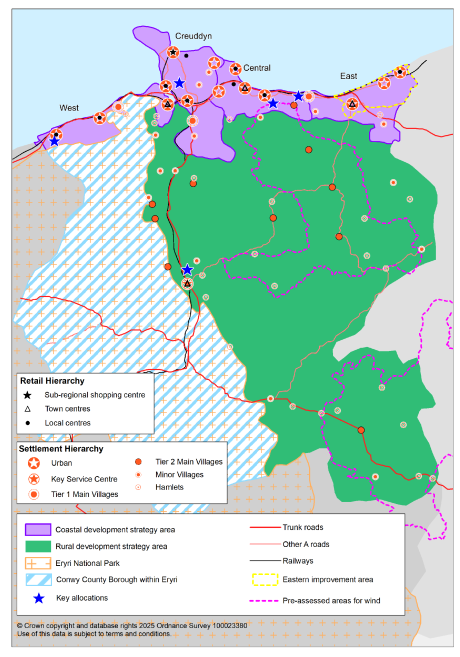
4.4.19 There will be a need to have a balanced and adjusted approach to distribution of the growth within the four coastal sub-areas to ensure the high level flood risk constraints associated with the East are fully factored. As such the growth that cannot be accommodated within the East will be proportionately distributed across the remaining sub-areas as being the most sustainable of locations.
4.4.20 To accommodate growth, the settlement boundaries and Green Wedges have been reviewed and amended. Development outside of settlement boundaries in the urban settlements and Tier 1 Main Villages of the CDSA will not be permitted, except in exceptional circumstances to support changes in employment demand (see policy ED/3) and to assist registered social landlords to bring forward sites for affordable housing (see policy HS/5).
CDSA: West
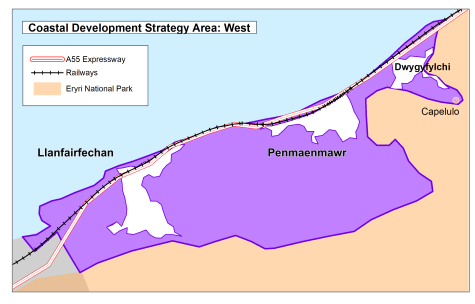
4.4.21 This sub-area lies at the western extremity of the RLDP area, physically separated from the Creuddyn area by the Penmaenbach headland and is bounded to the south by Eryri National Park. Llanfairfechan and Penmaenmawr are the two urban settlements within this strategy area and are generally self-contained with a good level of facilities and services (refer to Figure 4).
4.4.22 To reflect the population levels, services and facilities, good accessibility and the impacts related to the adjusted growth distribution from the East, 10% of housing growth (market and affordable) is planned for within the West sub-area, including completions, permissions, windfall and new allocations. As a result of topography and land availability in Penmaenmawr, the majority of new homes will be located in Llanfairfechan, which has excellent accessibility to the strategic rail and road network and the wider higher order urban settlements.
4.4.23 Based on the conclusions of the Commercial Market Analysis Report (BP19), no new employment allocations will be located within the West sub-area. Llanfairfechan experiences primary school capacity issues currently and has been identified as a priority area in CCBC Education Services Sustainable Communities for Learning 9-year Strategic Outline Programme. To ensure growth and new housing is deliverable a new mixed use strategic site is proposed in Llanfairfechan consisting of 145 new homes, affordable housing, a new primary school and recreational space. Improvements to the pedestrianisation from the wider residential areas and active travel routes will need to be improved to support the sustainability of the strategic site and area (see policy PL/17).
4.4.24 The Tier 1 Main Village of Dwygyfylchi is located within the West sub-area, as is the Hamlet of Capelulo. They lie to the east of the urban settlements of Llanfairfechan and Penmaenmawr and have good access to the urban settlements via the strategic transport network and public transport. The level of growth within these settlements will accord with the settlement hierarchy and reflect the current range of facilities and services and those planned over the plan period.
CDSA: Creuddyn
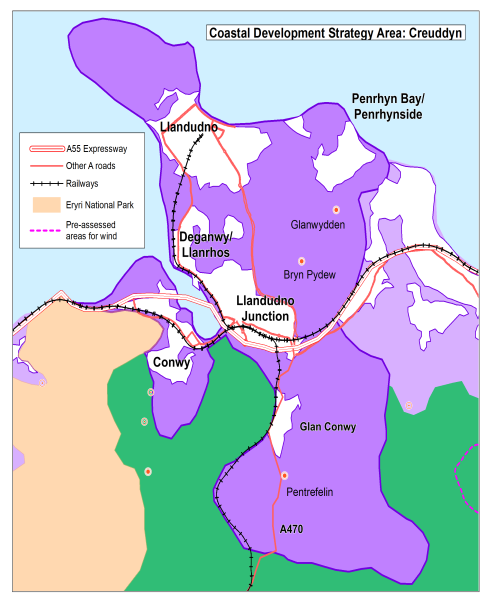
4.4.25 Llandudno, Llandudno Junction, Deganwy and Conwy are the main urban settlements within this area, performing an important cultural, social and economic role to the plan area. They are located strategically with excellent links to the road, rail and public transport network. Over the plan period it is projected that approximately 30% of the housing growth (market and affordable) will be located within the Creuddyn sub-area consisting of completions, permissions, windfall and new allocations.
4.4.26 Whilst a key area for growth, land availability is constrained due to physical, historical and environmental issues. Sites are proposed at:
- Llanrhos between the urban settlements of Deganwy, Llandudno Junction and Llandudno consisting of 140 new homes (including affordable housing), allotments and recreational space.
- Former Ysgol Nant y Coed in Llandudno Junction for 50 new affordable homes and recreational space.
- Queen’s Road at Llandudno for 70 new homes (including affordable housing) and recreational space.
- Land at Bryniau, Llandudno for 3.85 hectares of class B1 employment land.
4.4.27 These sites are supported by excellent accessibility to the A470 and A55 and alternative modes into the higher order urban settlements. Public transport, active travel and green infrastructure improvements will be required.
4.4.28 The town centre of Llandudno will not accommodate any further major convenience or comparison retail up to 2022, but will be protected and, where possible, enhanced to ensure a balanced and mix of uses that sustain the activity throughout the day and evening. The serviced tourism and accommodation offer within Llandudno will be protected, enhanced and further diversified towards all year round tourism. Llandudno will recognise the changes in shopping habits, in particular, the comparison offer.
4.4.29 Llandudno Junction acts a key economic hub at the heart of North Wales with excellent road, rail and public transport linkages. Key existing employment sites (as shown on the proposals map) will be safeguarded.
4.4.30 Conwy will see limited housing and employment growth mainly due to its environmental and historical quality. Within Conwy town centre a balanced approach will be implemented to ensure the needs of the community are met but at the same time the historic and environmental assets are protected and enhanced to contribute positively to tourism.
4.4.31 Other settlements within the Creuddyn sub-area will also support some level of growth, commensurate with their level within the settlement hierarchy (figure 5). The Tier 1 Main Village of Glan Conwy is located to the south of the Creuddyn sub-area along the A470. It sits to the south of the urban settlement of Llandudno Junction and has good access to the urban settlements via the strategic transport network and public transport. The level of growth within Glan Conwy will reflect the current range of facilities and services and those planned over the plan period.
CDSA: Central
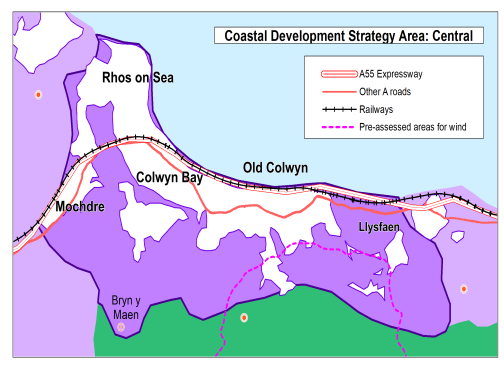
4.4.32 Over the plan period it is projected that approximately 35% of the housing growth (market and affordable) will be located within the Central sub-area consisting of completions, permissions, windfall and new allocations.
4.4.33 Colwyn Bay serves the retail and economic needs of the surrounding area and continues to undergo significant investment and improvement to the town centre and beach frontage. It is situated along the strategic rail and road network and served well via public and alternative modes of transport. To continue investment the area will be further regenerated over the plan period.
4.4.34 The allocation of a residential site to the south of Old Colwyn consisting of 300 (250 during this RLDP period) new homes and recreational spaces. The site will be supported by improved highway, public transport and active travel linkages. Should capacity at local primary schools need increasing as a result of this site and / or population change, land has been safeguarded adjacent to Ysgol Swn y Don to allow for a new extension. The local GP surgery, Cadwgan, is at capacity and there is no room to develop or extend the existing building. CCBC and BCUHB have agreed a Statement of Common Ground which includes a number of mitigation measures to help accommodate any additional patients created by the development. A commuted sum will be sought from new residential developments in the Old Colwyn area to help facilitate such measures (subject to evidence and financial viability).
4.4.35 A second site is allocated in this area at the former government offices off Dinerth Road, Rhos on Sea. This site will deliver 50 new affordable homes and recreational spaces.
4.4.36 The Tier 2 Main Village of Llysfaen is also located within the CDSA due to its relationship to Old Colwyn. Regarding land for economic uses, as a result of high level strategic accessibility, land availability and highways capacity, land has been allocated at Llanddulas Quarry for employment uses (some of which falls within the Llysfaen boundary, the rest being within the Llanddulas area). The site measures 12.65 hectares in total and is allocated for a mixture of B class employment uses. The Hamlet of Bryn y Maen is closely related to upper Colwyn Bay, however the sustainability of this settlement is limited by the strategic linkages to the main roads and the public transport network. The policy approach to these settlements over the plan period will be informed by their position in the settlement hierarchy, with the level of growth reflecting local needs and the current range of facilities and services that they offer.
CDSA: East
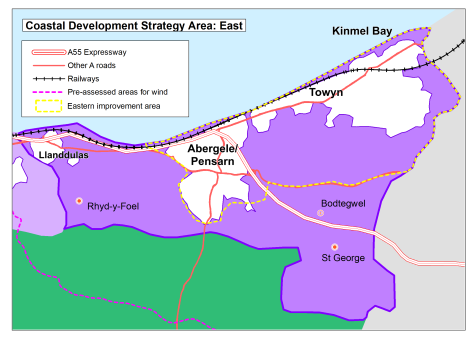
4.4.37 The East sub-rea consists of the urban settlements of Abergele, Pensarn, Towyn and Kinmel Bay and the Tier 1 Main Village of Llanddulas as the main residential and economic centres. The area serves essential service needs of the surrounding catchments, including wider rural area.
4.4.38 Abergele has undergone high levels of housing and employment growth over previous years, which in turn has placed significant strain on the traffic capacity of the town centre. Development in Abergele will be limited over the plan period with no new site allocations. Focus will be placed on regeneration within the Abergele and Pensarn area supported by new town centre interventions.
4.4.39 The East sub-area also includes the urban settlements of Pensarn, Towyn and Kinmel Bay. These areas are highly constrained from defenced flood risk resulting in limited opportunity to accommodate housing and employment growth over the plan period. The area also experiences deprivation and opportunities to deliver community’s needs is limited. The area is subject to flood defence improvements, although this is only to hold the line as opposed to assisting growth opportunities. These constraints and lack of development opportunity is recognised within the new RLDP strategy through the promotion of a new Eastern Improvement Area.
4.4.40 As such, over the plan period it is projected that approximately 15% of the housing growth (market and affordable) will be located within the East sub-area, consisting of completions, permissions and windfall only. No new housing allocations will be allocated in these areas.
4.4.41 The Tier 1 Main Village of Llanddulas is located along the strategic road and public transport network with Abergele falling to the east and Colwyn Bay to the west. Local housing growth will be supported through the RLDP and will reflect the current range of facilities and services and those planned over the plan period. As a result of high level strategic accessibility, land availability and highways capacity, part of the land allocated at Llanddulas Quarry for employment uses falls within the Llanddulas area. (The rest is outside within Llysfaen boundary). The site measures 12.65 hectares in total and is allocated for a mixture of B class employment uses. This is the result of high level strategic accessibility, land availability and highways capacity.
4.4.42 The need for growth that cannot be accommodated in the East will be portioned throughout the remaining sustainable urban settlements within the CDSA.
RDSA
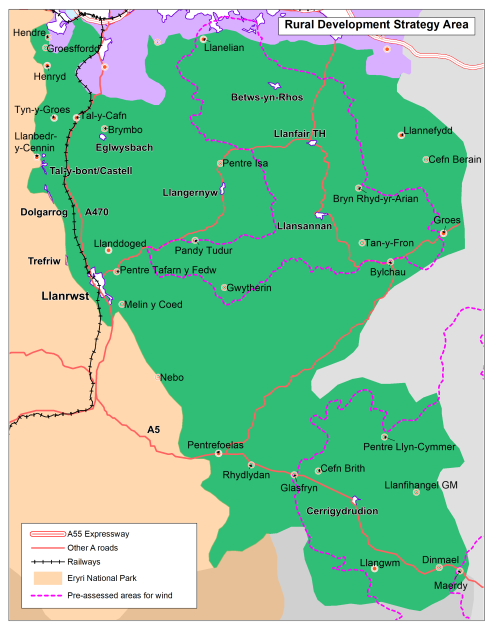
4.4.43 For most rural areas in the Conwy RDSA, the opportunities for reducing car use and increasing walking, cycling and use of public transport are more limited than in CDSA. Therefore settlements falling within the RDSA will focus on local growth and diversification dependent on their sustainability and position within the hierarchy of settlements. Llanrwst is defined as the Key Service Centre serving much of the rural hinterland of Conwy RLDP area and is where employment and housing development will be focused for the RDSA.
4.4.44 A strong rural economy will be promoted to support sustainable and vibrant rural communities. The establishment of new enterprise and the expansion of existing business is crucial to the growth and stability of rural areas, supported by the required housing and necessary community infrastructure.
4.4.45 The new strategy focuses 10% of housing growth to the rural settlements which have relatively good accessibility by non-car modes when compared to the rural area as a whole. 10% of employment will also be located within the RDSA.
4.4.46 The majority of rural growth is focused in Llanrwst, which is a settlement that supports the wider rural communities in terms of employment, retailing and community services and facilities. Llanrwst is the largest and most sustainable of the settlements falling within the RDSA, located some 13 miles from the urban settlements of Llandudno Junction and Conwy. It is served primarily by the A470 trunk road, with the A548 and B5106 also providing local road links, whilst the Conwy Valley rail line connects to the coastal strategic rail network. To encourage development in sustainable locations an allocated site at Llanrwst is proposed consisting of 100 new homes (market and affordable) and recreational spaces along the A470. Vacant employment land at the Ty Gwyn Industrial Site will also be safeguarded for future development.
4.4.47 The Llanrwst settlement boundary and Green Wedges have been reviewed. Development outside, but on the edge of, the Llanrwst settlement boundary will be permitted, in exceptional circumstances to support changes in employment demand and deliver affordable housing sites, where there are no unacceptable impacts.
4.4.48 Most of the Tier 2 Main Villages, Minor Villages and Hamlets are also located within the RDSA (Figure 8) with levels of employment and housing growth in these communities related to their needs for economic and residential development, based on the settlement hierarchy.
|
Settlement hierarchy |
West |
Creuddyn |
Central |
East |
|
Urban |
Llanfairfechan, Penmaenmawr |
Conwy, Llandudno Junction, Deganwy / Llanrhos, Llandudno, Penrhyn Bay / Penrhynside |
Rhos on Sea, Mochdre, Colwyn Bay, Old Colwyn |
Abergele/ Pensarn, Towyn, Kinmel Bay |
|
Tier 1 Main Villages |
Dwygyfylchi* |
Glan Conwy |
N/A |
Llanddulas |
|
Tier 2 Main Villages |
N/A |
N/A |
Llysfaen |
N/A |
|
Minor Villages |
N/A |
Bryn Pydew, Glanwydden, Pentrefelin |
N/A |
Rhyd y Foel, St George |
|
Hamlets |
Capelulo* |
N/A |
Bryn y Maen |
Bodtegwel |
* Settlement falls partly within Eryri National Park Source: SPPS, CCBC
|
Settlement hierarchy |
RDSA |
|
Key Service Centre |
Llanrwst |
|
Tier 2 Main Villages |
Betws yn Rhos, Cerrigydrudion, Dolgarrog*, Eglwysbach, Llanfair TH, Llangernyw, Llansannan, Trefriw*, Tal y Bont*/Castell |
|
Minor Villages |
Groes, Henryd, Llanbedr y Cennin*, Llanddoged, Llanelian, Llangwm, Llannefydd, Pentrefoelas, Tal y Cafn, Tyn y Groes |
|
Hamlets |
Bryn Rhyd-yr-Arian, Brymbo, Bylchau, Cefn Berain, Cefn Brith, Dinmael, Glasfryn, Groesffordd, Gwytherin, Hendre, Llanfihangel GM, Maerdy, Melin y Coed, Nebo*, Pandy Tudur, Pentre Isa, Pentre Llyn Cymmer, Pentre Tafarn y Fedw, Rhydlydan, Tan y Fron |
* Settlement falls partly within Eryri National Park Source: SPPS, CCBC
Settlement hierarchy: urban settlements and the Key Service Centre
4.4.49 The urban settlements within the CDSA and Llanrwst in the RDSA are, and will remain, the main focus for residential and economic development over the plan period. These are the largest settlements with a population of at least 3,000, and it is these settlements which have the greatest transport links, facilities and services to meet the needs of their residents.
4.4.50 Existing and proposed economic developments in these settlements which support local jobs will be supported. Sites are identified in Llanfairfechan, Llanrhos, Llandudno Junction, Llandudno, Old Colwyn, Rhos on Sea and Llanrwst which will meet the need for a range of employment, residential, allotments, education and recreation space provision. In order to provide opportunities for increased delivery of affordable housing for local need, developments for 100% affordable housing will be permitted on suitable sites outside, but adjoining, urban settlements and the Key Service Centre.
Settlement hierarchy: Tier 1 Main Villages
4.4.51 The RLDP identifies three Tier 1 Main Villages, which are smaller and with fewer local services and facilities than the urban settlements, so the level of growth supported over the plan period will generally be proportionately lower. The Tier 1 Main Villages are nevertheless located in highly sustainable locations with good access to strategic transport links and the urban settlements, therefore some development sites will be permitted in these locations in line with Placemaking Policy Framework.
4.4.52 There are no allocations within the Tier 1 Main Villages. The policy approach will focus on the delivery of 50% affordable housing on sites within the settlement boundaries of Tier 1 Main Villages. Lower levels within the settlements may be permitted on such sites, subject community need and viability assessment. In order to provide opportunities for increased delivery of affordable housing, developments will be permitted on suitable sites outside, but adjoining, Tier 1 Main Villages, subject to a minimum provision of 100% affordable housing.
Settlement hierarchy: Tier 2 Main Villages
4.4.53 It is vital that the Tier 2 Main Villages are able to sustain themselves in order to create sustainable places. These settlements primarily serve their local community and as such local growth and diversification will be promoted to retain community identity, protect the Welsh language and encourage a more balanced age structure.
4.4.54 Land will not be allocated for new development in the Tier 2 Main Villages. Alternatively, a flexible approach is promoted within the settlement boundaries. New enterprises and business expansions will also be supported. A constructive approach towards agricultural development proposals will be adopted, especially those which are designed to meet the needs of changing farming practices or are necessary to achieve compliance with new environmental, hygiene or welfare legislation. A positive approach to the conversion of rural buildings for business re-use, in addition to taking a positive approach to diversification projects in rural areas will be adopted.
4.4.55 In recognising past housing delivery in these rural settlements greater flexibility will be applied. Both market and affordable housing is permitted within the settlement boundaries on windfall sites. Such schemes will generally be smaller than the higher order settlements to protect the natural environment and character of the settlement. Affordable housing exception sites and employment opportunities may be permitted outside, but on the edge of, settlement boundaries at a scale appropriate to the function of the settlement and where there are no unacceptable impacts.
Settlement hierarchy: Minor Villages
4.4.56 Minor villages experience the same issues as other rural communities but are more self-contained than the Tier 2 Main Villages. The priority for the Minor Villages is to improve vibrancy, protect community identity and create a more balanced age structure. These settlements serve their local population well but have fewer community services and facilities than the higher order rural settlements, and as such should be protected and promoted.
4.4.57 There are no settlement boundaries for Minor Villages and no site allocations are made. Alternatively, an appropriate level of development will be supported to meet local growth and diversification. The establishment of new enterprise and the expansion of existing business will be permitted supported by the required housing and necessary community infrastructure appropriate to the character of the settlement. Development will be to a lesser level than that permitted in the higher order rural settlements.
4.4.58 A constructive approach towards agricultural development proposals will be adopted, especially those which are designed to meet the needs of changing farming practices. The conversion of rural buildings for business re-use, in addition to taking a positive approach to diversification projects in Minor Villages will be adopted.
4.4.59 Greater flexibility will be applied to housing development to meet needs over the plan period. Both market and affordable housing may be permitted within the confinements of the settlements on windfall sites, where it represents infill or rounding off. Such schemes will generally be smaller than the higher order rural settlements to protect the natural environment and character of the local area. Affordable housing exception sites and employment opportunities may be permitted on sites adjoining settlements at a scale appropriate to the function of the settlement and where there are no unacceptable impacts.
Settlement hierarchy: Hamlets
4.4.60 Hamlets are the smallest tier of settlements identified in the Conwy RLDP and generally consist of very small clusters of approximately 20-50 houses. Local facilities and public transport links are generally poor, making these less sustainable locations for new employment or residential development. Nevertheless, recognising that small rural communities can still have a need for new housing, limited residential development will be permitted, driven by local need.
4.4.61 No settlement boundaries are identified in Hamlets, but on suitable sites within the settlement, which constitute infill or rounding off, an element of market housing will be permitted to support affordable housing delivery. Settlement extensions, on sites adjoining the existing Hamlet will only be permitted in exceptional circumstances to provide 100% affordable housing, subject to compliance with other policies.
Settlement hierarchy: open countryside
4.4.62 The open countryside, outside any recognised settlements, is a dynamic and multi-purpose resource and it must be conserved and, where possible, enhanced for the sake of its ecological, geological, physiographic, historical, archaeological, cultural and agricultural value and for its landscape and natural resources. Green Wedges and Special Landscape Areas are defined to protect those areas that make an exceptional contribution to the landscape assets. The need to conserve these attributes will be balanced against the economic, social and recreational needs of local communities and visitors. Whilst the protection of the open countryside should be maintained wherever possible, the expansion of existing businesses located in the open countryside may be supported provided there are no unacceptable impacts.
Sustainable placemaking and improved well-being
4.4.63 Sustainable places and improved wellbeing is the priority goal of the Conwy RLDP. In planning for sustainable places, this strategy embraces sustainable development principles and the concept of placemaking. All development decisions within Conwy LPA, should seek to contribute towards the making of sustainable places and improved well-being in line with the Spatial Framework and Placemaking Policy Framework. The RLDP should direct development to create sustainable places which are attractive, sociable, accessible, active, secure, welcoming, healthy and friendly. Taking such action will ensure that the RLDP embeds the spirit of the WFG Act and seeks to take positive steps to creating sustainable places and enhance the economic, social, environmental, cultural and linguistic well-being of communities.
Key spatial strategy components
4.4.64 The new spatial strategy is formed having been considered against a number of key strategy components, which are based on the BPs, the issues identified and the proposed objectives. The strategy has been influenced by a number of the key strategy components to ensure that it is right for Conwy’s RLDP:
Figure 11: table showing key strategy components
|
Key strategy component |
Considered in strategy |
|
Has regard to national, regional and local strategies, plans, policies and evidence. |
Yes |
|
Has regard to the WFG Act, 5 key planning principles and sustainable outcomes. |
Yes |
|
Seeks to create sustainable places and embraces sustainable placemaking. |
Yes |
|
Promotes healthy places, equality and wellbeing in Conwy. |
Yes |
|
Promotes a more balanced age-structure and seeks to reduce out-commuting by supplying and protecting the right level of homes, jobs and community facilities to support the retention and return of the younger and economically active population. |
Yes |
|
Promotes a holistic strategy and allow for new homes and employment to be provided in line with the hierarchy of settlements to reflect the sustainability, accessibility and functional attributes of settlements, services and facilities and ability to accommodate growth. |
Yes |
|
Recognises the high level flood risk and highways constraints to the East of the County Borough and the need to progress investment and regeneration to promote resilient communities. |
Yes |
|
It supports and provides for the necessary utility and community infrastructure to support growth. |
Yes |
|
Seeks to provide 4,300 new homes and 1,760 affordable houses supported by the required utility and community infrastructure. |
Yes |
|
Seeks to increase the number of smaller housing units, opportunities for adapted living and an appropriate split of affordable homes. |
Yes |
|
Is deliverable and reflects past build rates and capacity of the development industry. |
Yes |
|
Promotes greater flexibility in the rural areas to reflect the difficulty in delivering housing schemes and ultimately provides for a framework that protects community identity and supports local growth. |
Yes |
|
Provides for 1,500 new jobs to contribute to economic growth and jobs creation which reflects the Conwy ELR, regional North Wales Growth Deal and infrastructure supply, whilst at the same time providing flexibility for changes in economic demand. |
Yes |
|
Reflects the Conwy Employment Market Analysis with regards to the appropriate location for new employment growth. |
Yes |
|
Recognises the limited availability of PDL, but at the same time prioritises PDL opportunities where suitable and deliverable, prior to greenfield. |
Yes |
|
Promotes an appropriate level of development in rural settlements to meet local growth and diversification. |
Yes |
|
In rural areas it conserves attributes balanced against the economic, social, cultural and recreational needs of local communities and visitors. |
Yes |
|
Adopts a constructive approach towards agricultural development proposals, especially those which are designed to meet the needs of changing farming practices or are necessary to achieve compliance with new environmental, hygiene or welfare legislation. A positive approach to the conversion of rural buildings for business re-use, in addition to taking a positive approach to diversification projects in rural areas will be adopted. |
Yes |
|
Contributes to the delivery of physical and social regeneration opportunities and provides for a diverse and cohesive range of settlements and communities. |
Yes |
|
Recognises the value of language and includes policies to support growth, protect, promote and enhance the Welsh language. |
Yes |
|
Enhances design quality to create healthy places. |
Yes |
|
Protects from urban sprawl and inappropriate development through review of the Green Wedges and use of settlement boundaries. |
Yes |
|
Identifies deliverable and available site allocations. |
Yes |
|
Encourage alternative sustainable modes of transport to increases walking, cycling and public transport, reduces dependency on the car for daily travel and contributes to the reduction in climate change. |
Yes |
|
Supports the continued success of existing tourist growth by encouraging appropriate tourism-related development, which is sympathetic in nature and scale to the local environment. |
Yes |
|
Ensures sustainable tourism is promoted which seeks to accommodate all-year round tourism as opposed to seasonal, but at the same time ensuring local community identity is protected. |
Yes |
|
Supports telecommunications infrastructure in appropriate locations and sets out policies for telecommunications development, including criteria-based policies to guide development to suitable locations. |
Yes |
|
Seeks to support proposals for new broadband infrastructure or improvements to existing networks or apparatus. |
Yes |
|
Recognises the benefits of renewable and low carbon energy as part of the overall commitment to tackle climate change and increase energy security. |
Yes |
|
Supports renewable, low energy sustainable energy use and grid access within developments. |
Yes |
|
Considers and plans for the protection and allocation of minerals needs over the plan period. |
Yes |
|
Promotes sustainable waste management. |
Yes |
|
Protects and enhances the natural, historic and built conservation qualities of the area and its high value landscapes. |
Yes |
|
Establishes what the coast means locally and develops specific policies, which reflect the characteristics of the coastline. In doing so it acknowledges the interrelationships between the physical, biological and land use characteristics of the coastal areas and the impacts of climate change. |
Yes |
|
Protects and enhances green infrastructure assets and networks. |
Yes |
